A bakery, restaurant, deli and craft stations all flow from zone to zone in a new hospitality project within the Ritz-Carlton, Kazakhstan. Designed by London interior design studio Blacksheep, Mökki elevates the user experience by raising the bar with luxury and detail.

Mökki is sprawled across the third floor of the hotel. Despite the mix of offerings available in the space, they are all united through a holistic design approach. Every touch point has been considered – from the food down to the branding, and of course the interior design. Branding was an important part of creating a complete experience for the project and Blacksheep directed the naming, menu design and staff uniforms.
.
Branding was an important part of creating a complete experience for the project.
.
Kazakhstan is a fast-growing city with a new wave of luxury coming through, creating a destination for business and leisure travellers. As such, Mökki sets a precedent in the city.
Celebrating the craft of food, the interiors encourage guests to curate their meals by traversing the different zones and stations.

Intersection of different zones within the space.
The entrance features patinated brass walls with wide Italian oak floor planks – a repetition of the brass has been followed through with an inlaid floor detail.
.
The interiors encourage guests to curate their meals by traversing the different zones and stations.
.
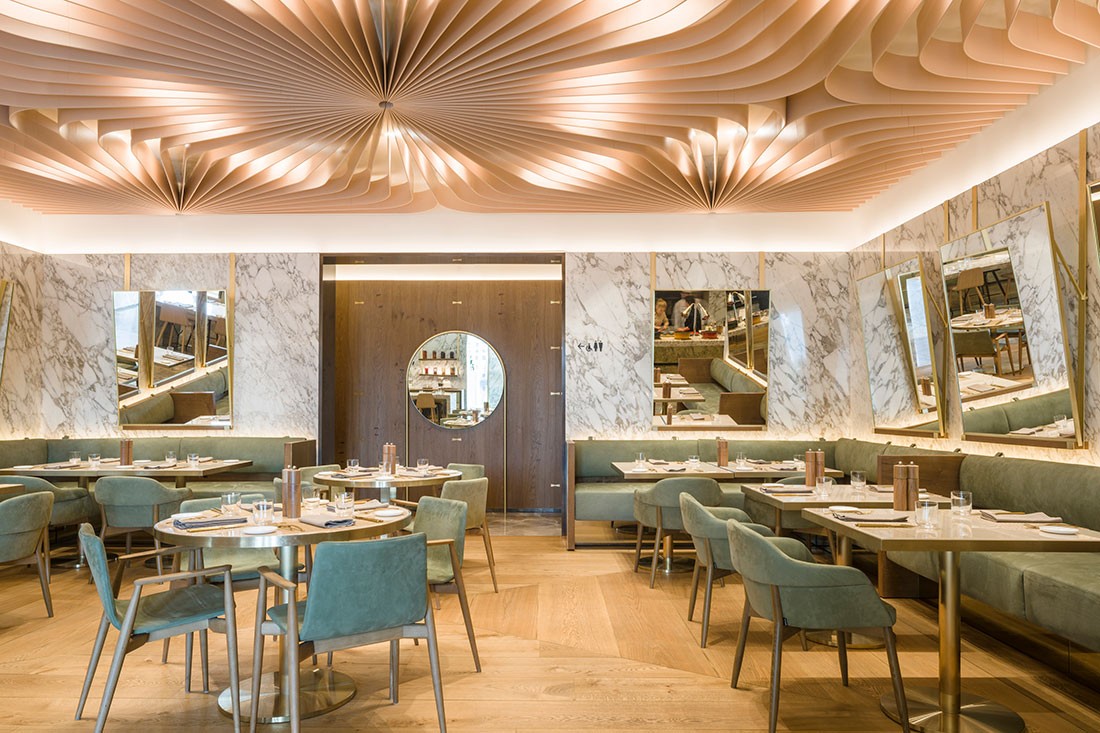
Wanting to create separate zones while still having a clear sense of familiarity throughout, the material palette shares variations on similar finishes. From rich Calacatta Italian marble in gold tones, to natural oak and combinations of suede, leather and velvet upholstery – the effect is a relaxed yet refined environment with a level continuity.

The raised dining area.
The interior has been designed to create a relaxed and intimate dining room with continuity throughout, using rich Italian Calacatta marble, natural oak, brass detailing and a combination of suede, leather and velvet upholstery that visually elevate the interior environment and connect each of the spaces to form a coherent whole.
A curving plywood fin ceiling structure underpins the palette and program to reinstate that sense of a unified whole.