The home of architecture and design in the Asia-Pacific
Get the latest design news direct to your inbox!

Get the latest design news direct to your inbox!
We find ourselves mid-step in a polarising post-pandemic workplace shift. While we can only anticipate what the future will bring, the INDE.Awards’ The Work Space Shortlist reveals where we currently stand.

July 14th, 2020
INDE.Awards Juror James Calder of ERA-Co is fascinated by what the future might hold for the post-pandemic workplace. A close look at the shortlisted projects for The Work Space category, sponsored by Woven Image, points quite clearly towards a distinct level of design sophistication. But even the most advanced of workplaces still embody the ‘legacy’ workplace models of past decades.
“The main thing I observed [while judging The Work Space] is just how good the consistent quality is of the projects and design work,” says Calder. “It is increasingly difficult to choose the stand-outs as the overall standard is high.”
However, “I have a slight nervousness about what this tells us about the future of work, as it seems to me that the design level is high but the workplace models used … haven’t changed for a decade or two.”

CBA Axle, South Eveleigh, Woods Bagot
At the beginning of 2020, the world looked very different to what it is today. And, as Calder says, the region’s top award-nominated workplaces are uncompromising in their design quality. But in three months of pandemic-level isolation, a paradigm shift has taken place. While we consider the implications to future workplace strategy and modelling (and what will surely be disruptive and exciting design outcomes for 2021 and beyond), two shortlisted Work Space projects stand out.
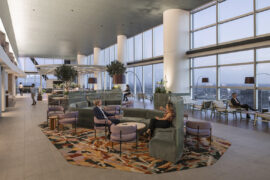
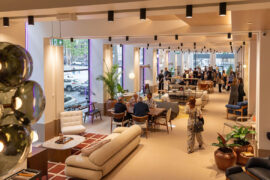
Perhaps the ‘wokest’ of workplaces, CBA Axle, South Eveleigh by Woods Bagot takes the idea of digital connection to a new dimension. Axle building has been developed as the smartest of smart buildings. At the same time it is also a very human building – in terms of scale, architectural strategy, amenity and workplace philosophy.
Its diversity of ‘me’, ‘we’ and ‘us’ settings, mixed with the ability to be plugged in from anywhere hopefully means that this workplace will be highly adaptable to a future in which staff may continue to work in isolation, coming together for essential meetings.

IDIN Architects Office, IDIN Architects
In Thailand IDIN Architects Office by IDIN Architects has finessed the ‘work from home’ concept ahead of it becoming a hard reality for many. Here the design offers plenty of open spaces between building and site boundary. The building mass is interwoven with terraces and courtyards for connection with natural light and greenery.
Within this mass sits a café and meeting room (front, ground floor), the working space (second floor), and a private suite for the owner (rear zone, third floor). The underlying ethos in this project is that the better the quality of the designer’s life, the more efficient pieces of work they will provide. An ethos that feels more relevant now, than ever before.

South Terrace Mezzanine House, Philip Stejskal Architecture
For The Work Space sponsor, Woven Image, innovating for work-life futures has been central to its operations for the past 33 years. “This year’s Work Space shortlist demonstrates a fascinating shift from historical workplace contexts towards a hybrid office: blended home-work typologies (we’re particularly impressed by South Terrace Mezzanine House by Philip Stejskal Architecture in Australia); and highly flexible office spaces that align modern working behaviours with business productivity,” says Abi Eskdale, international marketing manager for Woven Image. “Even more impressive is the scale of some of these projects – from very intimate single sites, to precinct scale.”
Join us and the region’s top winners at the free INDE.Awards 2020 Digital Gala this August 13, register here.
INDESIGN is on instagram
Follow @indesignlive
A searchable and comprehensive guide for specifying leading products and their suppliers
Keep up to date with the latest and greatest from our industry BFF's!
The internet never sleeps! Here's the stuff you might have missed