Funded by the community and built between 1920 and 1925, the township of Warwick had essentially formed around the church. The resultant building, simply put, is beautiful, with a 30-metre-high bell tower, locally quarried sandstone walls and lovely decorative detailing.
The original lighting was sparse. The church had been floodlit, which rendered it featureless; however, the lamp type was obsolete and no longer produced. As a result — and despite the bell tower being the tallest structure in the town — the church was only visible at night from moon glow and stray light.

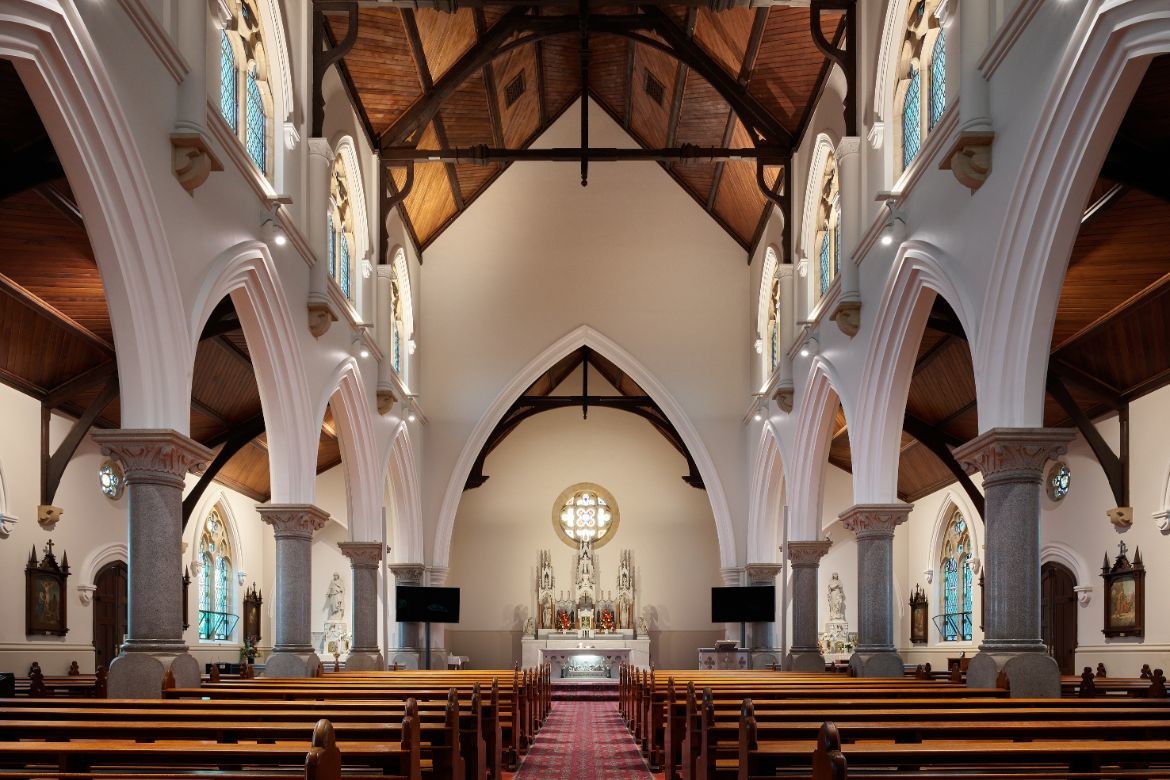
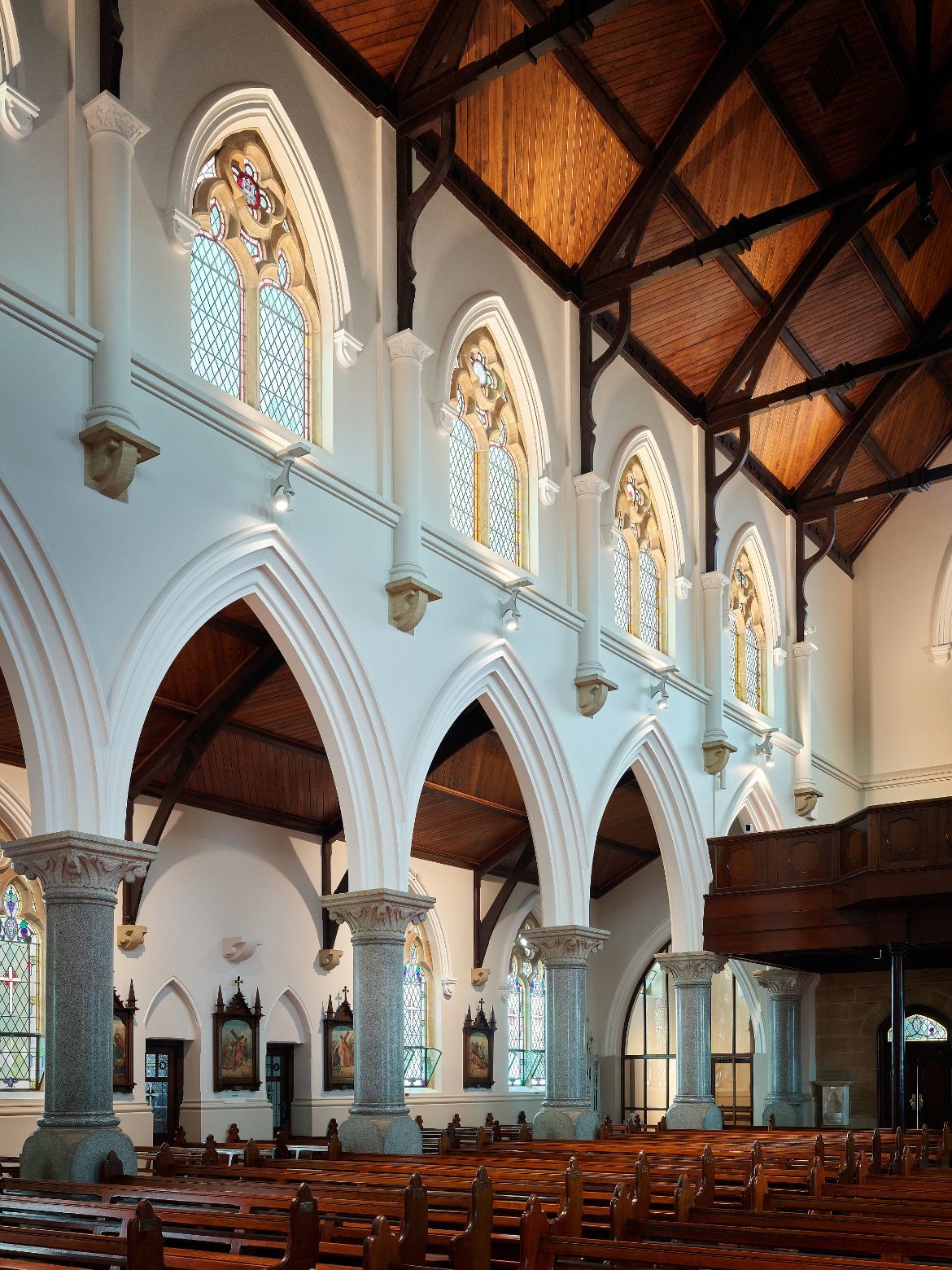
The interior experience was similarly bereft of grandeur: “The entire nave, which is the main core of the church where the worshipers sit and pray, and ceremonies go forward, was illuminated by high-mounted fluorescent tubes that flickered sometimes and required regular changing,” says Gillard.
A lot of energy was consumed for limited purpose: “Father Franco [Filipetto] was very keen to correct the lighting and make the church compliant; to make it look ambient and elegant, and for features such as the beautiful timber herringbone ceilings to be celebrated,” Gillard explains further.

Lighting the church was also about theatrics. For example, externally, the church is now a chiaroscuro-like interplay of light and dark. The back-lit vibrant stain-glass windows pop because the surrounding walls were kept dark. The bell tower is gently lit but remains imposing. Emphasis was placed on highlighting textures and architectural features. “It was very important not to put too much light on to the church. We wanted to make the external glow by illuminating from the inside, through the leadlight windows,” says Gillard.
Gillard’s exceptional eye can be seen in the lighting of the portal, the undercover main entry space to the church. It is designed to spotlight Father Franco in his white robes as he welcomes guests for evening ceremonies. Entering St Mary’s church, another exceedingly well-crafted idea is a halo light where narthex meets nave. This is by design, the perfect place for photos of the bride or couple. The high-quality LED beautifully illuminates the person and especially their face.
Related: Restoring a cafe pavilion with Sam Crawford Architects

The most overt piece of theatre is the lighting of the Father presenting to his flock. When he lifts his arms for the sacrament or to make a point, they cast large shadows onto the wall behind him. The shadows can be seen from the back of the church.
On a technical note, the luminaires Gillard sources are all fit-for-purpose high-quality LED; she only uses the volume and wattage to do the job. Another outcome she is very proud of is that her designs greatly reduce energy consumption as well as carbon and ecological footprints. “Even though we’ve had to use more lights and they cost more, we actually reduced energy consumption by 85% and brought forward payback,” says Gillard. St Mary’s might be the first major church in Australia to be completely lit by LED.

As a heritage building it was important that all new lighting did not impact existing infrastructure. Since more luminaires were required to meet compliance and the client’s brief, Gillard could not rely on nailing and screwing and instead clever proprietary solutions were used to overcome heritage constraints. Gillard also designed bespoke luminaires based on Christian iconography. For example, the luminaire on the underside of the choir space is a quatrefoil (four partially overlapping circles forming a cross) made from matching dark timber.
Winning the International LIT Lighting award (Heritage), St Mary’s is an exemplar of good design and exquisite illumination. The church is also an outstanding example of Jenni Gillard’s attention to detail and expertise.

The Gillard Group comprises Jenni Gillard Architectural Lighting Designers (established 2005) and Aglow (established 2008). The design studio uses art and science to deliver unique lighting solutions, while Aglow uses business cases and technology to deliver sustained value for installed LED under their Lighting as a Service initiative.
Gillard Group
gillardgroup.com.au
Photography
Scott Burrows



We think you might also like this article on Ipswich CBD with Buchan.