Housing affordability and the appropriate use of cities’ existing building stock continue to be some of the defining design questions of our time. Fender Katsalidis’ (FK) recently completed project at The Alba is a timely reminder of how aged care forms an important component of considerations around mixed-use approaches to the city and adaptive reuse in architectural design.
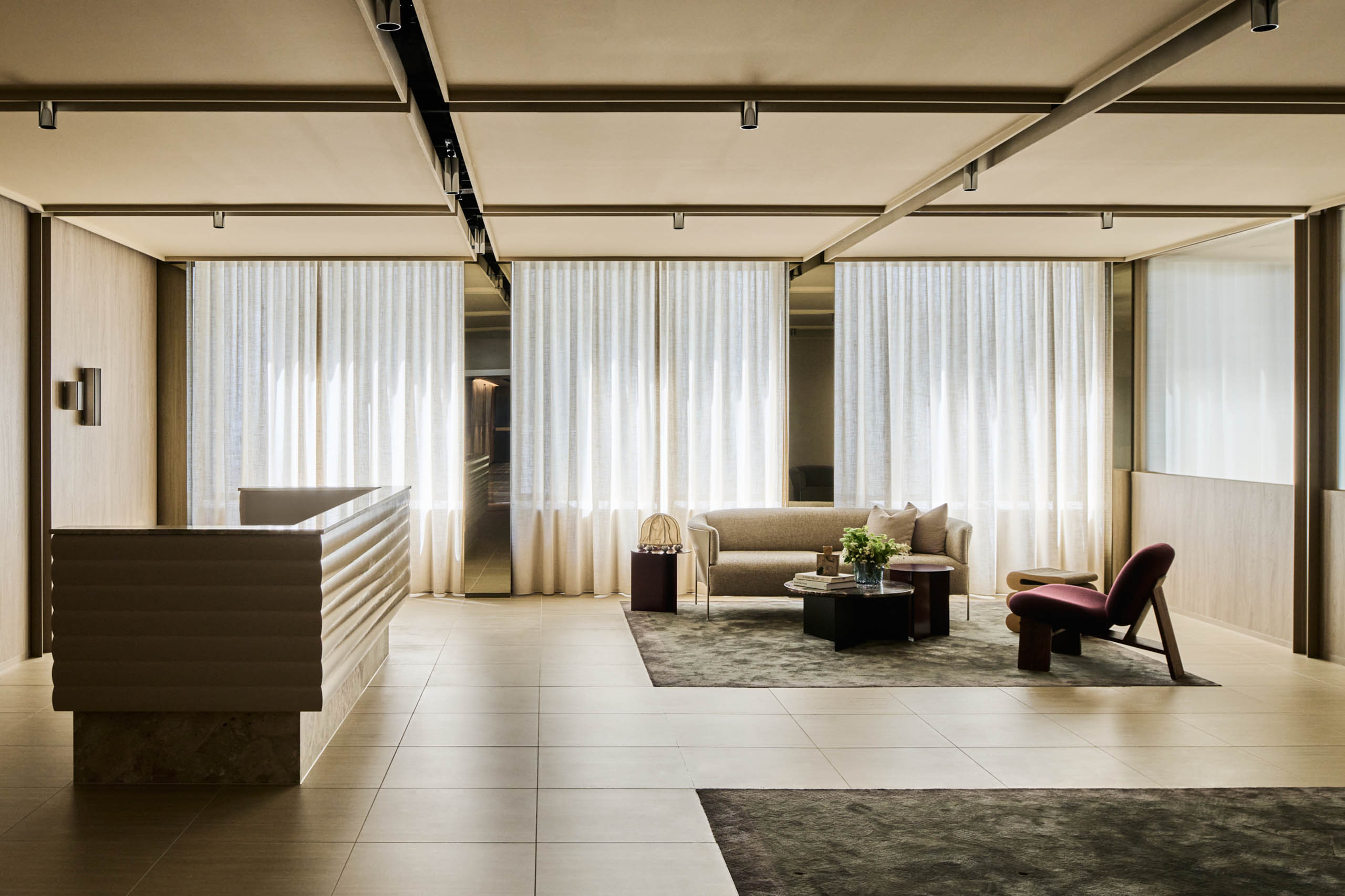
The completion of The Alba brings about a new whole as it forms an extension of FK’s next-door project, The Grace. The architects have consciously set up the pair as sister buildings, part of a wider appreciation for the importance of connections at the street and urban planning level. A ground floor cafe as well as a shared arrival space for the two buildings underline the sense of community and refusal to disengage from the surrounding city. FK worked in collaboration with Sibling Architecture on the entry lobby and restaurant interiors.

The real spirit of the project shines through in its adaptive reuse. Prior to its reincarnation as The Alba, the 1970s office building served as Australian Unity’s corporate headquarters. Aged and underused, it was the kind of building that is drawing the attention of the Victorian Government as it works through its Housing Statement with plans to convert close to 80 office buildings into residential and mixed-use projects.
“At The Alba, Fender Katsalidis has proven that there is great opportunity, and considerable commercial viability, in converting ageing and unused buildings into meaningful vertical communities,” says executive general manager of social infrastructure at Australian Unity, Ryan Banting.

The intervention involved a balancing act of hard-headed engineering, including fully documenting the building to get a clear picture of its standing in relation to contemporary structural standards, and more aesthetic concerns to actually design a desirable new environment.
“Adapted on the merits of its existing bank of materials, the majority retention of The Alba is a huge celebration from an environmental perspective, but it was not a project without its own unique challenges,” says FK principal, Jessica Lee.
Related: Jessica Lee comments on aged care

Lee continue: “In contrast to The Grace, which benefited from established floor-to-ceiling windows, The Alba had an unfathomably solid north-facing concrete wall. We strategically punched it with as many holes as we could and supplemented it with thin, lightly tinted glazing to heighten its transparency.
“Simultaneously, a lot of weight was added to the building, within the core of the structure and at its base, in careful balance with the concrete that was being cut out. Eventually, this stacked up to equate to about 200 tonnes of extra steel, or 50 elephants in extra weight.”

The result, say the architects, is luxury aged care in a design that – by virtue of its adaptive reuse – is more environmentally friendly. “Corridor spaces are warmly lit and arranged to avoid extended lengths typically found in more clinical environments,” says Lee. “Alongside homely furnishings, artwork and subtle way-finding interventions, the corridors can become quiet dwelling spaces for moments of respite.”
The Alba features 14 floors of assisted living apartments and residential aged care, as well as communal and private dining spaces on the level above. Other common areas also include a theatre, library, outdoor terrace and rooftop garden. It’s all part of a design philosophy that has prioritised community and social engagement while championing a vision of adaptive reuse in our cities.
Fender Katsalidis
https://fkaustralia.com
Photography
Willem Dirk du Toit


We think you might also like to read about this Melbourne office by Fender Katsalidis.