The home of architecture and design in the Asia-Pacific
Get the latest design news direct to your inbox!

Get the latest design news direct to your inbox!
When is a showroom not a showroom? When it doesn’t feel like you’re shopping for a car. Jackson Clements Burrows digs deep into the customer psyche to design a hospitality-slash-retail space for Mercedes-Benz.




Car commercials: a glossy display of precision engineering and sophistication, condensed into a 30-second montage. A vehicle glides through picturesque surrounds – rugged natural terrain, or perhaps a metropolis full of model types. The effect is emotive, and aspirational. You want that car.
But new wheels are a major investment, and for most, the road between that first flash of desire and committing to buy is a lengthy one. So, how can luxury brands maintain consumer interest over the long term?
The Mercedes Me concept stores go some way to making the high-end approachable by giving motor enthusiasts and casual diners alike an immersive branded experience outside of the showroom. Since establishing the first space in Hamburg in 2014, Mercedes-Benz has subsequently opened in Munich, Moscow, Tokyo, Beijing, Hong Kong and now Australia’s first, in Melbourne – each iteration a totally unique, site-specific expression.
Mercedes Me Melbourne inhabits a shell by Woods Bagot, as part of the Rialto Towers street level refurbishment. In consultation with Mercedes-Benz Australia/Pacific’s CEO and managing director, Horst von Sanden, and St.Ali director, Salvatore Malatesta, Jackson Clements Burrows (JCB) developed a nuanced design for the landmark corner tenancy.
“We held some really great workshops to find out how everyone wanted it to feel, more than work,” says Simon Topliss, senior associate at JCB. “Fundamentally, it needed not to feel like a showroom, while still having a car on show.”
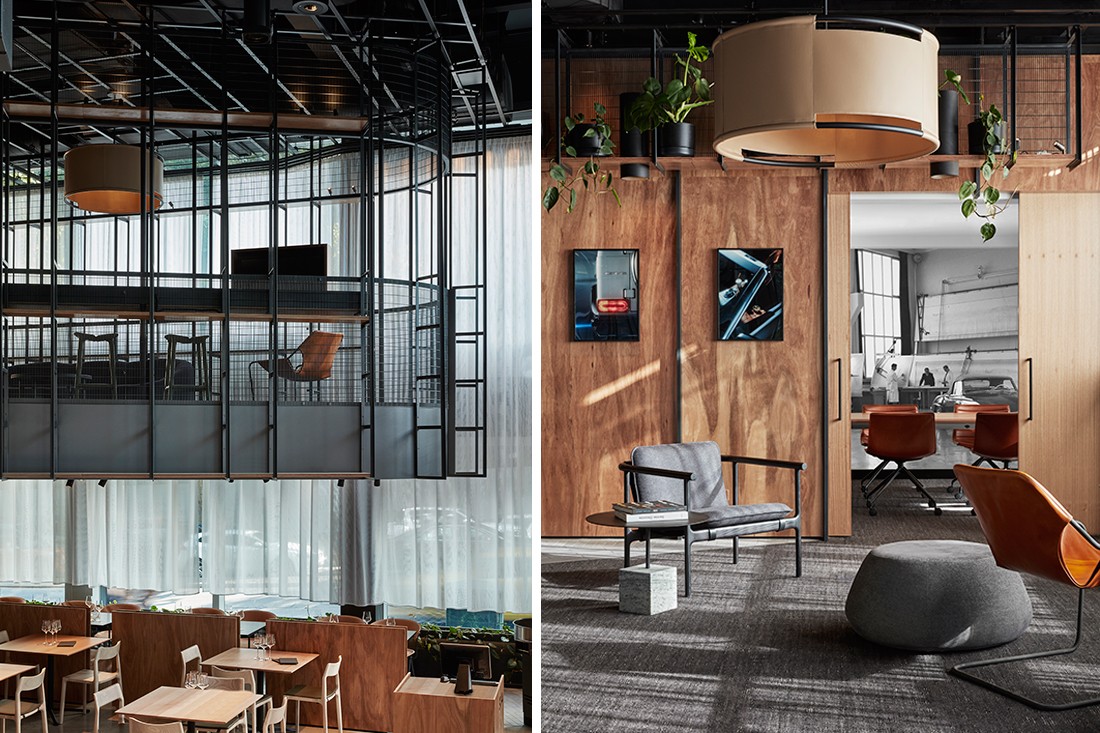
JCB approached the project with the notion of creating a super home for the Mercedes-Benz customer. This resulted in a series of interconnected spaces representing the domestic sphere: living room, garden, kitchen and most importantly, garage. For the opening, a replica of one of the first Mercedes cars – one of only a handful in the world – was flown over from Germany to take pride of place in the ground floor restaurant.
“Prior to the opening, we did wonder how Melbourne might receive it. It’s such an unusual concept. Every week it’s a new car in the middle of a café, how is that going to feel? How do we treat that?” says Topliss. “But the experience makes sense here, a lot like streetside dining.”
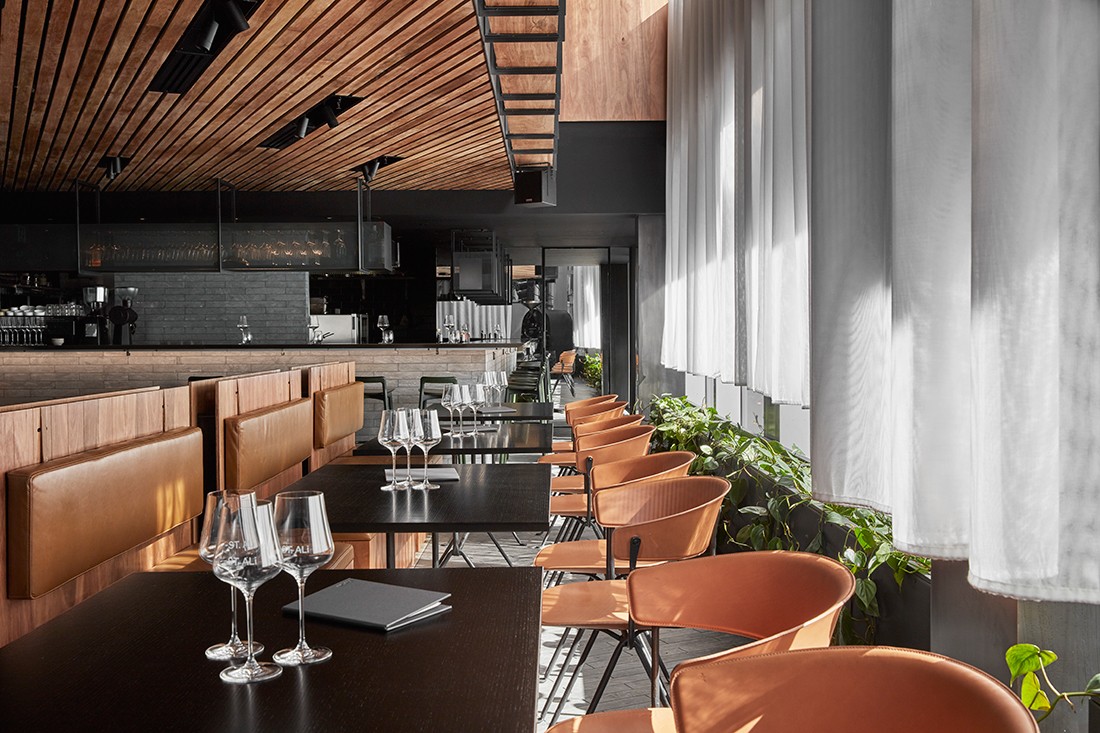
Against a strong material palette of concrete, timber and stone, the split-level formation of the interior is defined by an expressed steel framework, alluding to the suspended manufacturing frames observed in archival photography of an original Mercedes-Benz factory floor. This structure neatly wraps the bulk of the first floor overhead, and provides storage options with inbuilt shelving throughout the rhythmic linear pattern.
The two floors are distinct in purpose, giving the locally revered St.Ali crew double the stage to demonstrate their coffee and culinary prowess. “Sal was keen to have a grab-and-go espresso bar upstairs, and for the lower level to have more of a restaurant feel,” says Topliss.
Below, the space is designed to transform seamlessly from relaxed dining to open-plan party venue, while above, a mezzanine of a more intimate scale comes complete with reading lounge and barista.
The levels are connected by a stairway of tiered upholstered booths, with one powered up to convert into a DJ booth, as required. As befitting a brand at the forefront of technological development, the car showcase area comprises a wall of individually programmable digital displays, including an operable door fitted with switch glass.
“The store had to be able to convert from a café to an event space, have a sense of St.Ali, and speak the language of Mercedes-Benz – all of those things were crucial to the overall design,” says Topliss. “But most importantly, it had to be part of the fabric of Melbourne.”
Want to know what was specified? Check out the dissections here. And for all the best in design news, sign up for our newsletter here.
INDESIGN is on instagram
Follow @indesignlive
A searchable and comprehensive guide for specifying leading products and their suppliers
Keep up to date with the latest and greatest from our industry BFF's!
The internet never sleeps! Here's the stuff you might have missed