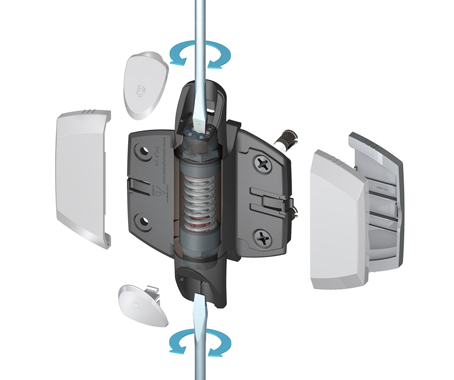
The Vizage™ Glass Gate hinge is designed especially for glass gates. It marks a new era in stylish, architectural-quality gate hinges by D&D Technologies Pty Ltd.
January 19th, 2011
D&D Technologies is renowned for inventing and manufacturing the ubiquitous MagnaLatch® Child Safety Gate Latch, which adorns millions of swimming pool and childcare centre gates in Australia and around the world. The company boasts three Australian Design Awards and two Australian Design Marks for its products.
The new Vizage range is an extension of D&D’s highly successful TruClose® range of safety gate hinges. The hinge is made of tough, engineering-grade polymers, and the leaf covers are finished using zirconium-protected metal surfacing, all of which guards the hinges against rust, binding, sagging, staining and chipping.
No longer do gate fabricators need to hassle with cumbersome conventional hinges – traditionally toilet-door hinges – to meet the special needs of today’s round-posted fences and glass gates.
The only requirements for using Vizage hinges are common glass panels of either 8mm or 10mm thickness, and round fence posts of 50mm (2″) diameter.
In a design breakthrough, self-closing tension adjustment can be made from either end of each hinge! Each pair of hinges closes glass gates weighing up to 25kg (55lb), which covers most household gate applications.
All necessary components are supplied in one convenient kit to mount directly to gates, but because of the technicalities involved with glass gates (pre-drilled holes in toughened glass etc) typically a householder would obtain these hinges from a fencing or specialist glass fabricator
D&D Technologies
ddtechglobal.com
INDESIGN is on instagram
Follow @indesignlive
A searchable and comprehensive guide for specifying leading products and their suppliers
Keep up to date with the latest and greatest from our industry BFF's!
The Geelong College’s Sport and Wellbeing Centre ‘Belerren’ designed by Wardle is designed around bringing in natural light. But Shade Factor’s job was to help modulate and precisely control it for the most important competitive moments.
In the second instalment of our performance seating three-parter, we turn to DKO’s Michael Drescher and Jacob Olsen to peek behind Sayl’s confident architectural form and explore the ideas of inclusivity, adaptability and freedom to move as hallmarks of what sitting your best actually means.
Developed by bangdesign for Stylecraft, Kinn is an Australian-made collection of seating and occasional tables, shaped by modest proportions, practical detail and the changing demands of shared interiors.
In the last instalment of our three-part performance seating series, Alex Bain from Architectus explains why sitting well shouldn’t feel like sitting at all and explores an unexpected success metric of the hybrid workplace: the grounding power of emotional support.
GIRT, the new podcast from Monique Woodward and Nic Brundson, explores architecture through a reinvigorated lens. Hear from the hosts about their favourite moments from the series.
Paul Tabouré and Simon Hancock of THERE speak to Ola Bednarczuk about their practice, and why branded environments are more in demand than ever.
South Australia’s first step towards integrated design is being scrapped, and the local design community is not happy. Anthony Caggiano investigates.
Designed by Futurespace, the design strategy for Savills new Sydney digs was influenced by ABW methods, allowing for the breakdown of both physical and communication barriers to enable a more coherent, collaborative, team-accessible workplace.
The internet never sleeps! Here's the stuff you might have missed

Somewhere in the rush toward efficiency, we lost something beautiful.
Aeron Chair’s new shades, Nightfall and Jasper, arrive with a sense of quiet cohesion – no bells and whistles, no loud technicolour; just two timeless, perfectly versatile near-neutrals. But the new hues aren’t just about colour – and their significance is much more profound than their surface-level subtlety might suggest.
Late night rethinks, endless material testing and prototyping, half-finished or abandoned projects – the work behind-the-scenes work is often where ideas come undone. Elton Group’s Think Good Micro-Grant – a $5,000 annual fund now open for applications – exists to back this kind of unseen effort.