The home of architecture and design in the Asia-Pacific
Get the latest design news direct to your inbox!

Get the latest design news direct to your inbox!
Faced with a tight timeline and specific parameters, Molecule have applied a single, bold architectural move to their workplace fit-out for Karara Capital in Melbourne’s CBD. Alice Blackwood reports.
August 20th, 2015
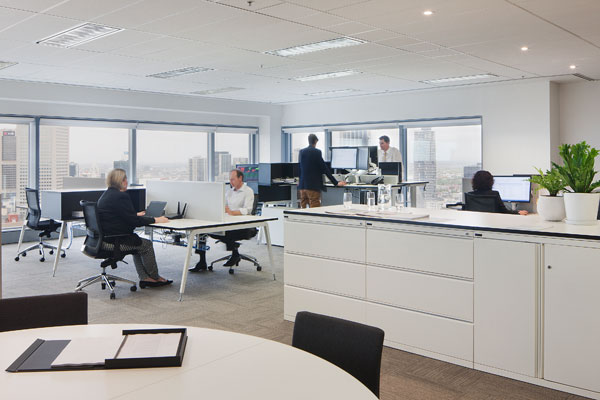
Tasked with designing a new office for Karara, Molecule was given a fairly open-ended brief limited only by site – a commercial office space set on the 33rd level of 101 Collins – and Karara’s requirement to structurally separate their client liaison zone from the internal office space.
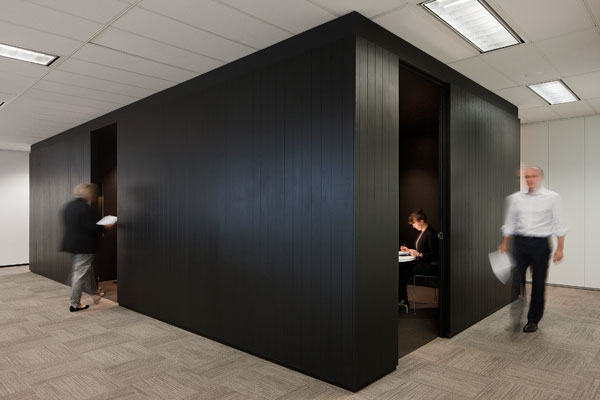
Timings were tight and the office’s basic layout was already established by its previous tenant. Breaking up the otherwise standard workspace is a large black box: this is Karara’s central services pod and contains stationery closet, bathrooms, storage and meeting room.
“We really had to push for the dark palette,” say co-directors Anja de Spa and Richard Fleming of Molecule. “It was going to give it that point of difference; where most workplaces use colour, we knew there was a significant art collection that would be featured as part of the fit-out, so we strove to keep colour out.”
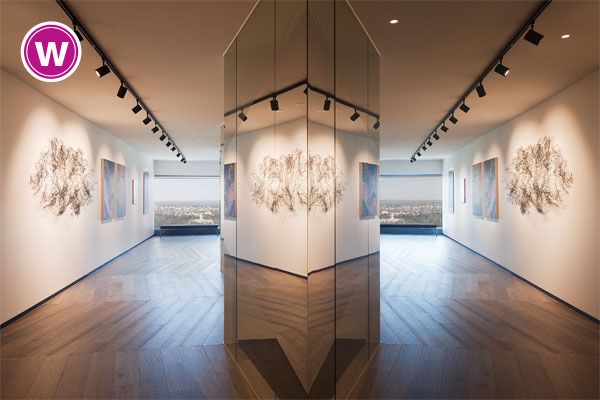
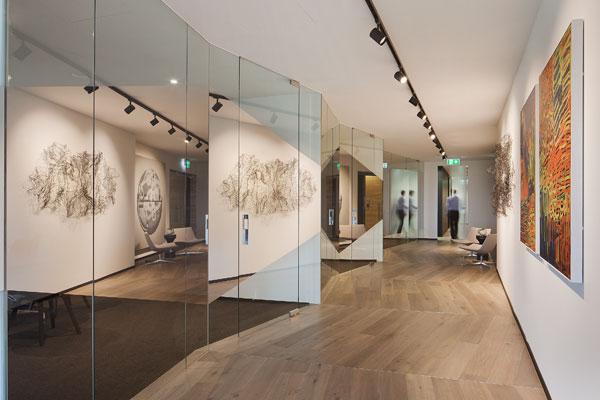
The art collection comes into play in the main ‘reception’ area, a long, quiet passageway hung with a curated selection of art works. Facing this is a series of neighbouring meeting rooms, cleverly contained behind a stepped glass façade. Stretching 16 metres, the façade is cut into a series of kinks that cleverly refract light and colour – almost like a kaleidoscope – pulling you down the length of the passageway toward a bright square of light. Stepping into this space is akin to stepping into an art gallery.
The effect is quite beautiful and curious, with shifting, refracting images pulling light in and directing the viewer down and through the long, narrow space. Art pieces and flooring alike move into the fifth dimension, the latter lapping at the façade in a fascinating “tidal effect”.
Read the full story in Indesign Issue 62.
INDESIGN is on instagram
Follow @indesignlive
A searchable and comprehensive guide for specifying leading products and their suppliers
Keep up to date with the latest and greatest from our industry BFF's!
With the Show’s focal point on Building, Renovation and Design, the experts, products and design ideas available, demonstrate to visitors what they can do in their home to be design savvy and eco-friendly at the same time.
The internet never sleeps! Here's the stuff you might have missed