The home of architecture and design in the Asia-Pacific
Get the latest design news direct to your inbox!

Get the latest design news direct to your inbox!
Ligne Roset is the story of a family business started over 150 years ago. And their famous Togo sofa is the culmination of their continued search for hand-crafted quality.
November 19th, 2013
In 1860, Antoine Roset created a small factory of parasol shafts in Oussiat, in the department of Ain. The business grew, and in 1892, he purchased a property on the banks of the Brivaz river in order to install paddle wheels to chop his wood. By then, he employed 30 workers. However, just as the company was taking off, it fell victim to the changes in fashion – women at the turn of the century ceased to carry parasols. But Antoine Roset bounced back by using his wood turners to design chair legs and bars. This heralded the beginning of the furniture company, marked by the strong personality of Marie-Victorine, who succeeded her deceased husband in 1893 and passed on the reigns to their son. But it was their grandson, Jean Roset who would create a legend.

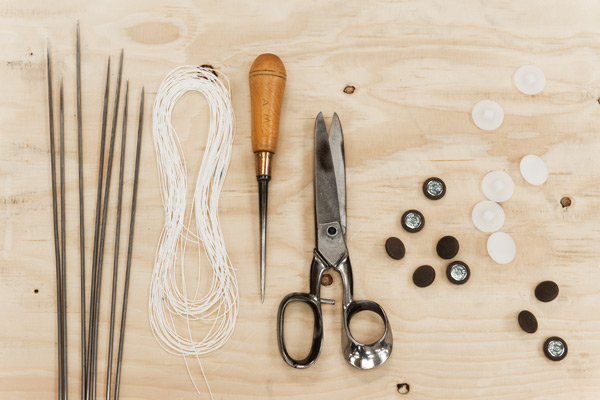
Togo is upholstered using long needles. The elasticity of the foam is measured by the tension when buttons are affixed.
Jean Roset was a man ahead of his time. Amidst a quickly evolving world, he aspired to approach designers. And at the Lyon fair in 1954, he was introduced to designer Michel Ducaroy. Ducaroy was an unassuming creator, a designer through and through, and one of the driving forces of French innovation. But when he first unveiled his new creation, Togo, at the 1973 Salon des Arts ménagers in Paris, more than a few doubtful looks were cast over this ‘seat cushion’. The world had never seen anything like it. In fact, Ducaroy himself described it as a “tube of toothpaste folded back on itself like a stovepipe and closed at both ends.”
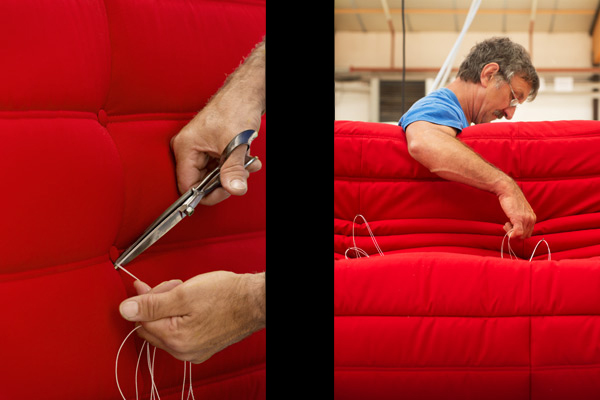
These buttons are upholstered in the same fabric or leather as the cover.
The Togo won the Rene-Gabriel prize later that year, awarded each year to the most innovative furniture. And though its visual comfort seems simple and obvious, Togo is the result of sophisticated expertise. Its structure, which combines three foams of various densities, is upholstered with a generously quilted cover. Its tapestry is the result of the unique and precise movements that shape its identifiable folds. And Togo, whose 40th year of production is celebrated this year, is perhaps Ligne Roset’s most recognisable piece. A legacy of their commitment to great, intuitive design.
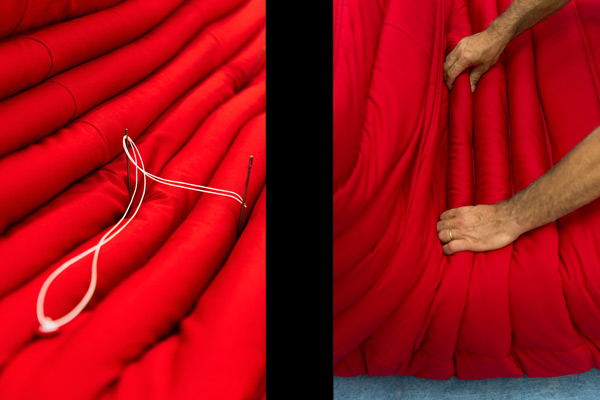
Double-stitching on a cover for Togo. The generous quilting contributes to its ultimate comfort.
DOMO founder, Frank Novembre is the man responsible for bringing the Togo to Australian shores and has sold over 700 of the iconic piece since 1997. “The Togo has been turning heads from the moment it was unveiled in Paris 40 years ago,” says Novembre. “I love the way its crumpled wrinkle-like appearance is inspired by the Shar-Pei dog breed – its contemporary design remains relevant today as it was in the 70s.”

The hand of man is irreplaceable: it executes the specific actions that give shape and personality to the Togo collection.
Crafted by hand in the town of Briord in the foothills of France, each Togo takes up to six hours to construct and includes three densities of polyester foam. It is history in the making.
Ligne Roset
ligne-roset.com
Domo
domo.com.au
INDESIGN is on instagram
Follow @indesignlive
A searchable and comprehensive guide for specifying leading products and their suppliers
Keep up to date with the latest and greatest from our industry BFF's!
The internet never sleeps! Here's the stuff you might have missed