The home of architecture and design in the Asia-Pacific
Get the latest design news direct to your inbox!

Get the latest design news direct to your inbox!
Wilkhahn’s stand at Orgatec 2016 drew huge crowds with products that showed the brand’s consistent push for innovation in workplace furniture.

The latest innovations from Wilkhahn, presented at Orgatec 2016

PrintStool One, designed by Thorsten Franck (who also created Wilkhahn’s "Stand Up") for Wilkhahn

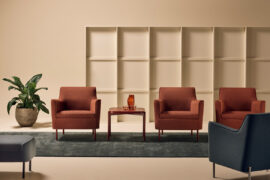
Occo chairs, designed by Jehs & Laub for Wilkhahn

Occo table, designed by Jehs & Laub for Wilkhahn

Metrik chair, designed by White ID for Wilkhahn

The IN Taskchair, designed by Michael Englisch for Wilkhahn

mAx conference table, designed by Andreas Störiko for Wilkhahn

mAx conference table, designed by Andreas Störiko for Wilkhahn
The crowds didn’t thin at the Wilkhahn stand at Orgatec 2016. Day after day, a steady stream of visitors inched their way from display to display – looking, sitting, swinging, folding, reclining and listening to the Wilkhahn team discussing the brand’s newest innovations for an ‘office for motion’.
The constant stream of visitors wasn’t a surprise, given Willkhahn’s position among office furniture brands as a leading innovator in terms of function, quality and design. For Wilkhahn, the best solutions are not those that are state-of-the-art now but irrelevant in two years’ time; the impetus of Wilkhahn is to find clever solutions that are long lasting.
That was evident throughout the stand, where products released as long ago as 1980 (for example, the classic FS-Line task chair designed by Klaus Franck and Werner Sauer – still in production) sat comfortably alongside the latest releases.
Some of today’s most pressing issues in workplace design – of the health of office workers, communication between office workers, and quality of design shone throughout the booth.
The IN chair, for example, incorporating Wilkhahn’s patented Trimension© technology, encourages changes in posture by allowing forward-backward, side-to-side and rotational movement – a significant benefit for the spine. “It’s not hard to move when you’re sitting on IN,” said Burkhard Remmers, Wilkhahn’s Director of International Communication and Public Relations, at the stand. “This balance between fostering motion and at the same time enabling us to concentrate on work is probably the best solution we have found.” IN, designed by Michael Englisch, was shown at Orgatec for the first time with a white through-dyed seat and back element.
Plenty of visitors were playing around with folding tables at the Wilkhahn stand. Presented alongside the evergreen mobile Confair folding table, designed by Andreas Störiko in the early 1990s, was the designer’s brand new mAx folding table. The sturdy, self-stabilising mechanism that defines mAx is an example of the simple yet clever design that characterises Wilkhahn products.
Wilkhahn’s ongoing relationship with designers jehs+laub was also emphasised by the Graph and Occo collections – chairs and tables launched in 2012 and 2016 respectively that form a visual family but cater to multiple contexts. The shell of the Occo chair is opened up into a striking back shape with a flexing quality. A huge variety of colours and finishes makes Occo suitable for spaces from conference rooms to canteens.
Wilkhahn’s focus on innovation really made an impact with two sculptural yet tech-driven products: the Metrik cantilever chair and the 3D-printed PrintStool One. Metrik designers WhiteID, who are better known for their work in the automotive field, transformed the cantilever-chair typology into something that speaks of the twenty-first century. Remmers called it “an aesthetic approach driven by new technologies.”
We’ll be reporting in greater detail on PrintStool One (designed by Thorsten Franck) in the weeks to come. Needless to say, the possibilities of harnessing user-activated 3D-printing technology in conjunction with biodegradable plant-based printing material is something that could turn the commercial furniture industry on its head. Now that’s innovation.
INDESIGN is on instagram
Follow @indesignlive
A searchable and comprehensive guide for specifying leading products and their suppliers
Keep up to date with the latest and greatest from our industry BFF's!
The internet never sleeps! Here's the stuff you might have missed