The home of architecture and design in the Asia-Pacific
Get the latest design news direct to your inbox!

Get the latest design news direct to your inbox!
Anthony Caggiano discovers a seating design inspired by deviating walkers.

April 21st, 2010
A seating system inspired by the way people interact with and behave in a street has won an Adelaide streetscape competition.
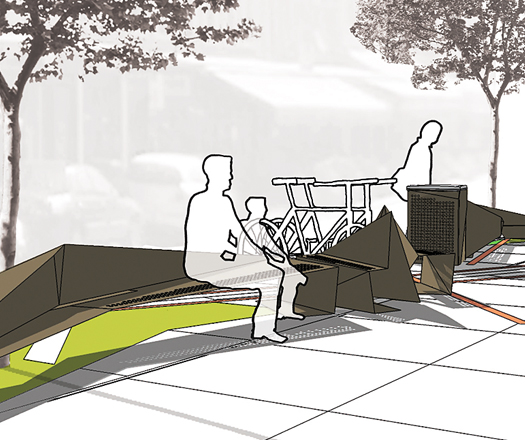
The “Folding Rundle”, a seating, bike stand and bin solution, won the 2010 New Architects and Graduates (NAG) Design Festival competition.
The award was an initiative from the Adelaide City Council and NAG for local artists and designers to produce more lively street fixtures for Adelaide’s cultural precinct, Rundle St.
Good friends, architects and UniSA tutors, Sasha Radjenovich and Sean Humphries, of Adelaide, developed the ‘Folding Rundle’, inspired by the constant changes in behaviour from people using the street.
“People never walk in straight lines… their attention is drawn to different things,” Sasha says.
“They turn their heads, their focus changes, things come in and out and people hear snippets of conversations as they meander on their journey, ” Sean says.
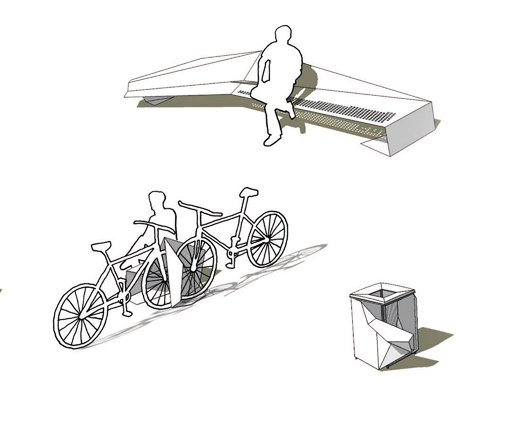
The seating system offers variable height seating, 2 bike racks and a bin enclosure.
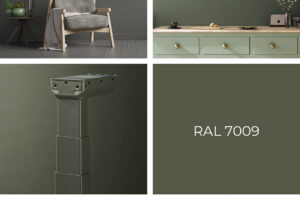
Made of folded steel primary and painted with Dulux Namadgi, the folds of the furniture were inspired by people’s distractions and changes in their travel path along the strip.
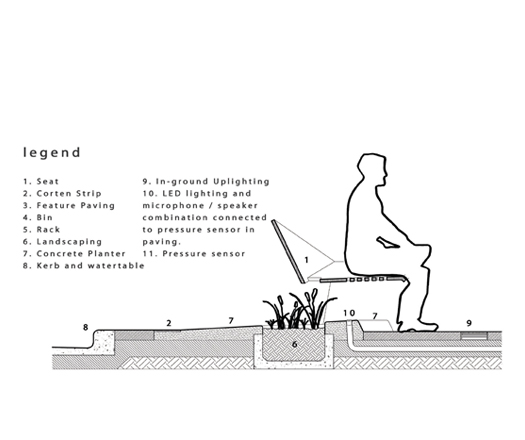
Building on the idea of constant deviations, the Folding Rundle’s recording station records people’s conversations on the chair and then replays random 5-10 second grabs, adding to the “murmur” of the street.
Adding to how people interact with the space, sensors light up the piece’s space when someone approaches it.
Adapting to how people use the space, the bike rack has an in-built stools for riders to sit or use as a bench space for other activities, such as rest a coffee or backpack.
The seat incorporates a run-off water system to irrigate plants below the chair.
Noting their short time in industry, Sean said it was a “big step” to have something built in the public domain.
Several examples of the work will be installed as part of a footpath upgrade to the area later this year.
South Australia Architecture Awards 2010
voice.architecture.com.au
INDESIGN is on instagram
Follow @indesignlive
A searchable and comprehensive guide for specifying leading products and their suppliers
Keep up to date with the latest and greatest from our industry BFF's!
The internet never sleeps! Here's the stuff you might have missed