The home of architecture and design in the Asia-Pacific
Get the latest design news direct to your inbox!

Get the latest design news direct to your inbox!
With the potential to save the lives of thousands, Australia’s first proton therapy unit, designed by Woods Bagot, starts construction in Adelaide next month.

June 23rd, 2020
The Australian Bragg Centre (formerly known as SAHMRI 2), Australia’s newest clinical and research facility, in the growing health and biomedical precinct of Adelaide, will begin construction next month.
Designed by Woods Bagot, the Australian Bragg Centre will be home to Australia’s first proton therapy unit for cancer treatment – the Australian Bragg Centre for Proton Therapy and Research.
Comprising of the lower three levels of the new facility, the proton therapy centre will deliver technologically advanced, precision radiation therapy, which has the potential to be a part of the cure for a significant number of cancers.
Because of the precise nature of proton therapy, radiation oncologists can target cancerous tumours directly with minimal damage to surrounding healthy tissue. It is a valuable treatment option for tumours close to vital organs or cancers previously considered untreatable.
Woods Bagot is the global studio behind the design of the flagship SAHMRI (South Australian Health and Medical Research Institute), a state of the art facility whose sculptural qualities inspire and promote the building’s function. Seamlessly interacting with its surroundings, SAHMRI Woods Bagot states the design benefits both the public and the teams working within the nine flexible research modules.

Woods Bagot director Thomas Masullo said, “SAHMRI was a catalyst in the resurrection of inner city Adelaide, and the evolution of an internationally-regarded health and biomedical precinct. The design of the Australian Bragg Centre echoes the gravitas of this precinct where state of the art technology is part of the city’s ongoing transformation.
The vision for the Australian Bragg Centre is to provide flexible, intelligent and high-performance research and work spaces that allow people to connect across teams, disciplines and generations. This new building will complement and accentuate the striking geometric façade of the flagship SAHMRI facility, which draws its design inspiration from the natural contours of a pine cone.
A restrained approach informed the design of the tower component, repetition of glass panels, rectangular curtain walling and sun shading system, create an elegant and sophisticated design aesthetic.
On the North Terrace, the corner site has three frontages: one to the city, one to the river, and one to Adelaide’s convention and entertainment precinct. A transparent building lobby, retail areas and an outdoor plaza will activate North Terrace.
The integration of built form and landscape results in a variety of public and private open spaces which Mr Masullo says will promote a flexible and healthy environment responding to the needs of staff, clinicians, patients and the community.
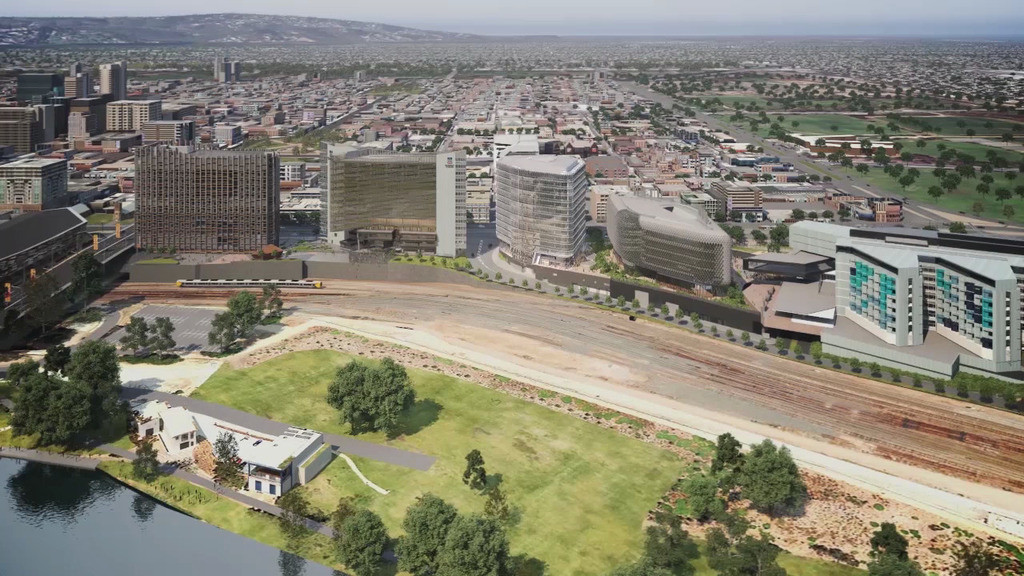
“Woods Bagot is proud to have been involved with the precinct for almost a decade. Completing Adelaide’s BioMed City precinct, the Australian Bragg Centre will acknowledge its sense of place within the Adelaide riverbank,” said Mr Masullo.
SAHMRI was Australia’s first laboratory building to be certified as a Leadership in Energy and Environment Design (LEED) Gold building. Woods Bagot plans to continue this with similar high sustainability standards for the design of the Australian Bragg Centre project.
The centre is planned for completion in 2023 and should be treating patients within 18 months of that date.
INDESIGN is on instagram
Follow @indesignlive
A searchable and comprehensive guide for specifying leading products and their suppliers
Keep up to date with the latest and greatest from our industry BFF's!
The internet never sleeps! Here's the stuff you might have missed