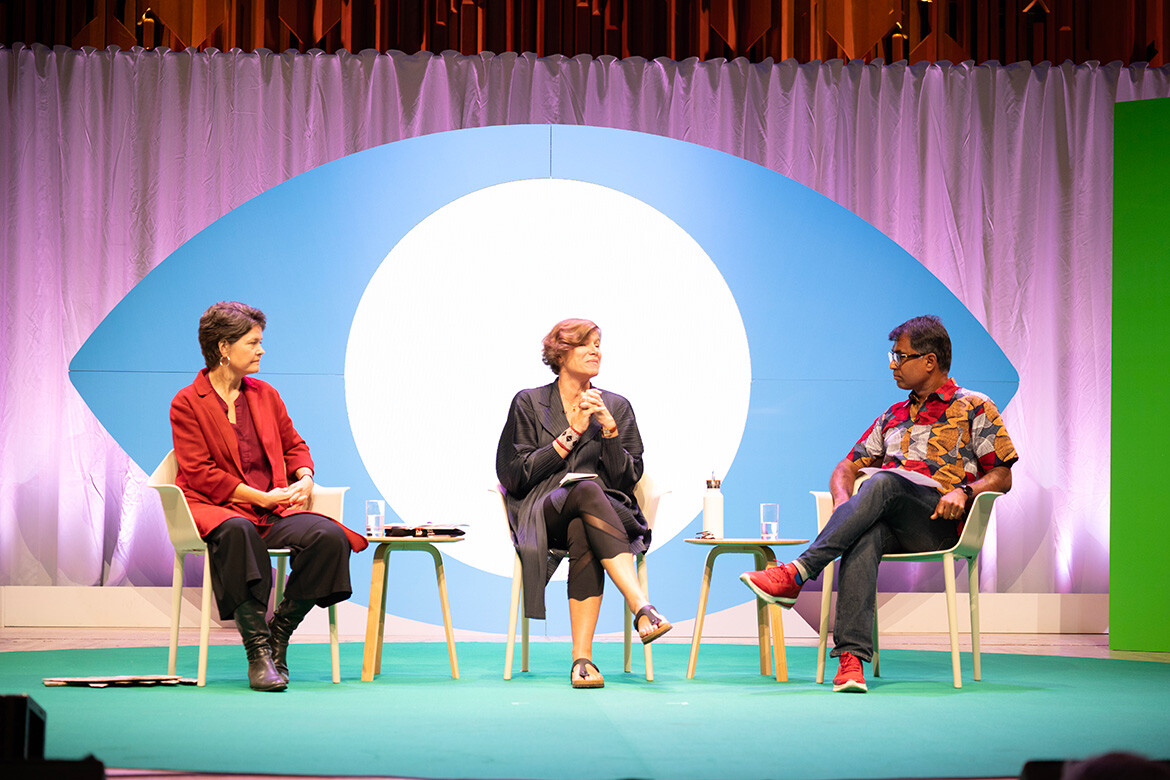
If money, policy and governance sit upstream, design sits downstream of the forces that set the real brief. This was one of the themes that came through loud and clear at the recent World Design Congress. Held in the Barbican’s concrete embrace, the two-day conference felt like a map for how the design and architecture industry can continue to stay relevant when the world is on fire.
Here are three concepts, distilled from some of the world’s foremost thinkers.
1. Design is a hinge
Despite the dire times, the message of what needs to happen next reverberated like a rallying cry. Design and designers have a critical role to play. It was put most persuasively by the Future Observatory’s Justin McGuirk: “Design is a hinge.” It’s a mechanism for change, a device that translates intent into movement, which is rather fitting at a time of overlapping crises – climate, housing, biodiversity, international conflict.
We’ve heard the dire stats about the climate crisis; we know the failing targets to the Paris Agreement. What changes behaviour are the flows higher up the stream: building timelines that don’t debilitate both architects and builders, procurement that prices in operational energy and reparability, ownership models that keep value circulating locally. What would it look like to draw a map of value flows first, then place your hinge where a small re-orientation can unlock a different future? In crisis, adjacent thinking – the backbone of design thinking and creative problem solving – is how we can enact systems change.

2. Creative collaborators focused on a single mission
Similarly, the economy shouldn’t be seen as an invisible force, but rather a medium ready for redesign. The rules of finance, the shape of procurement, the distribution of risk and reward – these are conditions that architecture exists within. And, as the two revered economists Kate Raworth and Mariana Mazzucato hashed out on stage, they are ‘designed’ systems. We have inherited an economic architecture that encourages extraction and acceleration. The question is not whether designers can transcend this architecture, but how to participate in its renovation. Is it possible to write the value of durability, repair and social outcomes into your contracts alongside cost?
One of the key solutions is making sure knowledge circulates rather than calcifying in IP silos. This means the net of collaborators needs to be thrown further than ever before. Rather than a platitude, true design innovation is waiting to bubble up from complex cross-disciplinary combinations. Biologists and soil scientists at the table with economists, policy advisers and insurers; arts and culture in the room to frame narratives the public can actually absorb; cost planners close enough to the ambition to keep a project credible.
Mazzucato pointed out that mission-orientated work is one way to hold such a coalition together. The framework is surprisingly simple: name a problem that matters (affordable housing, circular commercial fit-outs, nature-positive public space), set a time-bound outcome and align contracts and capital to the mission.
Related: To reach net-zero, we must tackle the ‘too hard’ basket


3. Prototype the system, document the process, share the narrative
It’s time to prototype systems, not just objects. McGuirk’s ‘design hinges’ matter most when they demonstrate the whole loop: sourcing, fabrication, logistics, maintenance, end-of-life and adequate policy to make it scalable. Document the process well-enough it can be repeated and then legislated. Make the IP open source, because repeatability is the point.
Finally, we need to tell better stories – not as spin, but as governance. “The climate crisis is partly a crisis of storytelling,” McGuirk notes. The narratives we circulate can shape briefs, budgets and belief.
If there was a shared ethic across two very jam-packed days, it was the need for an expanded circle of care. Designing for non-human life, why can’t façades be host to birdlife and gardens privilege pollinators rather than people? It’s about recognising that a building is also a habitat, and that maintenance and repair can be built into culture.

So, what might a more clear-sighted design industry look like from here?
It looks like treating procurement as a creative brief. It most certainly means bringing unusual collaborators into the room before decisions are finalised. It’s taking the time to be brave with R&D, and test ideas to create inspiring stories that can grow into new behaviours.
The role of design, then, is to connect. To connect policy to practice, finance to purpose, material possibility to cultural meaning.
World Design Congress
worlddesigncongresslondon.com
Photography
Johannes Frandsen