The home of architecture and design in the Asia-Pacific
Get the latest design news direct to your inbox!

Get the latest design news direct to your inbox!
Never have the challenges of entering our vibrant industry been greater and more competitive for emerging creative talent. Luckily, there are people trying to help.

While human-centred design, as a concept, has been built around creating a better product for the end-user, the million-dollar question still remains unanswered…
The answer, surprisingly enough, lies in design-thinking. The same applied thought that leads to the creation of what ends up being experienced at full scale, or held in someone’s hand, is slowly but surely creating a shift within our industrial practices.
Architecture and design is becoming less concerned with the physical artefact: the product of the “starchitect” (or equivalent), if you will, that we view and gawk at from our computer screens. Rather, across the globe, there is an increasing appreciation for a focus on people and their role in a building’s occupation or product’s use. As a result, our clients are becoming more focused on people, too. While incredible pieces of architecture or alternative kinds of design might pave the way for innovation, it remains up to how we use them to truly produce successful outcomes.
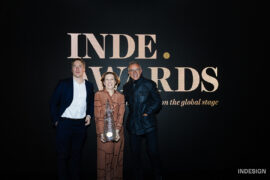
Of course, the outcome of any project depends on the people involved. But at the inaugural INDE.Awards, we are also keen to see how we might use this watershed regional award programme to address pressing concerns facing the full spectrum of our industry, today. Like many of the clients in the architecture and design space – all of whom seek our expertise in using design to lend competitive edge, leverage design’s capacity to attract and retain talent, or even just use design’s ability to empower end-users – our region’s design studios ironically (or, indeed, not very ironically at all) also obviously deal with similar problems relating to capital-D Design’s commercial imperative. Whether with respect to studio mission, in-house talent, studio structure and hierarchy, design process from ideation/conception to execution, practice innovation and the overall original authenticity of the studio and the designs it creates, the INDE.Awards celebrates design in our time, but is also keen to understand the future direction of our diverse industry – not to mention how we might begin to improve it for the better.
Through intimately collaborating with Australia’s most-active architects and designers to create spaces of exceptional quality and high-tech engineering, they are uniquely positioned to understand the growing difficulties faced by our A+D community. Cherishing the power and inherent strength of creating long-standing relationships with Australia’s leading practitioners, Team Tongue n Groove seek to bring much-needed attention to the position of human talent within our industry. They strive to highlight, that is, the importance of human-centred design in everything we do – design, that is, which aims to empower, that celebrates the growth of talent and the appreciation of authenticity in every aspect of what our industry produces, as well as every facet of our industry’s structure, itself.
Naturally, we all look to others to lead by example. And, as such, we cannot think of a better exemplar to lead the way into a more sustainable, driven and successful future for our design community than that demonstrated by Tongue n Groove. Rightly famed for their engineered materials and ecologically-conscious flooring solutions, we could not be more elated to welcome Tongue n Groove into Team INDE to bring to you an awards programme that looks forward to a bright future for us all.
INDESIGN is on instagram
Follow @indesignlive
A searchable and comprehensive guide for specifying leading products and their suppliers
Keep up to date with the latest and greatest from our industry BFF's!
The internet never sleeps! Here's the stuff you might have missed