The home of architecture and design in the Asia-Pacific
Get the latest design news direct to your inbox!

Get the latest design news direct to your inbox!
Cutting-edge machinery and expert design teams are raising the bar on commercial office fitouts

June 1st, 2025
Those who work within the commercial design typology would be well acquainted with Krost. A leader in premium workplace solutions, their extensive portfolio makes it the go-to for designers seeking everything from turnkey packages to fully bespoke pieces. Despite its global heritage, Krost feels authentically Australian, with expansive showrooms in Sydney and Melbourne and local sales, design, and manufacturing teams tuned to the region’s needs and aesthetic.
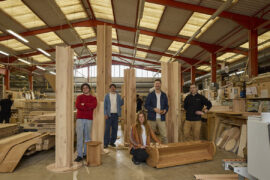
What many don’t know however, is just how localised the brand is, or indeed that their state-of-the-art manufacturing facility is actually located on Australian shores. Located in Smithfield, a key industrial and commercial hub in New South Wales, Krost’s local manufacturing is not only a dream for designers working within tight time frames and budgets, but it also is essential in continuing the brand’s evolution, letting them service Australia’s commercial design industry with the latest in innovation and product development.

Indeed, everything from their workstations, desks, tables, storage units and other joinery are locally manufactured in Sydney using the world’s best practiced methodologies on some of the most technologically advanced machinery available. Over the years, their production line has developed and grown to double its original size, and new machines introduced, with the currently operating suite including four CNC processing units and edge banders, as well as laser technology soon to be introduced to the floor. These machines, operated by highly skilled technicians and engineers, ensure every piece in the Krost portfolio is of the highest quality, with precision cuts and meticulously crafted joins standard across the range.
In addition to the machinery, the production line is also powered by an in-house-developed ERP system which lets every project be tracked in real time. This system ties in with the Krost design software to optimise and maximise their design solutions, with every project is proficiently managed end-to-end with total transparency. With this, the Krost team is able to work collaboratively and efficiently, ensuring waste is minimised, lead times are reduced, costs are managed, and quality is assured.

Designing and manufacturing locally also lets Krost make use of locally sourced materials. This not only helps to elevate and support the Australian supply chain, but also assists the brand in reaching their sustainability goals, whether through reducing their carbon footprint or providing durability and longevity to their product suite. For customers, this commitment to sustainability can carry through to embodied carbon calculations, but also serves an aesthetic purpose, with every client having access to a wide library of material finishes and wood grains that can be used to create bespoke joinery solutions.
For years, Krost has set itself apart for its range, its service, and its quality. Delving a little deeper reveals how this is no accident, but has been built through a commitment to local production and manufacturing. By establishing a state-of-the-art manufacturing facility in Sydney and maintaining showrooms and warehouses along Australia’s East Coast, Krost has put quality, efficiency, and customisation at the center of their ethos, proving they are not just a company that understands their end users, but also the industry they serve.

Discover Krost’s locally manufactured range and discuss your project needs at krost.com.au, sales@krost.com.au or visit their showrooms in Sydney and Melbourne.
INDESIGN is on instagram
Follow @indesignlive
A searchable and comprehensive guide for specifying leading products and their suppliers
Keep up to date with the latest and greatest from our industry BFF's!
The internet never sleeps! Here's the stuff you might have missed