The home of architecture and design in the Asia-Pacific
Get the latest design news direct to your inbox!

Get the latest design news direct to your inbox!
In the first of a two-part exploration of hemp in today’s built environment, we consider aesthetics and why the material hasn’t been used more widely.

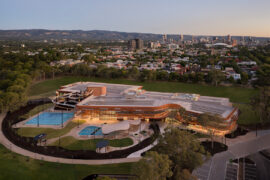
Powerhouse Place, Public Realm Lab, photograph by Tom Ross.
August 9th, 2024
Gold star for green credentials
One of the fastest-growing plants on earth, hemp was recognised early on for its versatility, and today is found in industrial and commercial products including textiles, paper, biofuel, food and building materials including paint and insulation – and is used as a structural and decorative finish.
Its basic physical properties are impressive. It grows up to six metres in a matter of months and is almost six times stronger than steel. But it is particularly relevant to the contemporary architecture, design and construction industries because of its remarkable carbon credentials: it is one of the few materials we can call carbon-neutral, because it absorbs more carbon than it emits throughout its growth cycle. It’s also a ‘nose-to-tail’ resource, with everything from its seeds, oils and fibres used in a productive way, with little to no waste.

In addition, once processed, hemp manages moisture effectively and possesses significant thermal mass – regulating internal temperatures and adaptable to various climates. Fire and mould-retardant, and termite resistant – this wonder material has benefits in spades. It saves running costs and carbon emissions, and at the same time increases user comfort and helps future proof projects against shifting environmental factors and zoning requirements.
Whilst it has been pursued for several decades by consumers for their individual homes, hemp has struggled to make an impact on a larger, commercial scale – a probable missed opportunity in our climate-sensitive context.
So, why hasn’t it been used more widely?

A resource with a rap sheet
Hemp has historically suffered from negative conceptual and, ultimately, legal association with the cannabis plant, from which it is virtually indistinguishable to the naked eye. “It only became legal in 2008 for growing, and in 2017 for eating [by humans in Australia],” says hemp advocate and building designer, Jeremy Thomas of Environmentarian. “So these two factors mean hemp is now not just legalised, but they also help with the de-stigmatising and redefining of the hemp narrative.”
Related: Radical logics of connectedness with Chris Fox

A question of aesthetics
As a natural material, hemp displays some very particular physical characteristics, which can be polarising and inappropriate for some architectural settings.
“We were looking at the hemp work that was being produced, and it didn’t really talk to us as architects,” explains Anna Maskiell of Public Realm Lab, who have recently completed the award-winning adaptive reuse of Mildura Powerhouse, which features hemp construction. “So, we were curious to ask: how do we lean into this kind of biogenic material that we really believe is the future and develop a new architectural language that responds to its properties?”
Phoebe Settle of Woods Bagot, who’s been working on Australia’s biggest hemp project to date at the University of Tasmania, agrees: “I think it may always be slightly niche in terms of its use, especially at a non-domestic scale, because of its particular appearance. It’s a very raw, natural aesthetic so that doesn’t suit every environment. Also, there are parameters around the thickness and there are only certain spaces that can take that kind of depth.”


The downside of youth
Being an immature industry, hemp procurement can still be a challenge to navigate, dependent on and vulnerable to unpredictable agricultural growth cycles. “At the moment, there’s a bit of a glut of unprocessed hemp in Australia,” says Dick Clarke of Envirotecture, who have been designing hemp homes in NSW for more than 12 years. “But three years ago, we were importing it [due to the drought],” he recalls. Along with challenges of availability, as a naturally grown material, there are also inconsistencies in character and quality to contend with – which can be a barrier for larger commercial projects.
Similarly, due to the newness of the industry, there is a skills shortage in hemp construction techniques – particularly for projects at scale. “There are people who do it, but those people are typically very small businesses, like one or two people, and have done it on a much smaller scale,” explains Alastair Flynn, Associate Principal at Woods Bagot. With demand, however, this is shifting. “We’ve got a number of jobs with first-time hemp builders, and they’re blitzing it, absolutely blitzing it,” enthuses Clarke. Prefabricated solutions like Otetto’s prefabricated Living Canvas® hempcrete walling system are also assisting with this transition, making it easier for commercial (and residential) installers to deliver projects at scale and help drive the movement forward.
Part two of this series on hemp is here!


INDESIGN is on instagram
Follow @indesignlive
A searchable and comprehensive guide for specifying leading products and their suppliers
Keep up to date with the latest and greatest from our industry BFF's!
The internet never sleeps! Here's the stuff you might have missed