The home of architecture and design in the Asia-Pacific
Get the latest design news direct to your inbox!

Get the latest design news direct to your inbox!
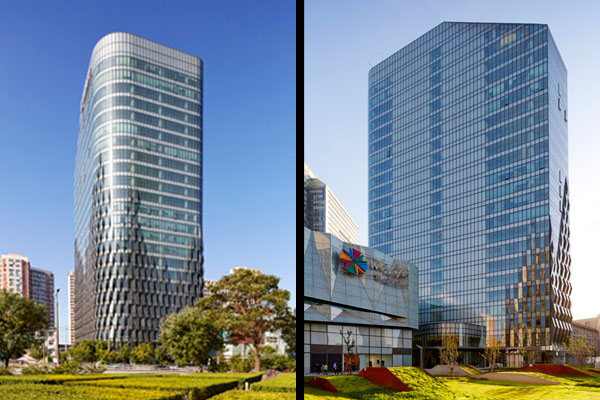
SPARK’s eye-catching ‘pleated’ and ‘woven’ facade in this mixed-use development resolves a variety of practical issues whilst referencing the textile market that formerly operated on the site.

November 12th, 2014
The Jing Mian Xin Chen project consists of two office towers and a retail podium. It’s located in Beijing’s Fourth Ring Road, immediately adjacent to the road, and with a protected public plaza to the rear.
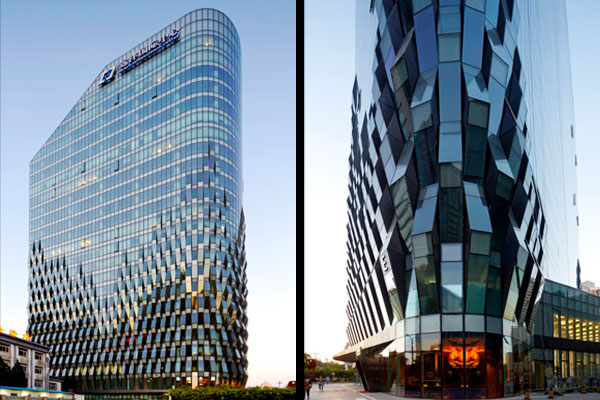
Given that the block’s massing was predicated and constrained by the sunlight requirements of a residential development to the north of the site, SPARK’s work focused on the design of the facade and landscape.
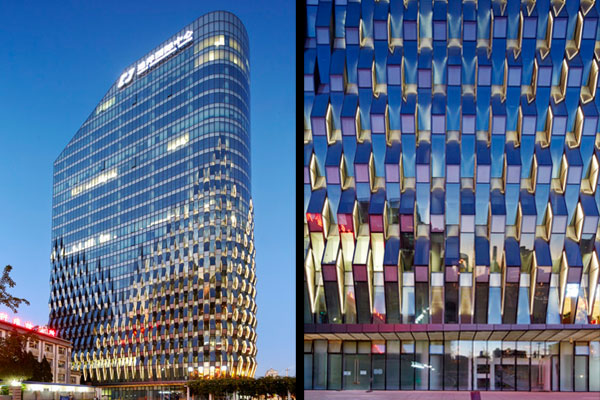
Inspiration for the ‘pleated’ and ‘woven’ facade was drawn from the former presence of a textile market. “The pleating and weaving effects emerged from the visualisation of the facades as pieces of three-dimensional fabric rather than paper-thin curtain walls,” says SPARK Director Jan Felix Clostermann. Here, pleats of perforated aluminium sheet establish a heavily textured facade for the retail podium, while angular ‘threads’ of glazing adhere to a weaving logic that slowly dissolves as it progresses upwards.
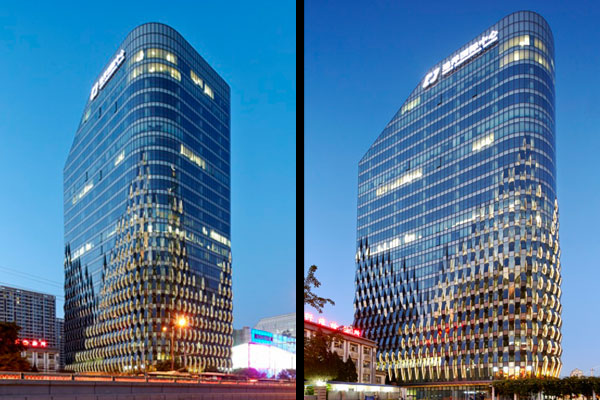
Beyond enclosure, the ‘thickened’ facade also performs a number of functions. For one, they baffle noise from traffic and offer a level of acoustic protection to the interior. The weave effect on the towers thus focuses on the lower levels, and fades out as it goes higher. In addition, in the case of the woven glazing, the facade engages with the interior space by sculpting new, habitable zones at the building’s edge.
The woven glazing also opens up new opportunities for ventilation. “The weave allowed us to add small side openings for natural ventilation. In most of Beijing’s Grade A office developments, windows are very large, heavy, top-hung panels that are difficult to operate and prone to falling. Many building operators do not allow windows to be opened for this reason, yet air conditioning is usually switched off at 6pm and remains off on weekends. This is a problem for those who need to work beyond regular office hours,” explains Clostermann.
Being smaller, lighter and easier to use, the side windows are thus a practical and low-tech solution to a common problem. The extremities of the ‘weave’ serve an additional function as easily accessed light boxes for nighttime illumination of the building.
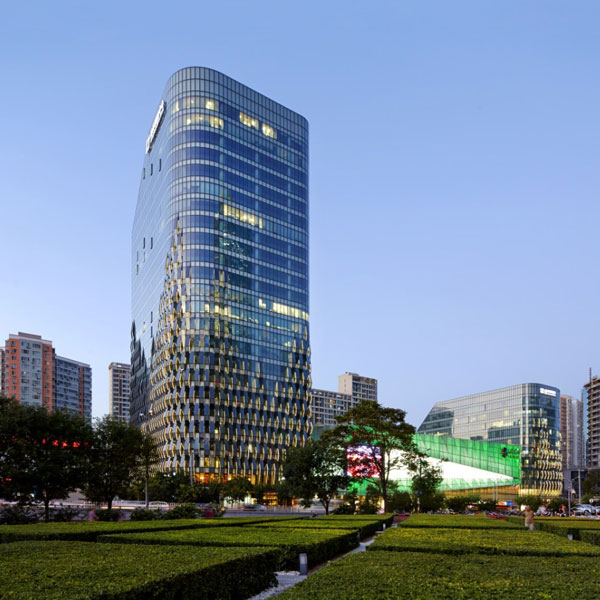
The plaza’s landscape follows a similar vein, establishing a habitable topography of folds on the horizontal plane. “The ground folds up to create seating, and to demarcate different zones in the plaza for different activities,” says Clostermann.
The project was named ‘Best Office and Business Development’ at MIPIM Asia Awards 2013.
SPARK
sparkarchitects.com
INDESIGN is on instagram
Follow @indesignlive
A searchable and comprehensive guide for specifying leading products and their suppliers
Keep up to date with the latest and greatest from our industry BFF's!
The internet never sleeps! Here's the stuff you might have missed