The home of architecture and design in the Asia-Pacific
Get the latest design news direct to your inbox!

Get the latest design news direct to your inbox!
Doshi Levien give us special insights into their new products for Kettal: fresh members for the Cala family, geometric rugs, and subtle duo-tone textiles and ropes that can be used across the Kettal collection.

Nipa Doshi and Jonathan Levien are in a good place right now in terms of their creative practice. “We’re going through an extremely liberating period for our studio at the moment. We’ve reached a stage where we’re choosing very carefully the projects we’re excited about, and that’s all we’re doing,” says Levien as we sit on Doshi Levien’s freshly released Cala Sofa in the Kettal stand at the Salone del Mobile.
Adds Doshi: “We have the freedom to explore the very artistic, experimental aspect of design – almost design as art, as the pure expression of ideas. Then we equally have the opportunity to do very industrially produced work. We’re really enjoying that diversity and freedom. It’s very liberating.”
As we get chatting about the duo’s new products for Kettal, it becomes clear that both art and industry have had their place in the development of the new pieces. The concept for the new Parallel fabric, for example (which is shown on the pavilions that create the Kettal stand as well as on the Park Life chair by Jasper Morrison), originated by looking closely at the structure of the fabric. Doshi Levien created a weave that would allow light to pass through and cast a pleasing check shadow pattern.
“This project was really looking at how to make a mix of colours visible on the surface, but when you hold it up to light the silhouette has to be interesting. On that fabric you’ve got a double line of yarns creating the check so when you hold it up you get the silhouette effect,” explains Levien.
“We went into quite nerdy detail to arrive at those designs,” he says. “You have to understand the structure of the fabrics, and how colour and structure work together,” he says. Doshi elaborates, “You can’t make a 3D model with textiles. Textiles behave very differently once they’re woven and you can’t visualise them on the computer.”
Levien adds, “And in terms of process, Nipa is actually creating colour; she’s not choosing a colour. She’ll paint and mix colours. It’s very much a process of making, not choosing.”
The new Bela rope emerged from similarly rigorous creative and technical processes. “Bela is a three-dimensional form of the very fine diagonal lines you get with a twill weave structure,” explains Levien. It plays on the tonal differences between colours, using the thin lines of the twill to mix colour so that from a distance the ropes look rich and on closer inspection the fine two-tone effect is visible. “There’s a melange in all the materials we’ve created,” says Doshi.
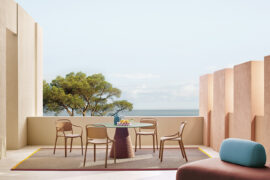
The Cala Chair has gained a family with new the release of a new dining chair, sofas, ottomans and tables. The Dining table has a monolithic and bold presence, providing a contrast to the lightness of the chairs. Set in to the table frame are different tops including wood and marble.
“For us it’s really good to work with a company where we are doing the iconic pieces like the Cala chair, but we’re also designing the materials,” says Doshi. “Kettal are in my opinion the most exciting outdoor brand in terms of their creative strategy… They’re putting colour into outdoors, which nobody did before. They were the first. I really like that.”
“Adds Levien, “Inventing their own materials gives Kettal huge scope for clarity in their brand. That’s something I think none of the other outdoor companies are doing.”
INDESIGN is on instagram
Follow @indesignlive
A searchable and comprehensive guide for specifying leading products and their suppliers
Keep up to date with the latest and greatest from our industry BFF's!
The internet never sleeps! Here's the stuff you might have missed