The home of architecture and design in the Asia-Pacific
Get the latest design news direct to your inbox!

Get the latest design news direct to your inbox!
A team of three Hong Kong designers unveils joint design for the permanent M+ Pavilion. Christie Lee finds out more from Vincent Pang.

July 27th, 2016
While we might have to wait another three years for the impending opening of Hong Kong’s first contemporary art museum, the West Kowloon Cultural District has unveiled its first permanent project, M+ Pavilion.
Conceived by Vincent Pang from VPANG Architects, Tynnon Chow from JET Architecture and Lisa Cheung, M+ Pavilion will officially open with its inaugural exhibition, Tsang Kin-Wah: Nothing, come September.
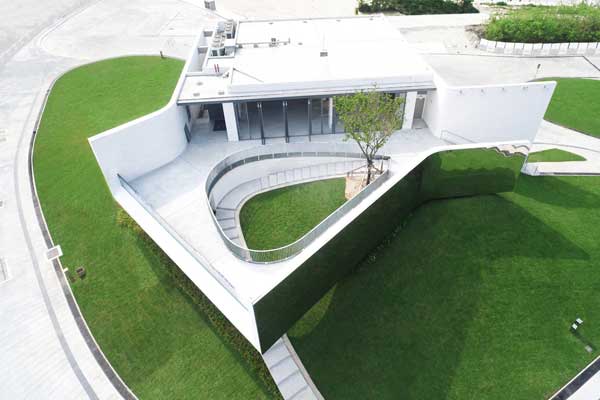
Sitting on a lush patch of green, the structure consists of a reception area on the ground floor, an indoor gallery and an outdoor deck on an elevated plane. “The pavilion is to be an extension of Norman Foster’s idea of the ‘City Park’. We want it to meld with the landscape,” Vincent Pang, director of VPANG Architects, notes.
Playing with the idea of a ‘floating art platform’, the main gallery floor is elevated, with the space between the ground and gallery space serving as a visual metaphor for how one must distance oneself from the hustle and bustle of city life in order to appreciate art in its totality. “The gallery provides a quieter space for artists to exhibit their works, and viewers to appreciate the art,” Pang notes.
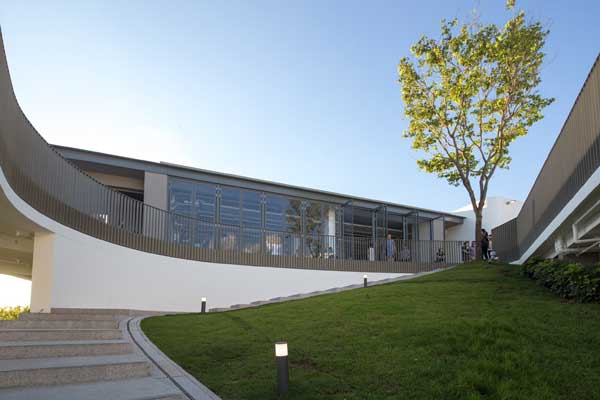
The space can be accessed in three different ways – via the main entrance on the ground floor, which leads visitors past a reception area and gallery wall to a lift that brings them up to the second floor, and two staircases. While one is located on one side of the pavilion, the other is a spiral staircase that snakes its way from the heart of the structure on the ground floor up to the outdoor deck.
There is a deliberate spatial fluidity between the indoor gallery space and outdoor deck, with the pared-down aesthetics allowing flexibility for both small- and large-scale projects, and a variety of art mediums.
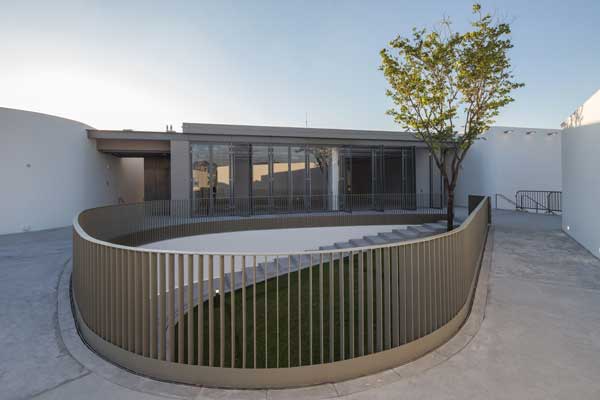
At the deck, two curved walls simultaneously open up to frame the Hong Kong skyline, providing a unique backdrop for any performance artwork that is to take place while also furthering the idea of a ‘City Park’.
The exteriors are wrapped in a film of stainless steel, which reflects the multifarious activities going on at the West Kowloon Cultural District. “With so many structures being built, the area is in constant flux. We want the mirrored surfaces to reflect that,” Pang says.
VPANG Architects
vpang.com
JET Architecture
jetarchitecture.com
INDESIGN is on instagram
Follow @indesignlive
A searchable and comprehensive guide for specifying leading products and their suppliers
Keep up to date with the latest and greatest from our industry BFF's!
The internet never sleeps! Here's the stuff you might have missed