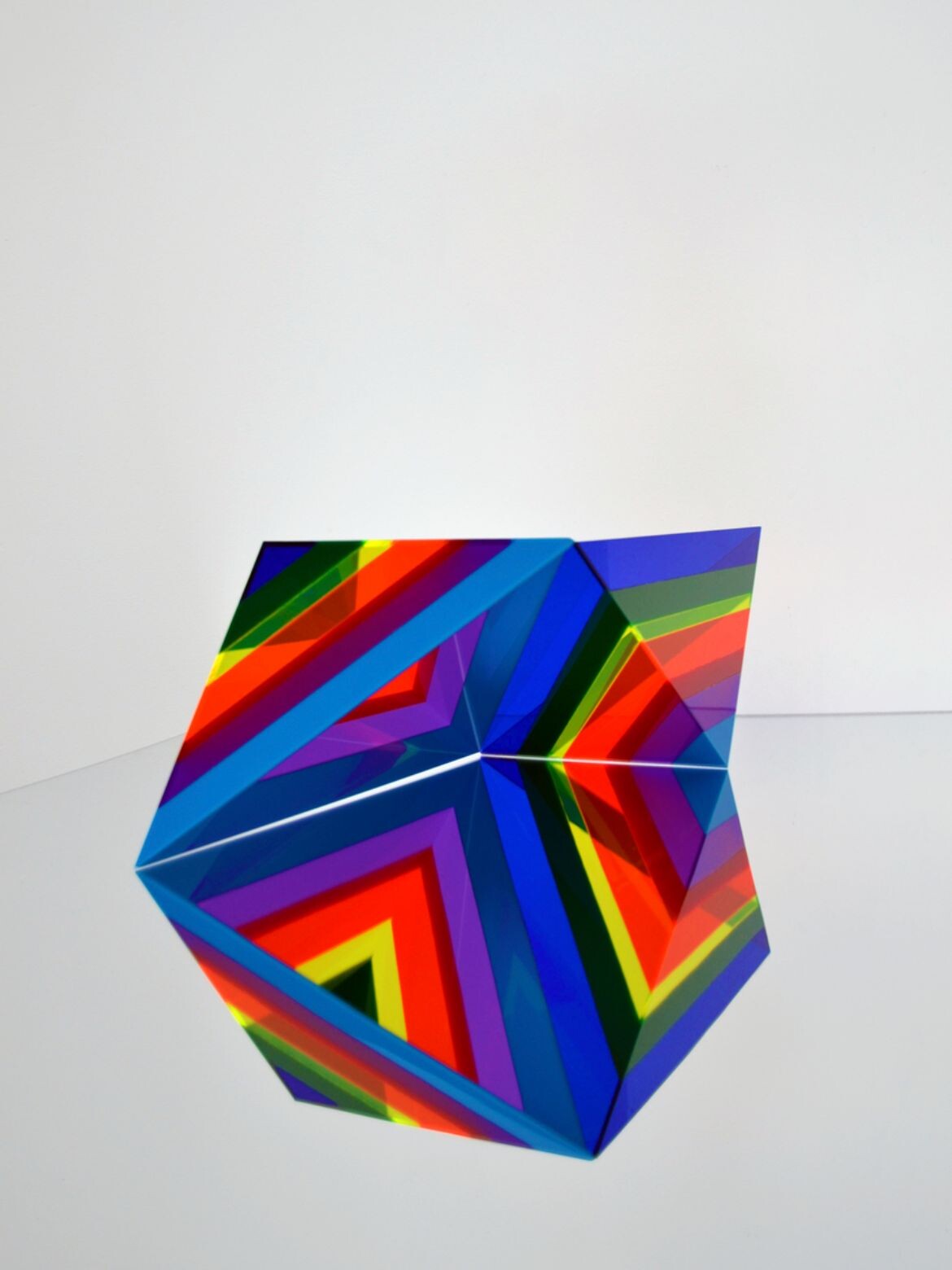
Working across the fields of painting, sculpture, installation and public art, Emma Coulter’s work is hallmarked by bright, solid, colours exploring geometric abstraction. Whilst her work is often articulated across the flat surfaces of a canvas or wall, creating the illusion of a three dimensional sculptural form, she also works in sculpture, utilising common building materials such as steel and cast acrylic. Emma is now represented by the James Makin Gallery.
Through intimate knowledge of ‘her’ colours the artist deliberately manipulates scale, proportion and colour relationships to control the perceptual outcome. There is a mind-bending element at work here, when Coulter uses colour to recede where a shape comes out or move forward where a shape is convex. The resulting work is often strange to look at and questions both border and depth. Her interior wall murals, or ‘spatial deconstructions’ (as the artist names them), are particularly interesting in their ability to be read as a large coloured forms pushing into the space, challenging the perception of the viewer.

Indeed, chromo-spatial manipulation can be summarised as colour-based artworks that use the relationships between colours — harmonious, complementary, contrasting, supporting — to seemingly shift sections forward and back in the picture plane. Artist James Turrell uses this same methodology to create voids and forms. His work Alta Green (1968 Salta, Argentina), for example, fills all but the corner of a room with green light and the result is an apparently solid skewed pyramid form, complete with reflection and sitting squarely in the space. A simpler example is the positioning of a single dark shade below a light one to create shadow, and thereby three-dimensionality.
Germany-based Katharina Grosse is another artist who works with the spatiality of painting and colour, making gestural, site-specific paintings within rooms and buildings and reversing the idea of illusionism by making immersive environments with which one can walk into.
Related: RONE transforms Flinders Street station
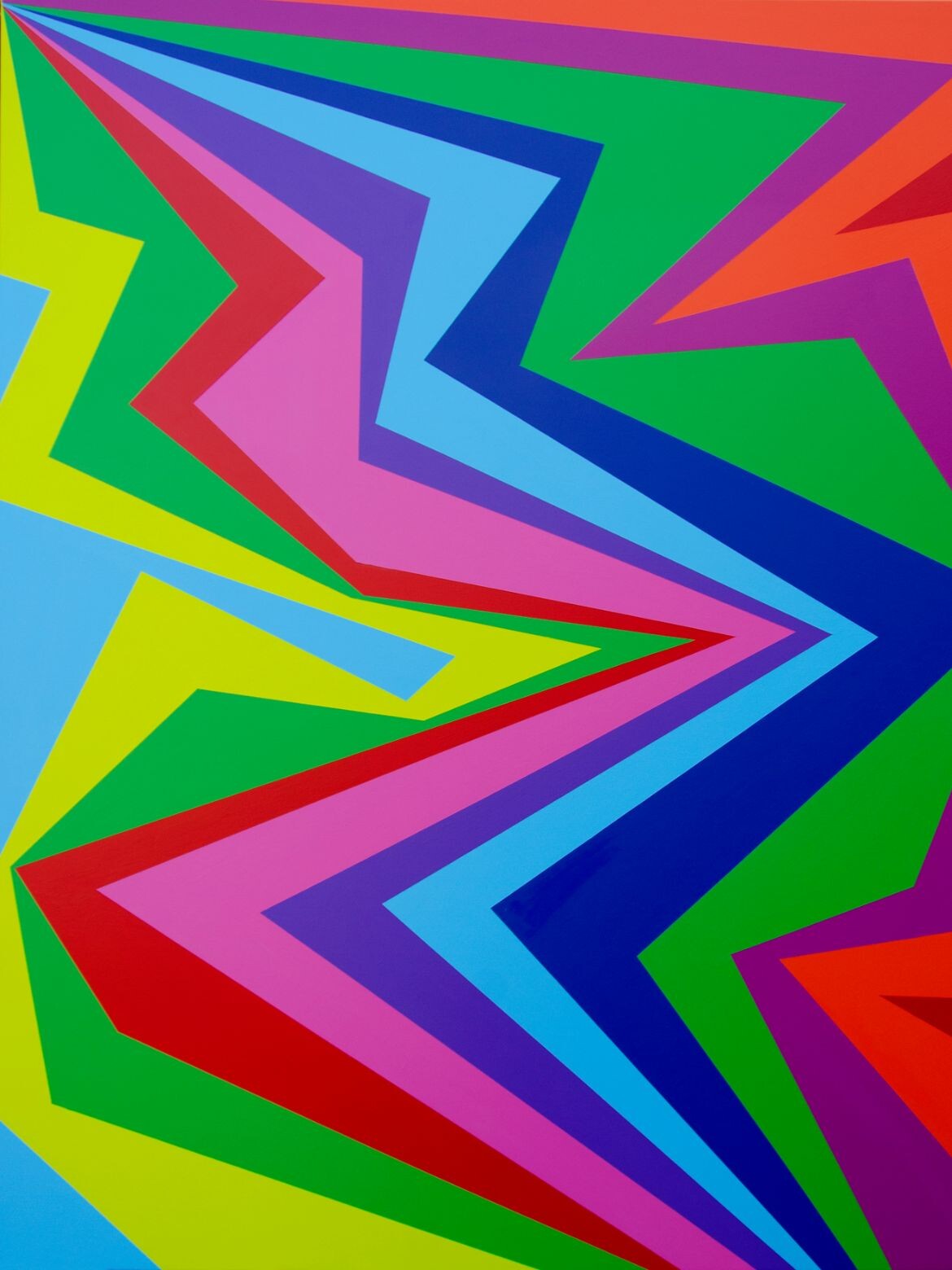
In making her own mark in architectural space, however, Coulter arranges colours that often create voids, or ‘cutouts’ and explosions of form with zig-zags that shift forward and back as width becomes narrow or form becomes void. Stripes shift from positive to negative as they bend around space and surface.
“I work with colour in a serial way through a refined colour palette, creating my own bold, idiosyncratic, spectrum as a type of non-verbal language. Through my work, I am questioning the boundaries of art and where it belongs. I am interested in the transformative power of colour as a visual sensation and accessible language,” says Coulter.
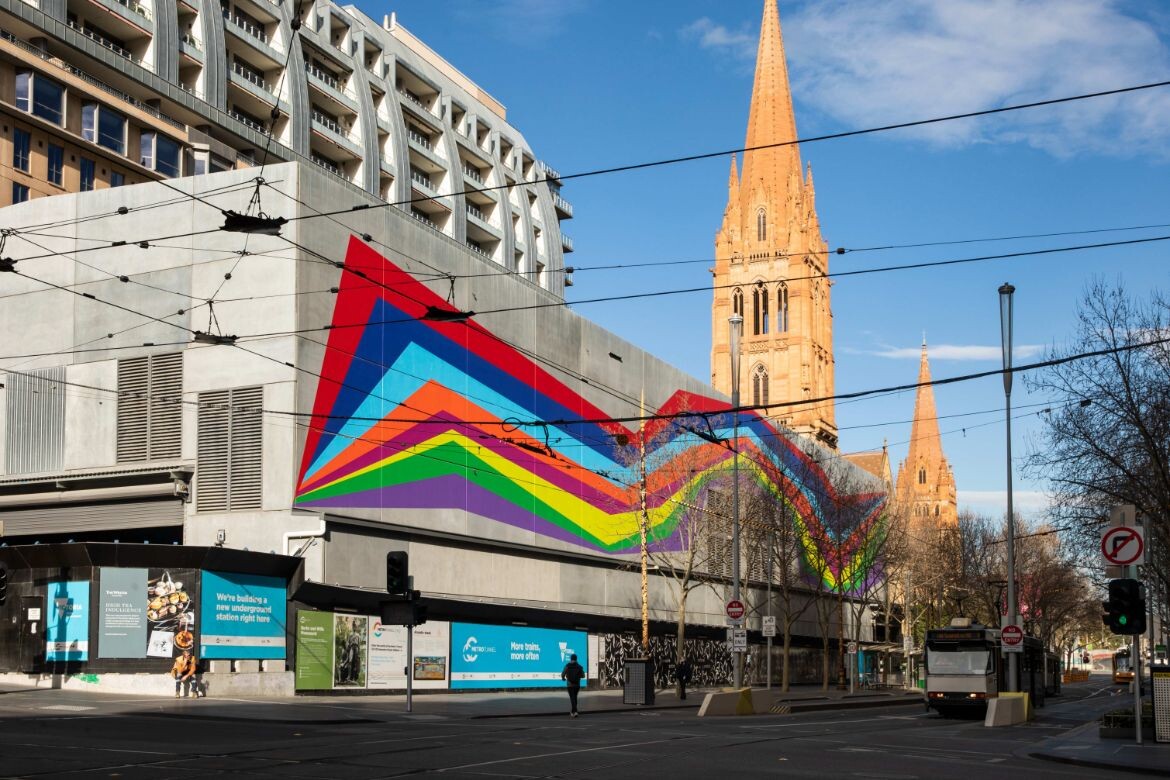
Those in Melbourne might remember her recent commission: a 130-metre-long work, ‘spatial deconstruction #23 (resilience)’, which covered the outer walls of the Metro Tunnel construction site. Occupying the entire city block of Melbourne’s most prominent intersection, “the work was intended as a gesture of resilience for the diverse communities of Melbourne, during the endurance of the COVID-19 pandemic in which Melbourne was one of the most locked down cities in the world”, says Coulter.
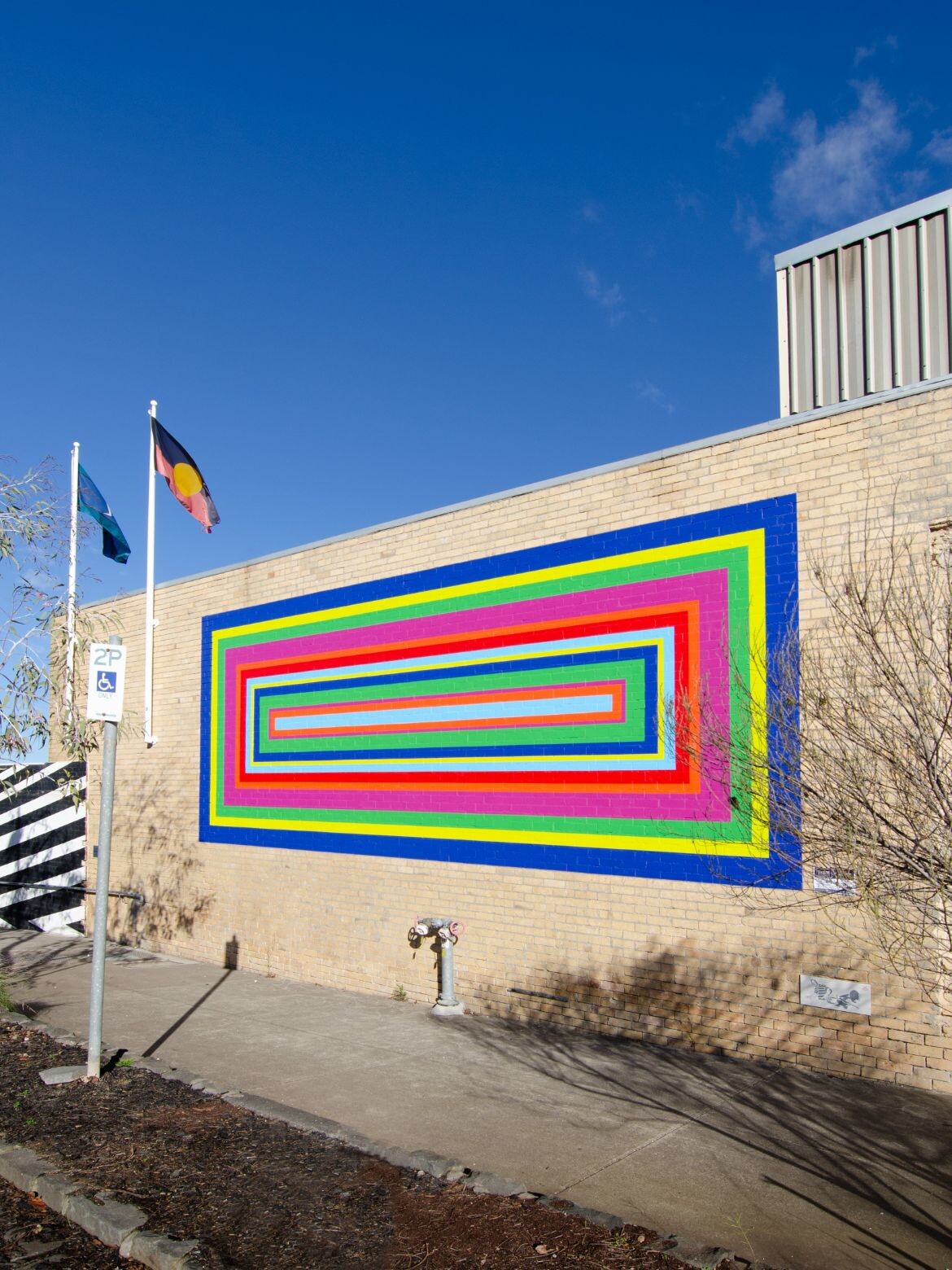
For her upcoming solo exhibition at James Makin Gallery, Coulter will explore the idea of ‘infinite systems’, applying her colour methodology across various media to create spatial outputs. Excited by the potential outcomes, director Jessica Velasquez says, “Emma Coulter’s work has become synonymous with the public landscape, with major commissions in the Melbourne CBD and interstate. We are thrilled to be able to show her extended practice of paintings and sculptures, which offer the same dynamism and intrigue of her public works.“
Currently exhibiting as a part of the James Makin Summer New group exhibition, Coulter has exhibited in New York and Germany, and throughout Australia. She has two significant public art projects underway for Yarilla Place Arts Museum in NSW and for CREMA the Eighth development in Melbourne. A major solo exhibition, ‘infinite systems’, is slated for 15 June-2 July at James Makin Gallery’s new space in Collingwood.
James Makin Gallery
jamesmakingallery.com
Emma Coulter
emmacoulter.com.au
We think you might also like this article on a storytelling exhibition at White Rabbit Gallery.