The home of architecture and design in the Asia-Pacific
Get the latest design news direct to your inbox!

Get the latest design news direct to your inbox!
Two of Australia’s most significant Modernist designers – one of them terminally underrated – get a spotlight in the Heide Museum 2018 program.

March 28th, 2018
Previous exhibitions about the Featherston’s have focused on one Featherston in particular. To be sure, the late Grant Featherston built a name for himself as one of Australia’s most significant Modernist furniture and object designers. Over his long career, which reached its arguable zenith in the 1970s, he became synonymous with style and good taste in homes and magazines nationwide.
But Mary Featherston, his partner in design, has tended to be chronically overlooked in most subsequent retrospectives on the house-name brand. It is the hope of curator and former Heide Museum CEO Kirsty Grant to rectify this in the upcoming Featherston exhibition.
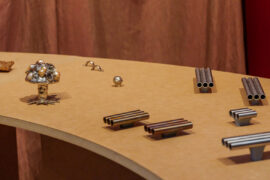
By virtue of his longer career, Grant’s work will make up the bulk of the Grant and Mary Featherston: Design For Life exhibition, starting with his lesser-known jewellery designs and rare handmade furniture items, with Mary’s collaborations joining the timeline later on.
“It’s an exhibition that’s distinct from previous ones that have been run about Featherston because it’s looking at both Grant and Mary, whereas before the focus has typically just been on Grant’s work,” says Kirsty, who is curating the retrospective in collaboration with design historian Dr Denise Whitehouse.
“The other thing that’s going to distinguish this exhibition is that we’ve got access to the Featherston archives, which we’ve been able to access because my co-curator Denise has been working with Mary for the last decade or so. There’s a lot that’s coming from the [National Gallery of Victoria’s] collection, and we’re also borrowing from private collections, so there’s a lot that hasn’t really been seen before.”

One of the more exciting pieces in the exhibition is the Cord Chair, a one-off design that was hand-carved by Grant before his focus shifted towards designs that were more efficiently mass-produced. Moving in chronological order, the exhibition then delves into the ranges that became Featherston’s calling cards, such as the Relaxation and Contour collections. According to Kirsty, one of the items in the latter range was what kickstarted the Featherston success story.
“There’s a very beautiful chair called the R152. It’s really the chair that began the Featherston phenomenon,” she says. “If you look through the Home Beautiful magazines from the 50s, most of the stylish homes have this chair in it. The one we’ve got in our collection comes from the NGV, who bought it in the mid-50s – so, almost immediately after it was created. It’s very rarely – if ever – been sat on, so it’s still got all of its original upholstery. It’s a very rare example of a chair from that period that’s in near perfect condition.
“By the 50s, Featherston was there all the time – which is particularly evident if you look through the magazines from the time. It became a household name and fully embodied style and design at the time – but it’s hard to answer why there’s such a continuing interest in that era, in not only furniture but in architecture and interiors and fashion. I think it’s partly nostalgia, but the younger generation seems equally interested in it. Maybe it’s because it is functional and it is beautiful, which are all of the things that design should be.”
Grant and Mary Featherston: Design For Life will be on exhibition at Heide from June 2018.
INDESIGN is on instagram
Follow @indesignlive
A searchable and comprehensive guide for specifying leading products and their suppliers
Keep up to date with the latest and greatest from our industry BFF's!
The internet never sleeps! Here's the stuff you might have missed