The home of architecture and design in the Asia-Pacific
Get the latest design news direct to your inbox!

Get the latest design news direct to your inbox!
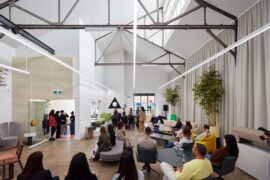
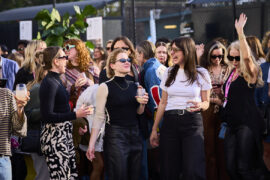
At Herman Miller’s Reach festival we witnessed the far reaches of innovation reach fruition, while also discovering the true depths of our collective disengagement.


“What is innovation?” muses Amanda Stanaway, principal at Woods Bagot and speaker at Herman Miller’s Reach festival on the future of work and workplace design. “There’s everyday innovation and disruptive innovation.” Most organisations, says Stanaway, want everyday innovation – they’re looking to build speed and efficiency into their workforce, processes and systems.
In her 15-minute key note address on innovation, Stanaway spoke of innovation not as a “state of mind” but rather a “white room” in which people are given the proverbial “space” to think, create, prototype, fail and thus, innovate.
A harsh truth of the 21st century, notes Stanaway, is that any process we might imagine being carried out by a machine, will most certainly be. Technology as an innovator is certainly a disruptor.
But it also gives rise to what Stanaway refers to the as the “creative economy”. “Being human and being able to create will be fundamental to us in the future,” she says.
Stanaway was joined by fellow key note speakers and industry figures including Brenton Smith of Bates Smart, Heidi Smith of Gray Puksand and Gavin Harris of Futurespace (to name just three). Each spoke with passion and verve on topics as far ranging as staff engagement, designing an experience, and sector differences defining contemporary workplace design approaches.
In Heidi Smith’s keynote lecture she noted that just 31.9 per cent of workers are engaged at the office. “For every one person disengaged, we have 1.5 engaged,” she elaborated. “Those disengaged staff cost over $54 billion a year.” And while workplace design isn’t wholly responsible for this, it is certainly an important part of the “engagement puzzle”.
Offering a cutting edge solution to the disengagement issue was Forpeople’s Richard Stevens and Joohee Lee, who presented their new Keyn Chair for Herman Miller. A meeting chair that directly addresses what Stevens and Lee refer to as “the boring meeting syndrome”, the Keyn is designed to move and shift with the body.
“Research shows that people move up to 53 times an hour while seated; you only have to watch people in a meeting for a short time to see how much they shift and fidget. So it made sense for us to consider how we enable the chair to move with the user,” they say.
In developing the concept and design of the chair, Forpeople spent a lot of time observing people in meeting spaces. “We [took] Herman Miller’s experience of high performance task chairs and ergonomic understanding, and leveraged that into a group of products for meeting spaces.”
The result is a chair that offers enough seat back flex that you can change your posture and shift around in a really simply way, while still seated. Thus the discomfort of boredom is alleviated by a flexible, malleable seat that offers spinal support. Even better, “the design of the seat back has enough flex to remain in contact with your back as you recline.”
It was a day of revelations and rich engagement among the architecture and design industry. And, with room full of Keyn chairs for visitors to sit in, there wasn’t a ‘bored syndromer’ in sight.
INDESIGN is on instagram
Follow @indesignlive
A searchable and comprehensive guide for specifying leading products and their suppliers
Keep up to date with the latest and greatest from our industry BFF's!
The internet never sleeps! Here's the stuff you might have missed