The home of architecture and design in the Asia-Pacific
Get the latest design news direct to your inbox!

Get the latest design news direct to your inbox!
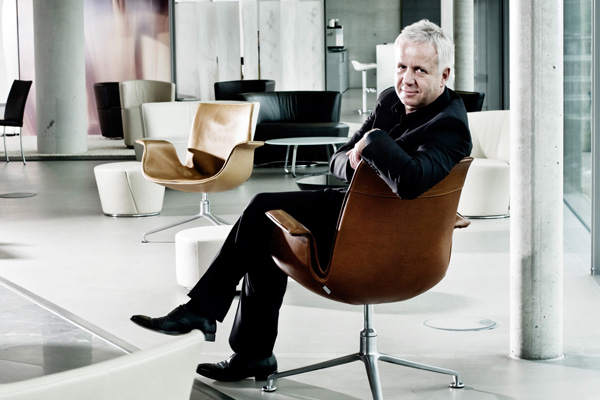
Under the auspices of CEO Markus Benz, German manufacturer Walter Knoll is taking its “living spaces” collections into a new era.
June 3rd, 2013

Having won over ninety leading international design awards in the last fifteen years, Walter Knoll has firmly established itself as a design leader in furnishings and upholstery for the home, executive offices and boardrooms. At this year’s iSalone in Milan, Indesign sat down with Mr Benz to talk about the important place of history, family and friendship in business.
IndesignLive: Can you tell us a bit about the company itself, how it started and what it means?
Markus Benz: The company is almost 150 years old now. In fact, the Knoll family were in fact an important role in the international history of furniture. The Knolls have always been the furniture family of ‘modernity’: initially, the company started as a leather treatment factory, however around 1900 the Knolls started to introduce the first club armchairs in Germany and was appointed “Supplier to the Court” of the King of Württemberg.
In detail, in 1865 Wilhelm Knoll – the grandfather of the Knoll dynasty – actually set up his leather business in Stuttgart, Germany. In 1907 his sons Wilhelm and Walter took over the company and began looking for new forms and functions of seating, especially the development of a club chair concept. It was these pioneering spirits that lead Walter Knoll to the USA in 1921. In 1925 he returned from the USA. Inspired by the culture and the art of the new world, he set up his own company – at the peak of the German Bauhaus period. Walter Knoll in fact supplied furniture to the famous Weißenhof development – the Bauhaus ‘town’ construction in Stuttgart – in 1929. Taking with him over seventy years of family experience, Walter Knoll’s oldest son, Hans Knoll, went to North America in 1938 to sell the Walter Knoll Prodomo range – an innovative furniture concept – and, shortly after, he founded “Knoll International”. After the war Hans Knoll helped his father to set up the production again in Germany. In the following decades the company Walter Knoll shaped the trends of furniture. In 1993 the company was taken over by the Benz’ family and since then has increased its output tenfold. And that’s Walter Knoll’s history – well a very short version of it at least.
IDL: So how did you come to sell furniture in Australia?
MB: In 1994, we got a license agreement in Australia. After that we found dealers; we found people and friends in the design community who believed in us, who were able to develop alongside us and understood our spirit. In 2007, the license agreement ended and we founded the subsidiary Walter Knoll Australia. With this involvement we guaranteed the Walter Knoll quality in product, service and short lead times in Australia.
IDL: Has the current economic situation significantly affected Walter Knoll?
MB: Of course, the current financial situation has affected Walter Knoll. But a company always has to be able to reinvent itself. An answer to difficult times always has two sides to it: one is to control costs and the second is to create performance. As a German company, we are used to creating high productivity under the condition of high labour costs. Furthermore, we invested in a strong product development campaign to create a high performance in the market. For example, we recently introduced the Leadchair – a highly aesthetic executive chair from EOOS. With Foster + Partners we launched a modern club armchair, Foster 520, based on a new upholstery technology. And with the Italian designer Claudio Bellini we created Liz – a delicate chair, both extremely light and extremely comfortable.
IDL: How much emphasis do you put on the relationship between designer and manufacturer?
MB:In the old days, the designers were friends with their manufacturers. And for me, it is still the same. With EOOS we have been working together for 17 years now, with PearsonLloyd for 15 years and with Norman Foster for more than ten years. I believe that our success relates to our capability to create relationships. And these social relationships are based on loyalty, reliability, longevity and respect. Our latest products show the full experience of all the people involved in the design process – designers, engineers and craftsmen. Our aim is to create products that are understood in all cultures, that means: a true value.
IDL: And finally, some word associations…
Dog: Friend.
Celebrity: Nice to talk to, maybe.
Sustainability: Natural interests.
Bad Design: Nightmare.
Culture: Relies on people.
Home: The most intimate place of somebody.
Australia: Adventure.
Milan: Centre of international design and lifestyle.
Design: A task to fulfil.
Mr Benz will be visiting Australia later this year we’ll be bringing you more on events surrounding the Walter Knoll Australia Tour in coming weeks.
Walter Knoll
INDESIGN is on instagram
Follow @indesignlive
A searchable and comprehensive guide for specifying leading products and their suppliers
Keep up to date with the latest and greatest from our industry BFF's!
The internet never sleeps! Here's the stuff you might have missed