The home of architecture and design in the Asia-Pacific
Get the latest design news direct to your inbox!

Get the latest design news direct to your inbox!
On the occasion of its 90th anniversary, Maruni comes round circle – in more ways than one. We speak with the brand’s key visionaries, president Takeshi Yamanaka, art director Naoto Fukasawa, and long-time collaborator Jasper Morrison.

(L-R) Naoto Fukasawa, Maruni's art director. Jasper Morrison, designer and long-time collaborator [Photo by Kento Mori].

Maruni's President, Takeshi Yamanaka.

(L-R) The Fugu chair, designed by Jasper Morrison. The T&O T1 chair.

(L-R) The Roundish Armchair and the Hiroshima Armchair, both designed by Naoto Fukasawa.

May 17th, 2018
The circle, one of nature’s most elemental forms, was a strong recurring theme among furniture designers at the Milan Furniture Fair this year. That’s not to say every furniture or joinery piece was rounded into organic curves. But the shape seemed to be applied, like an insignia, across all manner of chairs and tables.
It was perhaps most prevailing at the Maruni stand in Hall 16-20, where the Japanese furniture brand staged its 90th anniversary. New seating items from designers Naoto Fukasawa and Jasper Morrison orbited beneath two giant discs of light.
The stand was also designed by Fukasawa, who is the art director of Maruni, and has been an instrumental force in elevating the brand into the international marketplace.

A 90th edition of the T&O T1.
That pivotal crossing of paths between Maruni and Fukasawa happened in the early 2000s, says Maruni’s president, Takeshi Yamanaka. The company was still only trading domestically, and looking for a growth path through international expansion. “When we started working with Naoto-san, we had never exported. He was saying, ‘Go to the world’, but at that time, we could not imagine exporting. We did not yet have products [relevant to] an international market,” says Yamanaka.
In 2008 Maruni launched Fukasawa’s Hiroshima Chair, a piece that quickly became recognised as a modern icon. The partnership was cemented in 2010 when Fukasawa was appointed art director. In the years to follow, Maruni would present a series of new pieces, including Fukasawa’s Roundish chair, and the Lightwood collection by Jasper Morrison. Each helping to establish the Japanese design vernacular within a global community of hungry design consumers.
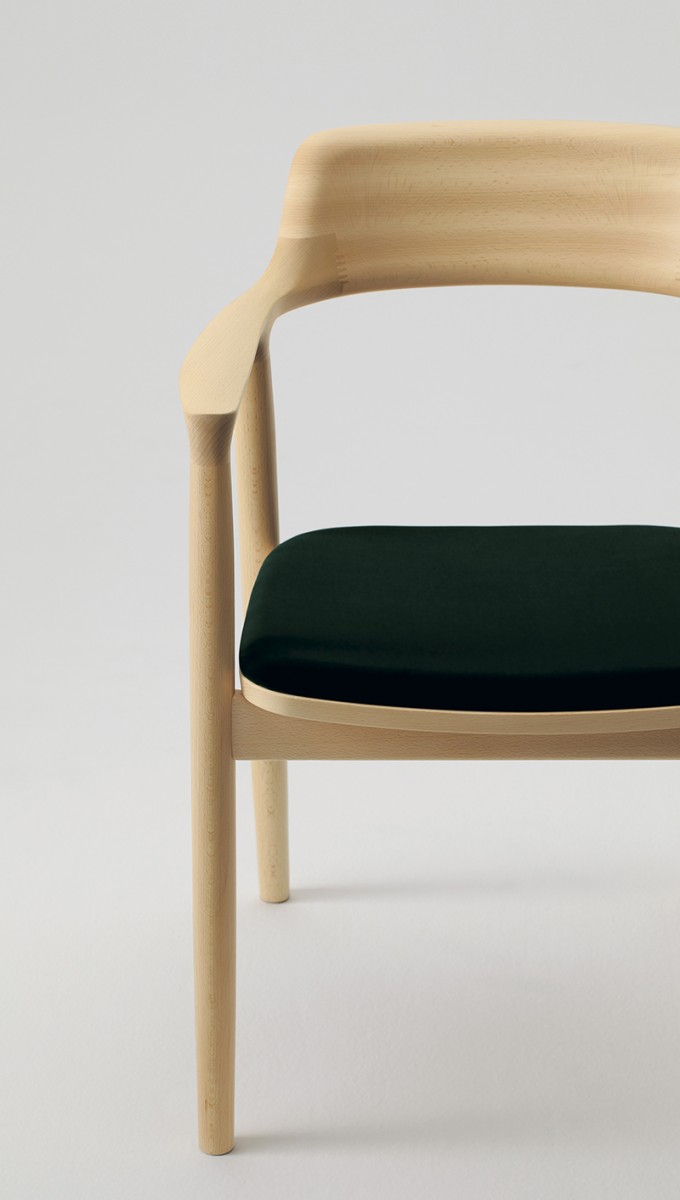
The iconic Hiroshima chair designed by Naoto Fukasawa was released with a special edition to celebrate the brands 90th.
Both Fukasawa and long-time collaborator, Morrison, take a ‘super-normal’ approach to their furniture design practice. Through their ongoing collaborations with Maruni, they have used its expertise in wood manufacture to explore the material’s essential qualities of beauty and comfort, in ever more complex ways. The outcome is always exceedingly simple, yet striking.
Marking number 90, Fukasawa has embarked on a particularly challenging project with Maruni, adapting the Roundish into a steam-bent armchair. Holding up a piece of paper, Fukasawa demonstrates how a single two-dimensional plywood cut-out has been molded into a three-dimensional ‘cup’ that rounds itself around the body, to hold and support.
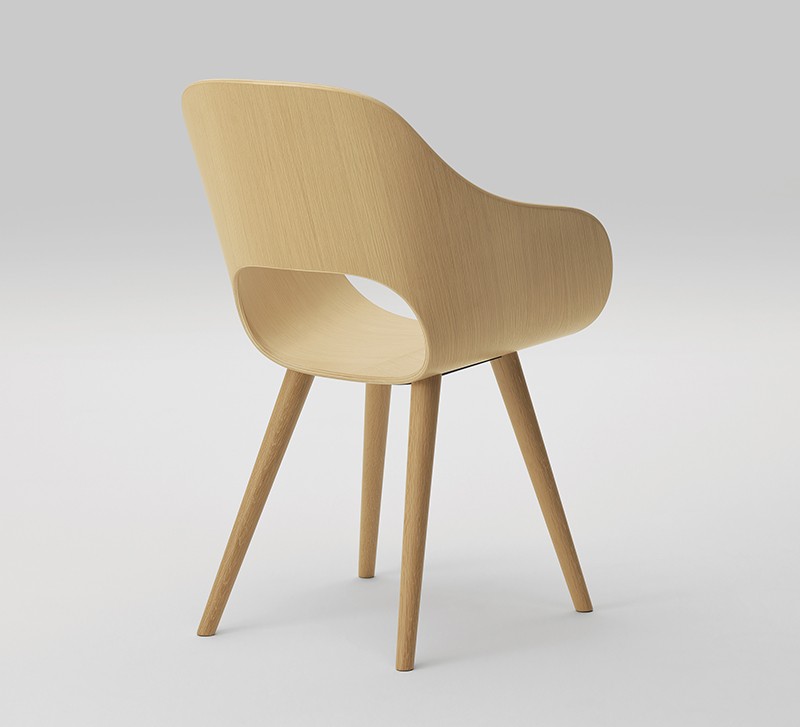
The Roundish by Naoto Fukasawa has been released as an armchair.
The rounded hole at the centre allows for the seemingly simple shape to achieve what is a complex curvature.
Complementing this is Morrison’s Fugu easy chair. “It’s a solid wood chair, which is something Maruni is perfect for making,” he says. “The goal was to make a chair comfortable enough not to need any upholstery. Just sit back, find a curve and settle in.” The intention there being: “Curves and angles can make a wooden chair very comfortable.”

The Fugu chair designed by Jasper Morrison.
With so many modern icons filling its collection, where does the future lie? Yamanka brings it back to the material and making process: “Our factory [in Japan] is located in a very [quiet, local] area, but I want to make it the mecca for wood lovers and wood manufacturers. If you ask which manufacturer is making the most beautiful [wood] furniture, I hope someone will answer, ‘Oh, that’s the Maruni company.’”
Maruni is available through SeehoSu.
Take a look at a recent project by Naoto Fukasawa for Issey Miyake.
–
Want more stories like this straight to your inbox? Sign up for our newsletter.
INDESIGN is on instagram
Follow @indesignlive
A searchable and comprehensive guide for specifying leading products and their suppliers
Keep up to date with the latest and greatest from our industry BFF's!
The internet never sleeps! Here's the stuff you might have missed