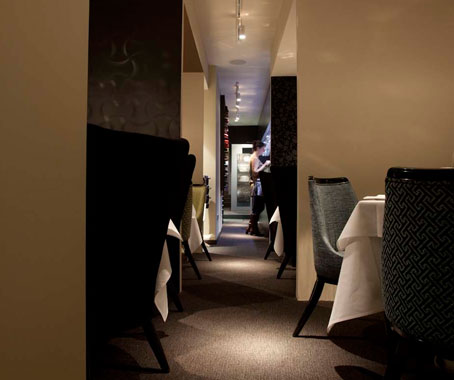
The 2009 Corian® Design Award for Edition 2 commercial category has been awarded to Amy Lanham and Nettleton Tribe Architects for their design of the Santos House refurbishment in Brisbane, Queensland. The award organisers said: “The design objective for this project was to enlighten the space through the considered use of materials and finishes. A […]
October 26th, 2009
The 2009 Corian® Design Award for Edition 2 commercial category has been awarded to Amy Lanham and Nettleton Tribe Architects for their design of the Santos House refurbishment in Brisbane, Queensland.
The award organisers said:
“The design objective for this project was to enlighten the space through the considered use of materials and finishes. A sleek, geometric design was explored to target a corporate inner city market. Organic shaped motifs were introduced to balance and compliment the overall design.
“An important design requirement was the use and consideration of the existing finishes including the glass re-enforced concrete cladding. Glazing patch fittings were used to align the new glass and Corian® walls precisely amongst the existing structure and cladding elements for a seamless integration.
“A mix of vision and obscure glazing combined with Corian® Glacier White enabled Nettleton Tribe to balance the privacy demands of the new tenancy spaces.”
Congratulations to Nettleton Tribe Architects on the win. Click here to enter Edition 4, now open.
INDESIGN is on instagram
Follow @indesignlive
A searchable and comprehensive guide for specifying leading products and their suppliers
Keep up to date with the latest and greatest from our industry BFF's!
In the first instalment of our three-part series exploring what it means to sit your best, we pose the question to Gray Puksand’s Dale O’Brien, who discusses the importance of ease and majority rule when it comes to sitting and reveals why specifying a task chair is not unlike choosing a Volvo.
In the last instalment of our three-part performance seating series, Alex Bain from Architectus explains why sitting well shouldn’t feel like sitting at all and explores an unexpected success metric of the hybrid workplace: the grounding power of emotional support.
Stepping into Intuit’s Sydney workplace certainly doesn’t feel like walking into an office. Why? In this film, we discover that, when joy takes precedence as a design driver, even a high-performing commercial CBD headquarters can feel like an intuitive wonderland that invites employees to choose their own adventure.
In the second instalment of our performance seating three-parter, we turn to DKO’s Michael Drescher and Jacob Olsen to peek behind Sayl’s confident architectural form and explore the ideas of inclusivity, adaptability and freedom to move as hallmarks of what sitting your best actually means.
A new addition to the Dropp series this chair is available in one, two or three seater models.
Recalling the warehouses of yesteryear and reflecting the label’s own sense of restraint, Henne’s new retail outlet is turning heads in Melbourne.
With design at its heart, King is finding ways to merge traditional knowledge and experience with future technological trends. In this video, we meet Manolo Bossi and the in-house design team in Sydney to find out how they work.
The Australian Institute of Architects (AIA) have announced the appointment of two new State Government Architects for Tasmania and Western Australia, but continue to apply pressure for roles in other states. The AIA SA Chapter President, Tim Horton, is concerned his state will fail to capitalise on the Federal Government’s infrastructure programs without the appointment […]
The internet never sleeps! Here's the stuff you might have missed

Designed by JPE Design Studio with Warren and Mahoney and cultural creative designer Karl Winda Telfer, Adelaide Aquatic Centre — Kauwingka — recasts civic leisure as landscape, gathering place and cultural story.
Scheduled to open later this year on the banks of the Parramatta River, the 30,000-square-metre Powerhouse museum — designed by Moreau Kusunoki in collaboration with Genton — represents a major shift in the geography of Sydney’s cultural infrastructure.