The home of architecture and design in the Asia-Pacific
Get the latest design news direct to your inbox!

Get the latest design news direct to your inbox!
What do classic designs bring to our lives? A special collectors’ edition of the PH 3½-3 lamp shows the cultural value of design quality, relevance and human resonance.

December 7th, 2017
It takes time for a design to take on ‘classic’ status, but when it does, the thing that disappears from our thoughts is a sense of time. A classic design seems up-to-date, relevant and valuable regardless of the era in which it’s experienced. It offers an enduring expression and becomes a cultural artefact – far surpassing the more simplistic status of a product for consumption.
Classic designs are a statement of the essence of things, exhibiting a design language that can be immediately understood across cultures. Their recognisable and readable character comes from their authenticity; function and design language are perfectly paired.
For the ideal example of the mastery at the heart of classic designs, you need look no further than Poul Henningsen – the Danish designer behind many of Louis Poulsen’s best known lights. The PH Artichoke, for example, needs no introduction; its layered, radiating leaves of copper or stainless steel create a thoroughly unique lighting form and an atmospheric, diffused lighting environment.
And equally recognisable and loved is Henningsen’s expansive collection of PH pendants – the descendants of his ground-breaking glare-free three-shade system that grew from his desire to tame the glare of the electric light bulb. The family of PH lamps embodies Henningsen’s scientific approach to light, where the spiral of the nautilus lamp or Mandelbrot set informed the curvature of a series of shades that direct reflected light (but not glare) downwards. These days it’s hard to believe that the three-shade system was designed all the way back in 1926.
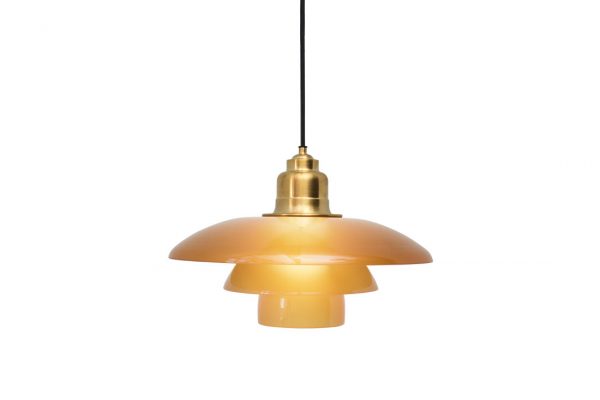
Later in the 1920s, special editions of the PH were released with delightful coloured glass shades. Louis Poulsen also experimented with warm-toned brass suspension systems at the time, and one of the particularly striking combinations was that of brass with amber-coloured glass for the shades. It was 1927 when that winning combination was first unveiled. But now, in 2017, it is available once more for a limited period of time.
Every lamp is made by hand, so each one bears the uniquely rich marks of variances in material and technique. When lit, this special limited edition PH 3½-3 emits a cosy warm glow. When unlit, the glossy glass surface mirrors the surrounds to embed the lamp in its context. It’s a rare addition to Louis Poulsen’s current spectrum of opal glass, aluminium and stainless steel shades – an old, but new, take on a classic design and a product to be treasured.
INDESIGN is on instagram
Follow @indesignlive
A searchable and comprehensive guide for specifying leading products and their suppliers
Keep up to date with the latest and greatest from our industry BFF's!
The internet never sleeps! Here's the stuff you might have missed