The home of architecture and design in the Asia-Pacific
Get the latest design news direct to your inbox!

Get the latest design news direct to your inbox!
For luxury hotel The Murray, Foster + Partners breathe life into a conserved building whose magnificent architecture provides the starting point for both intimate and public engagement.

Photo by Michael Weber
July 6th, 2018
Hong Kong’s hospitality industry has a new icon in the form of The Murray. After housing government offices for the past 40 years, the 25-storey listed building has been transformed by Foster + Partners into a luxury 360-room hotel operated by Wharf Hotels’ Niccolo brand.
The building’s distinctive architecture has a base comprising four-storey-high arches intersected by a podium and vehicle ramp, which had previously cut off the building from its surroundings. The redesign appropriates these elements by stitching them back to the urban fabric, linking with large green spaces flanking the site to the east and west.
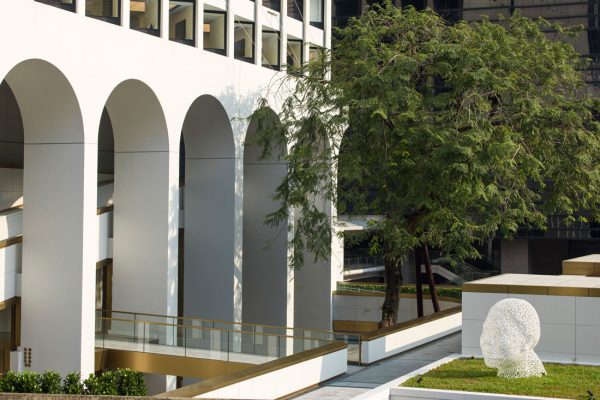
Photo by Michael Weber
“One of the most interesting challenges with The Murray was to give new meaning to the car access ramp… We felt it would be more appropriate to create an entrance sequence that’s pedestrian friendly and integrate the building closely with its surroundings,” says Colin Ward, Senior Partner at Foster + Partners.
The ramp now forms a continuous loop around the building, functioning as a unique entertainment and common space. A former car park at the lower level is now the new porte-cochère beneath the dynamic swirls of the ramp. A preserved century-old cotton tree in the forecourt rises through a void in the parking slab of the podium as an arrival centrepiece. From here, guests pass through the grand arches and an elegant staircase takes them to the Garden Level containing a lounge and restaurant. Capping the public experience is a rooftop bar offering panoramic views.
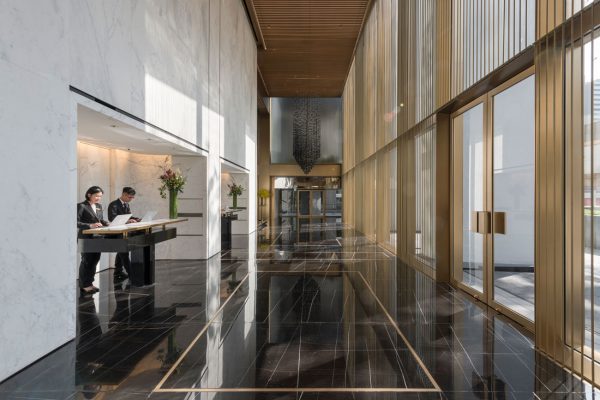
Reception desk
“Our design intent for The Murray has been to rediscover the romance of going into a hotel,” says Ward on the carefully crafted arrival sequence. “Most new-build city hotels nowadays are relatively anonymous. However, the 1970s building by Ron Philips and his team at the Architectural Services Department gives The Murray a unique sense of character,” he adds, highlighting how the redesign places the architecture at the forefront.
Within, a tempered yet sophisticated material palette of black-and-white marble flooring, polished metals, brass stainless steel and handmade glass complements the building’s elegance. “The concept was to showcase the inherent beauty of the materials – there are no applied finishes such as paint; all the materials are expressed honestly and come together to redefine luxury,” says Ward.
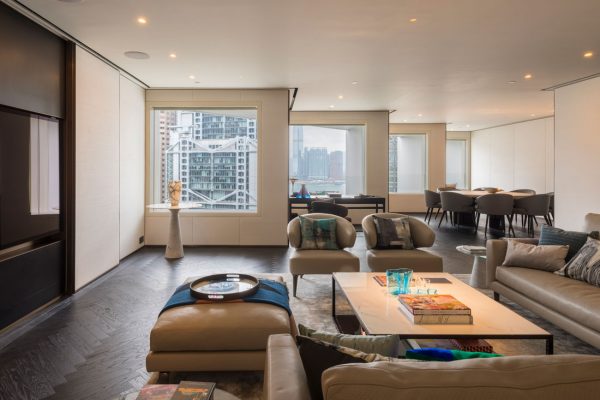
Penthouse Suite
Upstairs, guest rooms are planned to work with the distinct geometry of the existing building. The recessed, angled square windows, originally designed to avoid Hong Kong’s harsh sunlight, provide a modular unit and organising principle for the rooms; larger rooms incorporate more bays. “The windows at The Murray frame views like paintings, giving guests a unique, contemporary space to sit and read a book, chat or work,” describes Ward. Wallpaper with an abstracted motif of the architecture’s arches is one example of subtle bespoke detailing.
In Hong Kong’s dense urban jungle of glass towers, an architectural jewel like The Murray is rare. Foster + Partners’ delicate and egalitarian design returns integrity not only to the building but also its relationship with the urban realm.
Photography by Nigel Young / Foster + Partners unless otherwise stated.
INDESIGN is on instagram
Follow @indesignlive
A searchable and comprehensive guide for specifying leading products and their suppliers
Keep up to date with the latest and greatest from our industry BFF's!
The internet never sleeps! Here's the stuff you might have missed