The home of architecture and design in the Asia-Pacific
Get the latest design news direct to your inbox!

Get the latest design news direct to your inbox!
The Lim House’s unique scalene triangular site inspired HCFA Architects to create a symphony of three parts guided by strong geometrical principles.

May 16th, 2018
The Lim House by HCF & Associates is an interesting response to the demands of fitting a three-generational family and long-staying guests into an unusual scalene triangular-shaped site. Rather than a ubiquitous homogeneous volume, the firm’s founder Fong Hoo Cheong has composed a building comprising three parts, articulated clearly in both the architecture and interior programming, and guided by a play of vertical and horizontal elements.
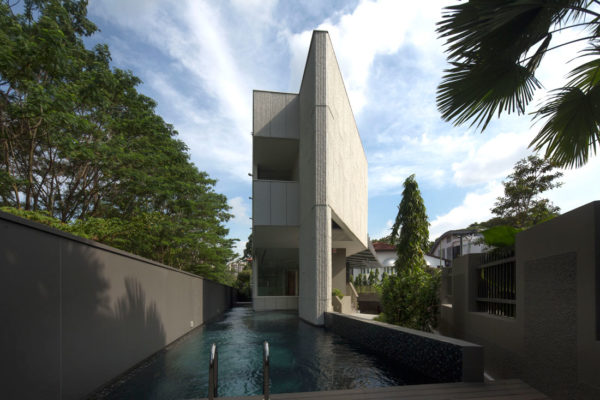
Fong points out the site’s location abutting the verdant Rail Corridor as one guiding factor for the parti. “It is this thin sliver of land attached to a larger centre of gravity of mass to the south that suggested a clear division of the vertical and the horizontal.” Additionally, the long edge of the scalene triangle facing east and the other two sides facing west and a cul de sac determined how the architecture should react so as to provide privacy and climatic comfort for the occupants.
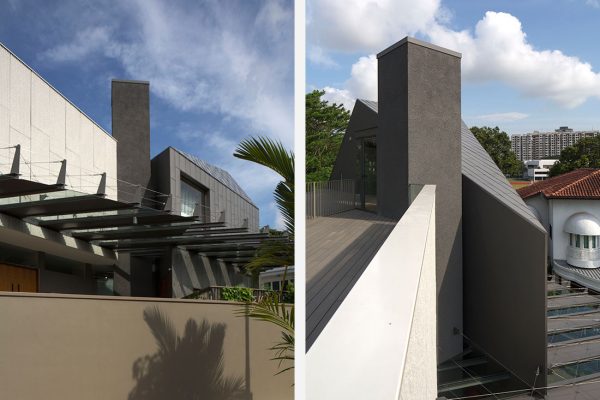
The first part of the composition is a two-room-thick vertical block rising from the basement to the attic, covered in blackened steel and capped with a steeply pitched roof. “This block suggests most clearly the archetypical pitch roof ‘house’ form, yet the use of a counterpoint ridge that creates a prism of parallelogram faces suggest that it is not a monopoly, token-like house icon. Something else is going on inside,” Fong highlights.
What happens inside is a show of spatial gymnastics involving void and space, light and shadow, centred around two atriums. One rises 11 metres above the dining room to the roof’s soffit, defined by a sculptural steel staircase wrapped in parallel slats that provides visual drama while screening off the western sunlight from a window. Inspired by the solar effects, walls here are coloured in a shade of the reflected light and rooms are finished in warm wood.
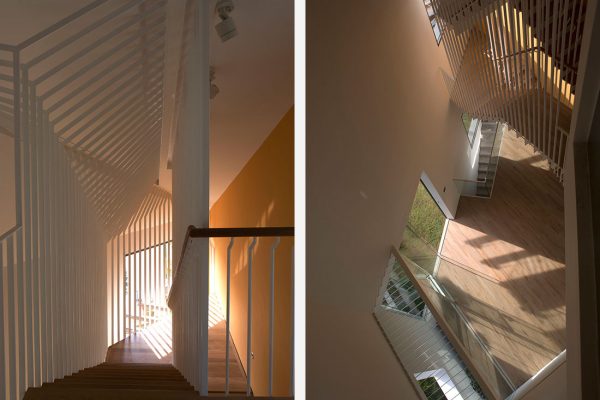
The other atrium introduces light into the basement from the first storey and basement views to the trees in the Rail Corridor. Both atriums are well ventilated, with the former acting as a vertical stack by rising to the attic and opening out to the roof terrace.
The second part of the architectural composition hovers over the site’s length horizontally, adjoining the pool. Clad in ribbed lightweight concrete panels, it contains the living room on the first storey and master bedroom above. The only openings in this block are ribbon windows facing the pool toward the east to avoid the western sun and the open road on the other side.
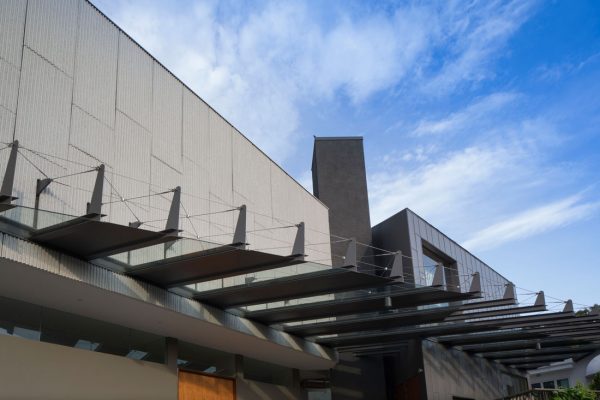
A vertical lift shaft and horizontal car porch canopy are the “hinge” elements binding the first and second block. Centrally located, these “operate in counterpoint”, says Fong. “The lift shaft is closed and solid as the canopy is a filigree of complexity consisting of stainless steel cables, galvanised steel horizontal ribs, glass and aluminium panels,” he describes.
These, together with the ribbed concrete and metal roof shingle pulled from the roof all fall within a tightly controlled underlying number order and geometrical dictum, he elaborates. “This order gives to the entire composition clarity within complexity…in essence, the geometry becomes the generating force, ordering the parts in concert with the needs of the client.”
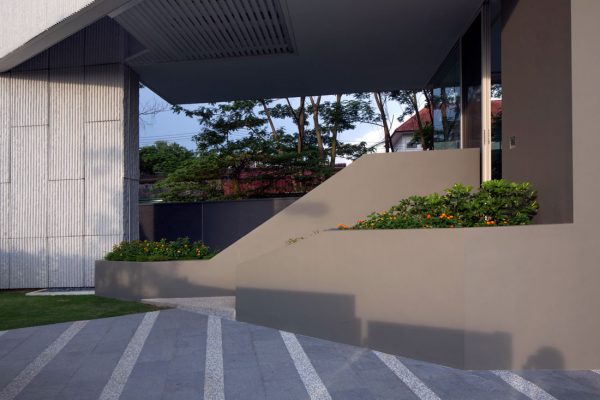
This project adds to the firms’ research on houses, as a typology that, though familiar, presents many opportunities for experimentation in order to encourage occupants to fully engage with both the house and site.
INDESIGN is on instagram
Follow @indesignlive
A searchable and comprehensive guide for specifying leading products and their suppliers
Keep up to date with the latest and greatest from our industry BFF's!
The internet never sleeps! Here's the stuff you might have missed