The home of architecture and design in the Asia-Pacific
Get the latest design news direct to your inbox!

Get the latest design news direct to your inbox!
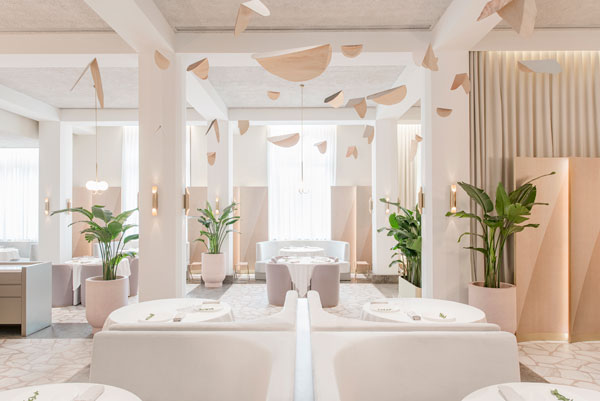
Odette, a newly opened French fine dining restaurant, celebrates a deep-seated food philosophy with delectable interiors informed by a restrained palette and an aerial art installation. Stephanie Peh writes.
December 3rd, 2015
Photography: Jovian Lim (Courtesy of Universal Design Studio)
One of nine F&B establishments to open at the National Gallery, Odette is the latest venture by The Lo & Behold Group. It is co-owned by chef Julian Royer, former head chef at Jaan at Swissotel, The Stamford. Since its opening in November, the fine dining restaurant has been widely praised in its entirety, from food to dining experience. At the heart of the Odette experience is Royer’s love for food and deep-seated respect for ingredients, where ideas were drawn to guide the design process.
Designed by London-based Universal Design Studio, the project was led by London-based, Singaporean designer Sacha Leong, who is a lead designer at the firm. Leong read architecture at Carnegie Mellon University and Bartlett School of Architecture, University College London. Before relocating to London, he worked at esteemed local architecture firm, WOHA.
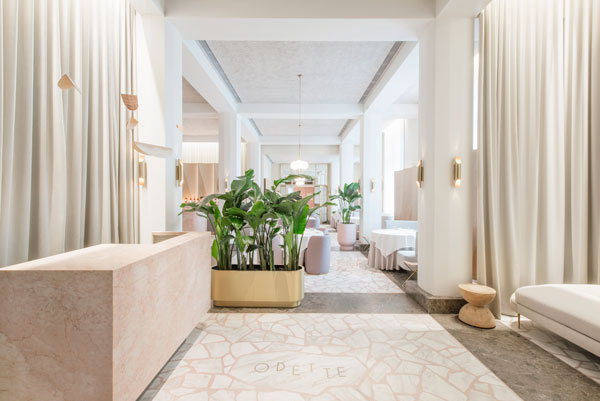
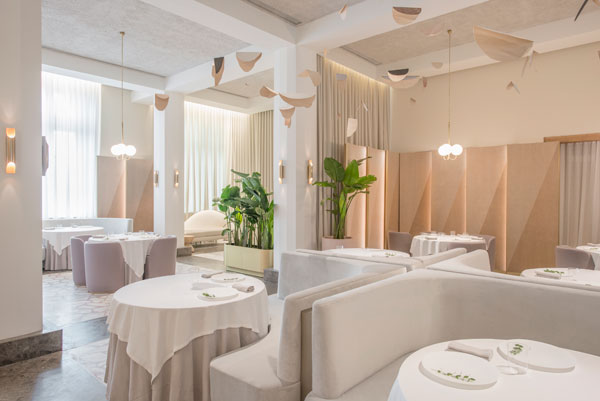
Much like how Odette was named after Royer’s grandmother, Leong drew inspiration from the chef’s love for pure flavours and refined methods. Carefully orchestrating a palette of materials, including fabric, natural timber, pink terrazzo marble with nickel and brass accents, Leong conveyed a restrained aesthetic that is attuned to Royer’s food philosophy.
The pastel colour scheme lends an enriching and non-invasive backdrop to the dining experience. Enhanced by natural lighting, the scheme is a fresh take on conventional fine dining restaurants, which often adhere to a rigid palette of dark colours.

Located within the registration room of the former Supreme Court, Leong was also drawn to the inherited features of the historical site – a lofty ceiling and large windows. Perceiving these characteristics as assets, he looked towards other original elements of the building for inspiration. Faceted columns and Palladiana marble floors that make up Odette reference original Corinthian columns and the age-old flooring found in other parts of the gallery.
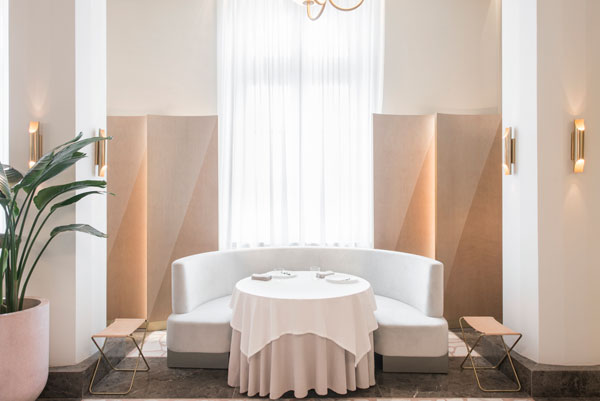
With a total of 12 tables, Odette sits approximately 48 guests. Each main seating booth was designed to cater to two to four, where guests are thoughtfully positioned to enjoy intimate seatings, while facing the grand view of the restaurant and its activities. A full-height glass-encased kitchen enables diners to witness the chefs at work.

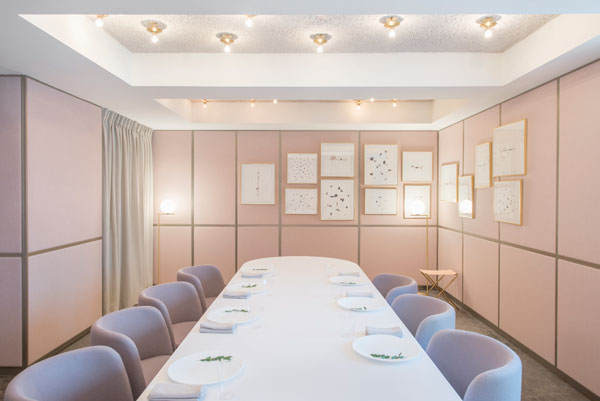
Booths aside, a private dining room holds up to 12, while the cooking enthusiast may reserve a table for up to four in the kitchen.
At the heart of the space is a mobile art installation titled “A Theory of Everything” (also featured in branding collateral). Crafted specifically for the restaurant by local artist Dawn Ng, the ceiling piece purposefully compiles mood boards gathered from Royer’s kitchen. Ng had spent eight months with Royer in the kitchen, carefully documenting, through abstract photographs, Royer’s research, processes and ingredients.
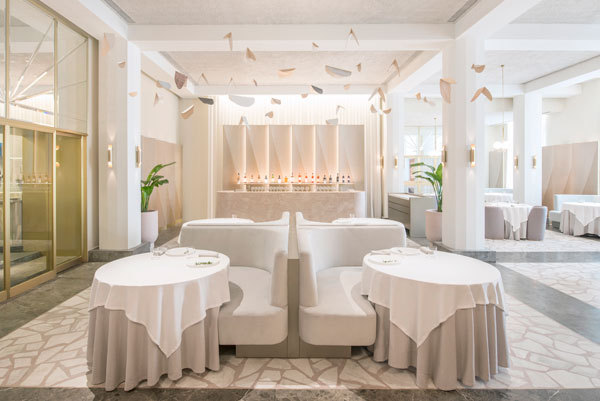
The images were treated and produced onto archival paper, before being attached to thin oak panels. These were then folded into organic shapes and held suspended from the ceiling.
Keeping the overall language consistent, Leong had picked up the colour palette of the restaurant (skin, blush and dust) from the mood board crafted by Ng.

Odette celebrates food with a fine dining experience that complements the chef’s philosophy seamlessly. This is the result of a collaborative process between the chef, designer and artist – and is what makes this restaurant a fitting addition to the national monument.
Universal Design Studio
universaldesignstudio.com
INDESIGN is on instagram
Follow @indesignlive
A searchable and comprehensive guide for specifying leading products and their suppliers
Keep up to date with the latest and greatest from our industry BFF's!
The internet never sleeps! Here's the stuff you might have missed