Housed within a 1960s building that has been recently refurbished by Stanton Williams, Tingatel House in London is the new home for The Office Group‘s flexible, co-working space, which features interiors by Universal Design Studio.

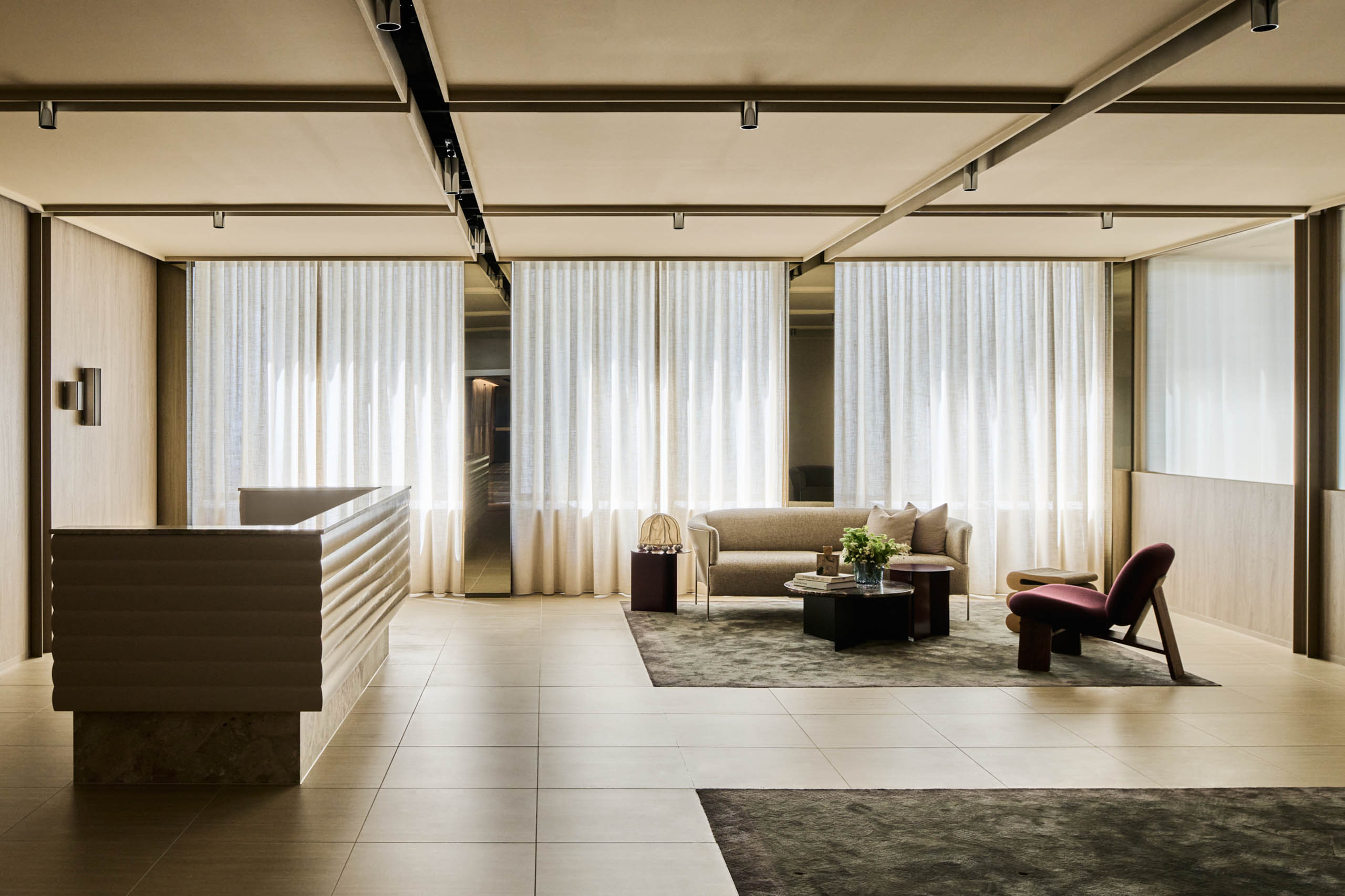
The waiting area at Tingatel House.
Founded by Edward Barber and Jay Osgerby of industrial design studio Barber Osgerby, Universal Design Studio has brought its deft design touch to the interiors.
The building was previously occupied by London’s Metropolitan Police and is located in a thriving central area of London. Tingatel House is seen as a new hub for entrepreneurs and independent businesses.

Stanton Williams has transformed the existing 12-storey building into a flexible office setting, designed to cater for a variety of work styles. Taking a sustainable approach, the project has expanded and improved the existing office accommodation with the creation of spacious communal areas in the new extension at ground and first floor levels, in addition to the conversion of the panoramic top floor.
Larger floorplates have allowed for more open plan and flexible layouts, which can easily be adapted or reconfigured down the track.

Universal Design Studio took inspiration for the fit-out from Tingatel House’s previous life as the Met Police building. This is most apparent in the subtle references to archival material from the building in the 1960s, which is then juxtaposed with its new uses today.
The former home of the first police computer – an ICT 1301 mainframe installed in the 1960s – the design for key new spaces within Tintagel House reference these state-of-the-art data processing technologies of the era with a strong graphic quality using materials such as brushed stainless steel, terrazzo and block colours, contrasted against contemporary fittings.

Terrazzo and brushed aluminium surfaces are a references to the building’s history.
Given the range of uses required throughout the space, the interior programming follows with a variety of spaces to accommodate. The design includes both private and open options, as well as meeting, break-out and hospitality spaces. Especially considered secluded and quiet corners ensures focus work can be carried out, alongside the more social and public areas.
In addition to a members’ bar, café, gym, workshop space, a central ‘forum’ for events and executive suite on the top floor, Universal has also designed a Secret Room within Tintagel House, a speakeasy-style member’s only space concealed behind a cleaner’s cupboard door entrance.

Tingatel House will be a beacon for refined design in a growing age of co-working, backed up by a demand of some 17,000 nomadic workers in the surrounding area.
Photography by Charles Hosea.
Check out another outstanding co-working space, The Working Capitol designed by HASSELL.
–
Get more design inspiration, sign up for our newsletter.