The home of architecture and design in the Asia-Pacific
Get the latest design news direct to your inbox!

Get the latest design news direct to your inbox!
Herman Miller’s design festival wrapped up on 15 September, after an impressive five-city tour. Tamsin Bradshaw looks back on the event, presenting a snapshot of what the pros had to say about developments in workspace design.

October 11th, 2016
Between 24 June and 15 September 2016, REACH visited five cities across the Asia-Pacific, bringing together experts and industry stakeholders for an insightful look at the future of workspace design, and how it can impact on employee happiness, sense of community, inspiration and productivity.
Herman Miller hosted the design festival in each of the five cities – namely, Beijing, Manila, Bangalore, Tokyo and Melbourne. Each event featured speakers, networking opportunities, and the ability to experience firsthand new products and services from Herman Miller, POSH, and Herman Miller’s partners. We spotlight five speakers, one from each of the events.
REACH Beijing: Ray Yuen, Woods Bagot
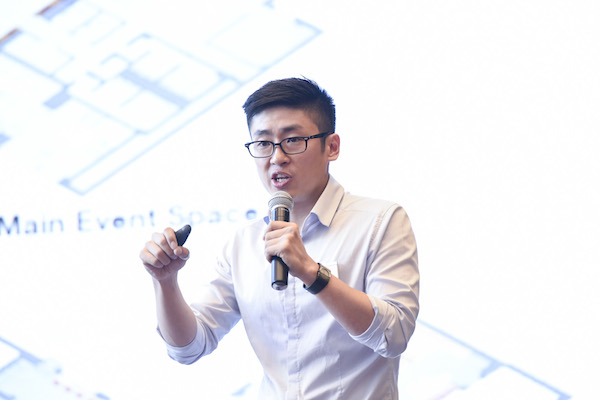
Ray Yuen speaking at REACH Beijing
On 24 June, the Woods Bagot Principal talked to the crowds in Beijing about our concept of work as a whole, and how work is “what we do; it’s not where we go.”
Yuen has spent 15 years creating offices spaces for brands like Tencent, Hewlett Packard and Bank of America Merrill Lynch, along with hospitality and retail space.
According to Yuen, “this idea of workplace being a place in which to produce work will disappear. Technology will continue to advance rapidly and it will eventually delete the need to physically go to an office to work. The concept of the workplace will then change to a place to share, learn and also to represent an individual’s beliefs or values. In the future, when you ask someone where they work, it will be like asking, ‘Which church do you go to?’”
REACH Manila: Richard Stevens, forpeople

forpeople’s Richard Stevens at REACH Manila
Next stop on the tour was Manila on 21 July. Here, forpeople’s Richard Stevens talked about the Keyn group of chairs his design studio recently worked on for Herman Miller.
These meeting and guest chairs feature special CradleFlex technology developed by the London-based design studio, in response to research suggesting that people move up to 53 times per hour when sitting down.
“The flex allows people to change their posture in a really simple way while seated, by enabling the seat shell to open up around 10 degrees,” says Stevens.
“It’s well established that there is a direct correlation between posture and productivity,” continues Stevens. “Therefore, it’s key to address postural wellbeing whilst considering technological influences and environmental shifts, through the design of products that enable and encourage people to move and adjust their posture and space throughout their day-to-day.”
REACH Bangalore: Steve Frykholm

Steve Frykholm speaking at REACH Bangalore
At REACH Bangalore on 28 July, Steve Frykholm offered the audience a behind-the-scenes look at life at Herman Miller. With more than four decades of working at the global furniture company, the Vice-President of Creative Design knows more than most about the brand’s history. He has worked on award-winning posters for Herman Miller, along with annual reports, and an in-house magazine, among other things.
“I was lucky to be involved in SEE, the potential of place [now SEE: the Potential of Space],” says Frykholm. “It was a magazine designed by Todd Richards, a thoughtful, creative, and independent designer. He introduced us to many new illustrators and photographers, who gave the publication energy and excitement.”
REACH Tokyo: Taiju Yamashita, DRAFT, Inc.
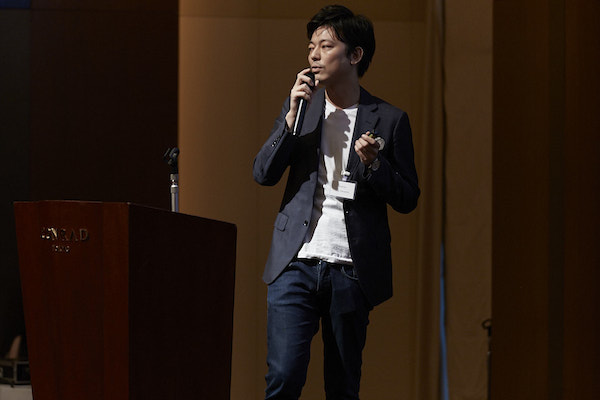
Taiju Yamashita at REACH Tokyo
Meanwhile, at REACH Tokyo on 4 August, Taiju Yamashita of DRAFT, Inc. was among the designers who weighed in about directions for workspace design in Japan and beyond. Speaking about employee engagement, Yamashita emphasised the importance of communication and collaboration in the modern office, in order to drive productivity and get results.
“A layout that allows various types of communication is important,” he says. “It’s becoming mainstream to divide spaces according to the content and purpose of the meeting. More specifically, various ways of promoting communication are being proposed that cannot be found in conventional conference rooms, such as box seats used in diners or round tables, which allow more than 10 participants to exchange ideas without worrying about seating arrangements.”
REACH Melbourne: Dr. Agustin Chevez, Hassell
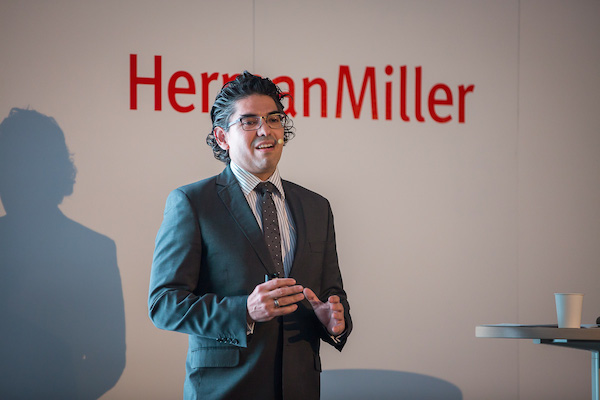
Dr. Agustin Chevez at REACH Melbourne
Wrapping up REACH 2016 was the Melbourne event on 15 September. Hassell’s Dr. Agustin Chevez was one of the speakers, talking about his own methodology, RAW, or Responsible Agile Workplace.
“RAW is based on the principle that organisations exist in an environment of change due to shifts in demographics, business structure, economic climate, technology and a variety of other circumstances that can challenge the design of the workplace,” explains Chevez, who has a PhD in workplace architecture, and who is also an adjunct research fellow at Swinburne University.
Like many of his fellows speaking at the various REACH events, Chevez has plenty to say about what work and the office will look like in the future. “As cognitive computing continues to evolve, the jobs left to us will be those that depend on the intrinsic characteristics of what it means to be human,” says Chevez. “It’s possible that the office of the future will be alien to us in its activities – in terms of what is considered work – as well as in terms of the space hosting it. But it might not be alien to us in the sense that it could be more reflective of the human nature that imbues and inhabits it.”
INDESIGN is on instagram
Follow @indesignlive
A searchable and comprehensive guide for specifying leading products and their suppliers
Keep up to date with the latest and greatest from our industry BFF's!
The internet never sleeps! Here's the stuff you might have missed