The home of architecture and design in the Asia-Pacific
Get the latest design news direct to your inbox!

Get the latest design news direct to your inbox!
Presented by Ikkan Art International, Moving Light, Roving Sight explores art through the medium of digital technology. Luo Jingmei reviews the exhibition and hears from art collective teamLab’s founder Toshiyuki Inoko about this dynamic art genre.

January 27th, 2015
Top image: ‘Flowers and People, Cannot be Controlled but Live Together – Dark (2015)’ by teamLab
Stepping into teamLab’s interactive installation ‘Flowers and People, Cannot be Controlled but Live Together – Dark’ is like wandering through a pixelated dreamscape: flowers bloom across the floor and walls, slowly, magically. At points, they wither, their petals floating across the three-dimensional canvas, and fade away into the darkness as viewers step across the digital field.
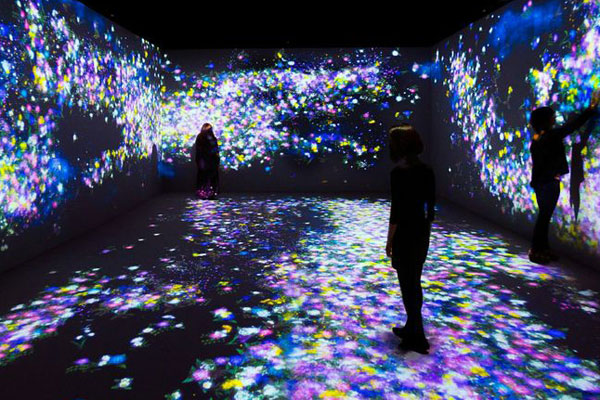 ‘Flowers and People, Cannot be Controlled but Live Together – Dark (2015)’ by teamLab
This is but one of nine artworks presented by Ikkan Art International from 22 January to 18 February 2015. The title “Moving Light, Roving Sight” appropriately describes the dynamism of the artworks that involve the use of digital technology. The variety of interactive mediums – digital installations, video, new media and sound works – allow for alternative avenues of art expression, and subsequently for the viewer, new and more intimate ways of interacting with and appreciating art.
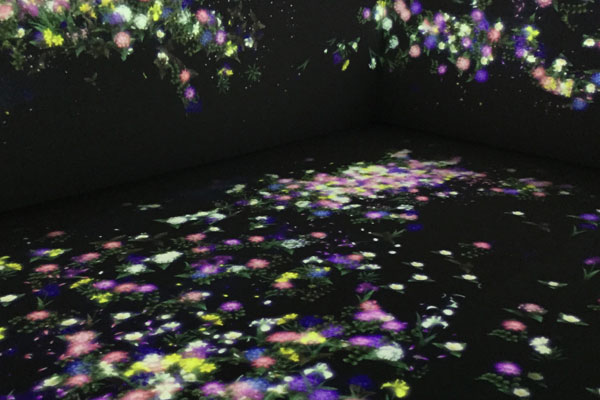
‘Flowers and People, Cannot be Controlled but Live Together – Dark (2015)’ by teamLab
Japanese art collective invisible designs lab’s ‘TIMECORD (CARNIVAROUS ROBOT eats SOUNDS and NOTES, 2015)’ is a visual and aural spectacle activated by a turntable, with a concept of condensing “the long history and activity of the universe, earth and mankind into a single track”. In contrast, South Korean artist Haegue Yang’s ‘Jewel-Wish Table Light (2010)’ is a quiet light sculpture of paraphernalia that blurs the boundary between art and everyday functionality.
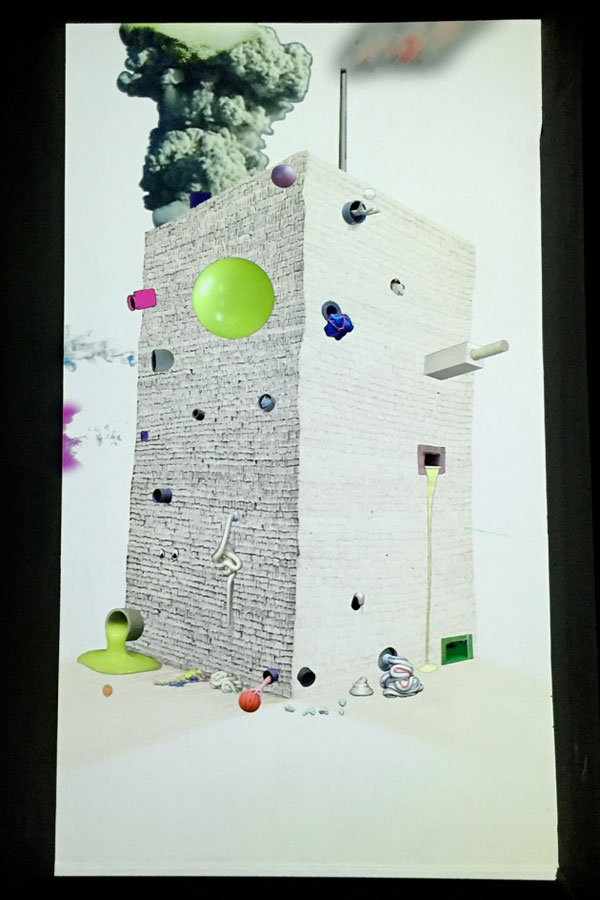
‘Tower (2009)’ by Teppei Kaneuji
In terms of video work, Teppei Kaneuji’s ‘Tower (2009)’, an animated microcosm of a building or cities that “re-envisions architecture as an organic phenomena”, and Oliver Herring’s experimental ‘Video Sketches 1-4 (1998)’ stop-motion video featuring the artist in various mise-en-scène, offer more quirky expressions of everyday topics in a manner that touches on the absurd.
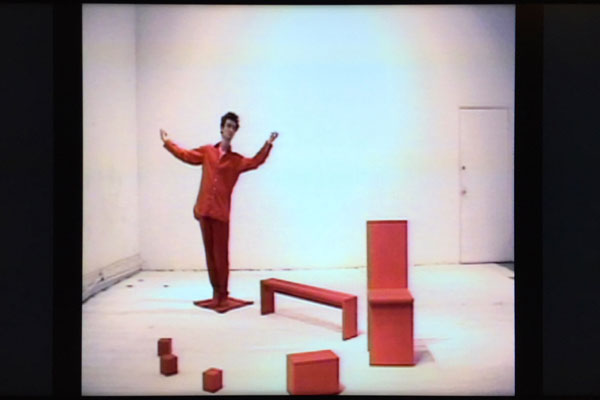
‘Video Sketches 1-4 (1998)’ by Oliver Herring
The other works comprise Jenny Holzer’s ‘Truisms (selections from 1977-79)’, a projection showcasing 232 of her famed one-liners written during her time as a student at the New York City’s Whitney Independent Study Program, Naoko Tosa’s atmospheric ‘Organic Geometry (2015)’ digital painting that uses non-figurative materials to create unique shapes though sound vibrations, Takashi Ishida’s cryptic ‘Burning Chair (2013)’ video created by shooting one frame at a time to produce a ‘moving image’ of drawing animation, and Douglas Gordon’s ‘Kissing with Scopolamine (1994)’ self-portraiture using a 35mm slide projection in negative.
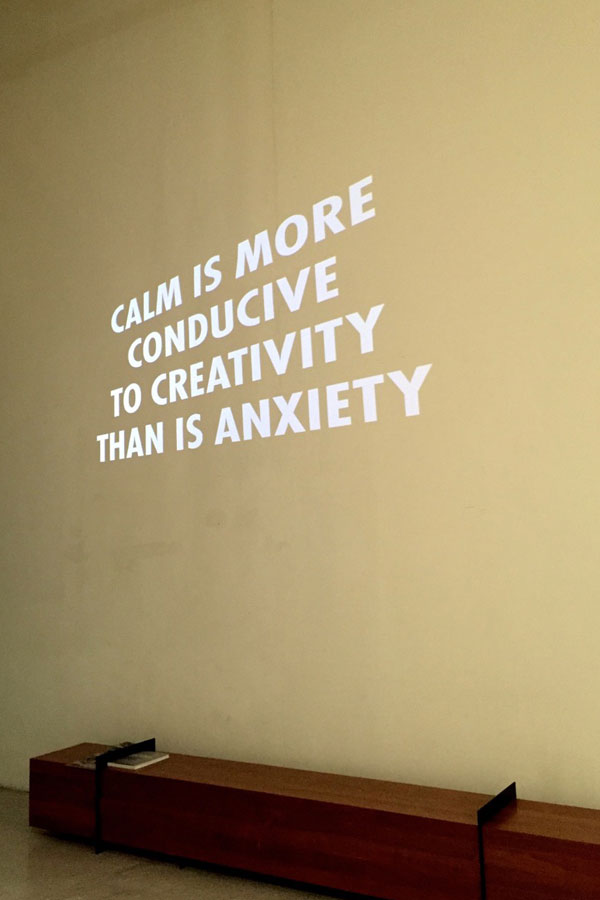
‘Truisms (selections from 1977-79)’ by Jenny Holzer
And of course, the highlight taking up an entire gallery is teamLab’s ‘Flowers and People, Cannot be Controlled but Live Together – Dark (2015)’. Established in Tokyo in 2001, teamLab is an “ultra-technologist” group made up of over 300 media specialists like programmers, mathematicians, architects, CG animators, artists, etc. that creates high-tech digital works inspired by traditional Japanese artistic styles.
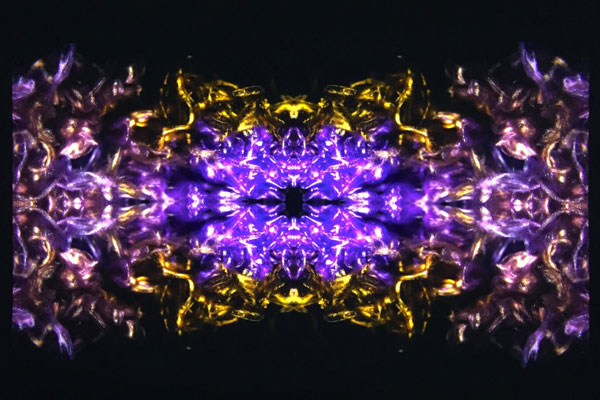
‘Organic Geometry (2015)’ by Naoko Tosa
According to founder Toshiyuki Inoko, the Group “creates works though experimentation and innovation, making the borders between art, science and technology more ambiguous.” This particular interactive digital installation shown at Ikkan Art International is rendered in real time by a computer programme. Its pretty animations reflect the symbiotic relationship between nature and humanity.
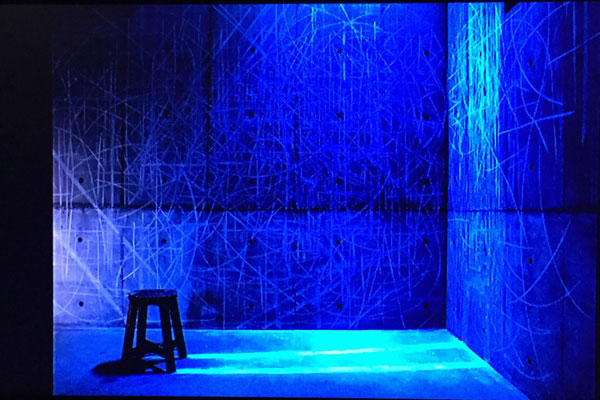
‘Burning Chair (2013) by Takashi Ishida
“The cycle of growth and decay [of the flowers] repeats itself in perpetuity. The viewer’s behaviour, [such as] making sudden movements or standing still, affects the cycle, causing the flowers to either wither and die, or spring up and blossom,” explains Inoko. This interaction between viewer and artwork means the artwork is continually changing, he adds. In an email interview, he tells us more about his inspirations and aspirations with the digital medium.
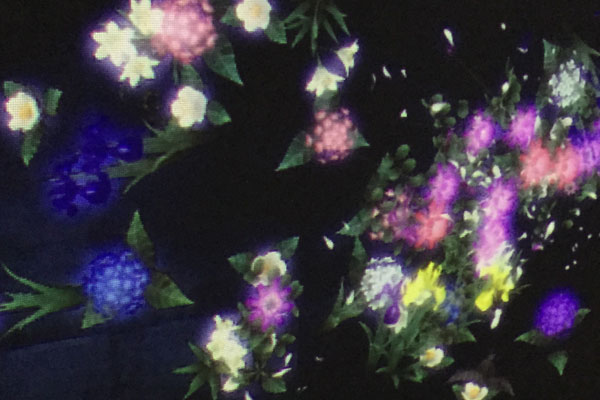
‘Flowers and People, Cannot be Controlled but Live Together – Dark (2015)’ by teamLab
What inspired ‘Flowers and People, Cannot be Controlled but Live Together – Dark’?
When teamLab visited Kunisaki Peninsula in Spring, we saw many cherry blossoms in the mountains and rape blossoms at the mountain base. We began to wonder how many of these flowers were planted by people and how many were propagated by nature. We also wondered what kind of behaviour would constitute artificial behaviour toward nature based on this premise that nature cannot be controlled, and whether these behaviours could perhaps give us clues about the future.
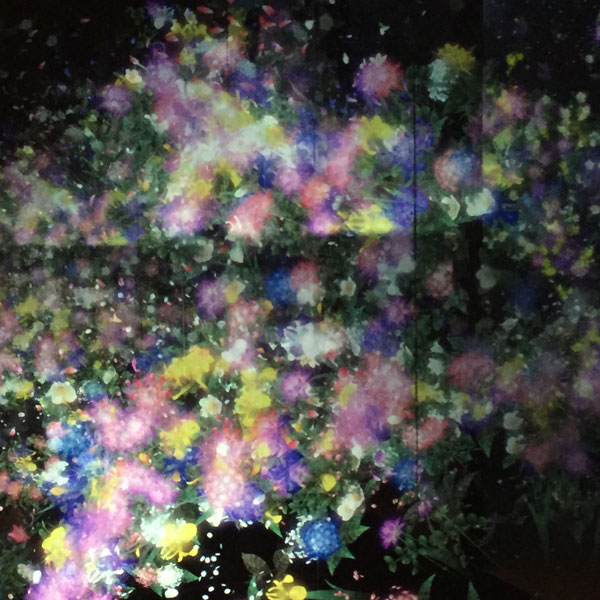
‘Flowers and People, Cannot be Controlled but Live Together – Dark (2015)’ by teamLab
Was there anything in your childhood that led to you being interested in using this medium for your art?
I became very interested in the Internet before, or perhaps it was just after, I entered university. Before it came along, information was controlled. I believed the Internet would create a whole new society. I loved the idea of technology changing the world and art changing peoples’ minds. So I committed myself to digital technology, which was a new field and decided to create art based on digital ideas. Moreover I wanted to be with my friends. I wanted to create new values with them. That is also why I started teamLab.
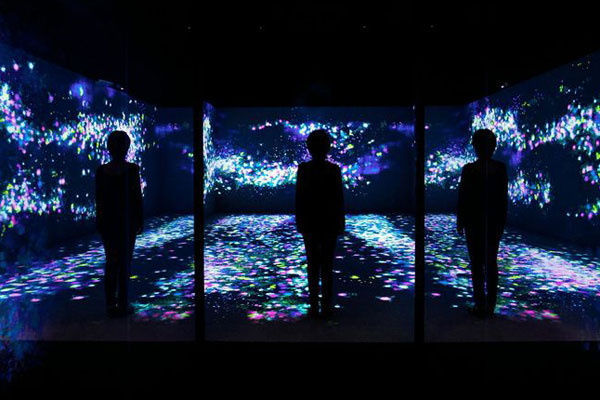
‘Flowers and People, Cannot be Controlled but Live Together – Dark (2015)’ by teamLab
Where does teamLab stand with respect to the development of video/interactive art as an art genre?
teamLab seeks to find new relationships between people and digital art in order to expand the concept of art. Digital technology lets us to express ourselves in ways that weren’t possible [before, allowing] human expression to become free from physical constraints [of traditional art mediums], enabling it to exist independently and change freely and provides us with a greater degree of autonomy within the space where the artwork is to be installed; we are now able to manipulate and use much larger amounts of space, [hence] allowing viewers to experience artworks more directly. Also interactive art… has more potential to influence the relationship among viewers themselves than before.
Ikkan Art International
ikkan-art.com
teamLab
team-lab.net/en
INDESIGN is on instagram
Follow @indesignlive
A searchable and comprehensive guide for specifying leading products and their suppliers
Keep up to date with the latest and greatest from our industry BFF's!
The internet never sleeps! Here's the stuff you might have missed