Giving an office building’s foyer a facelift is not easy. Not only should the refurbishment improve the layout to facilitate ease of flow, wayfinding and functionality, it should also enhance the feeling of welcome for visitors and a sense of belonging for staff. For the redesign of the main lobby and typical floors’ public areas in 61 Robinson (formerly known as Robinson Centre) in Singapore’s Central Business District, Brewin Design Office (BDO) has done that.
The building was acquired by ARA Private Funds in December 2019 through its Opportunistic Value-Add strategy, which aims to rebrand, reposition and revitalise a dated building through an asset-enhancement initiative, strategic leasing and by adding leasable GFA. The original building was constructed in 2000 by former First Capital Corp (now GuocoLand) to be used as their Singapore headquarters.

“The original architecture can be considered to be postmodern in style, but it was also driven by the company’s interests in development styles, perhaps incorporating larger scaled spaces and being guided by Feng Shui,” says BDO’s founder Robert Cheng. Two three-storey-tall water fountains clad in yellow onyx marble flanked both sides of the main lobby, a volume of space that gradually rose to a five-storey height in the foyer’s centre.
Forum Architects refurbished part of the exterior façade, retaining most of it save for a set of tinted glass panes that were replaced with metal louvres, of which angled facets reference existing elements in the building’s architecture. BDO continued this language to the interior, with the application of a beige palette of marble, limestone and rose-gold metal, as well as geometric forms that drew from 1920s New York architecture. BDO also turned the entire fifth-storey car park into new interior leasing units, and ensured the upgrades were in line with ESG and Greenmark ratings, such as improvements to M&E and ACMV systems that achieve better energy efficiency and light.
Related: Tan Kok Hiang: A Mindful Practice

“A new way of organising the interior architecture of the space, by redesigning the walls and the ceilings, created a new and improved proportion to the lobby. We lowered the ceiling to a 10-metre-height across the 6,000-square-foot lobby floor plate, spread evenly across the main vault. The height is much more proportionate to the width and length of the lobby, and more relatable to a person while still retaining a grandeur in scale,” explains Cheng.
Eighty-millimetre-thick limestone with an eight-strata pattern clad the lobby’s walls. “The stone perimeter walls act as an anchor for the lobby with so much presence that the empty lobby volume is read as a ‘form’,” says Cheng. They also clad the outer edge of the five-foot-way, augmenting cohesion between the interior and exterior spaces. Replacing a partially enclosed frontage to the five-foot-way with a 60-metre-long, floor-to-ceiling glazing, as well as the use of similar flooring materials in a receding pattern, are strategies with the same aim.
Related: Brewin Design Office’s Relearning Experience


Where the lobby’s walls extend another six metres to meet a vaulted copper metal ceiling, Cheng introduced a secondary band of material and colour – a faceted copper wall that continues from the four-metre-high limestone walls. Its shine is echoed at the lift lobbies, of which portals are detailed with ribbed, curved pipes in rose-gold metal at the transoms, as well as on the rippled mirror-finished metal panels mounted on the ceiling above the five-foot-way that continues into the lobby’s lowered ceiling.
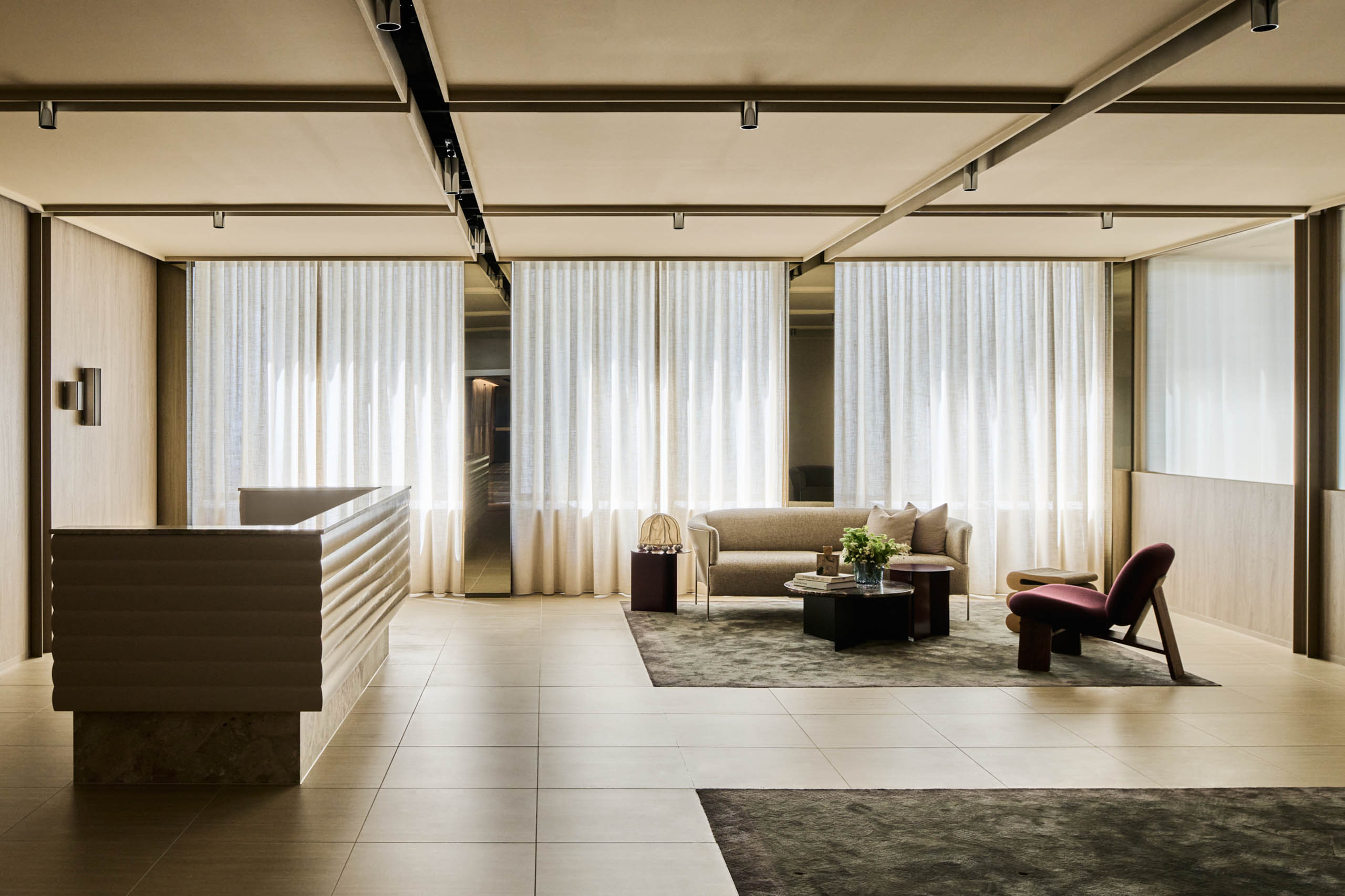
For added visual and physical connection, the walls between the lobby and retail units were replaced with operable glass panels. Cheng also designed organically formed lobby seating with solid, unfilled travertine marble slabs and solid walnut pieces. “Grounding the front section of the lobby, they were designed to be sculptural features that would not look entirely like furniture, seeing that there is to be quite a bit more visibility of the lobby interior from the five-foot-way,” Cheng explains. “The eventual overall mood and tone we wanted to create was to bring an element of hospitality into a commercial typology, to create a welcoming and energised space.”
Photography by Jovian Lim