The home of architecture and design in the Asia-Pacific
Get the latest design news direct to your inbox!

Get the latest design news direct to your inbox!
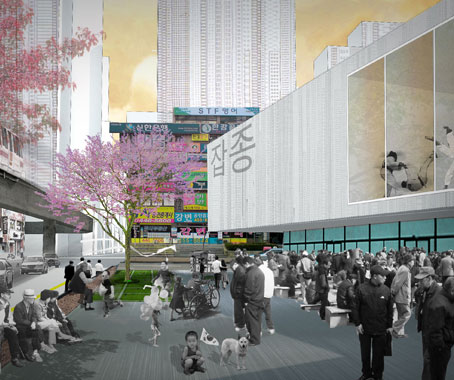
A first prize was awarded to not one, but two student teams with new urban solutions for an ageing Asia writes Yvonne Xu.
July 17th, 2012
Vertical Cities Asia, a three-pronged event comprising a student design competition, a workshop and a symposium, was first launched by the National University of Singapore’s School of Design and Environment with international philanthropic organisation World Future Foundation in 2011 in search of new urban models to address increasing urban sprawl, congestion and pollution faced by Asia’s overcrowded cities.
Anticipating the challenges of a rapidly-ageing region, this year’s competition is themed “Everyone Ages” and asks teams from 10 universities to address the rapid and exponential growth of Asian urbanism through designing one square kilometre of land for 100,000 people, taking into account factors such as liveability, feasibility, context, sustainability and technical innovation.
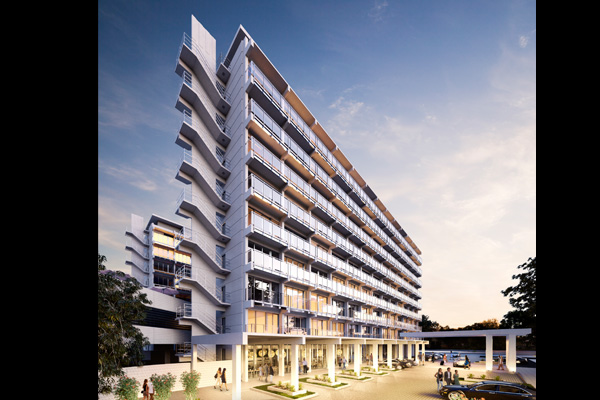
Equally compelling proposals by the two teams from Delft University of Technology resulted in a shared first prize being awarded this year. Both teams worked on the premise that “not everyone, but everything ages”. Team A’s Samuel Liew elaborates on his team’s concept, The Open Ended City:
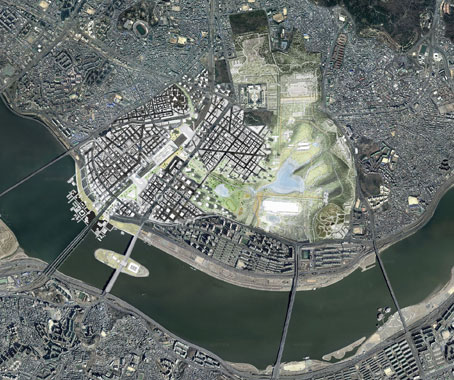
The Open Ended City: Samuel Liew, Stef Bogaerds, Claudio Saccucci, Erjen Prins and Jan-Maarten Mulder
“Spurred by what has been dubbed the Bilbao effect, developers and city planners have come to see iconic architecture as playing a central role in attracting investment in the form of tourism and big money, resulting in the production of architecture that is in favour of visually consumable forms. Our aim is to propose a development that retains the authenticity of the city while extending the dialogue between what is already existing and what is to come through uncovering and intensifying what is already existing.

The Open Ended City
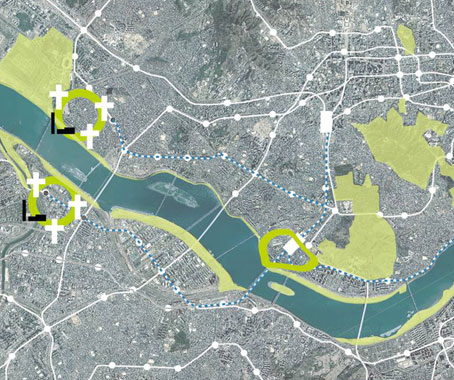
“The idea of community is being explored through programmatic circles as a means to organise programs in a meaningful way to provide for the needs of an ever-ageing population in a walkable radius,” says Liew, pointing to the focus on hybrid centres that “cater for elderly healthcare, education, cultural and sports activities, [designed to create] opportunities for the elderly to share their knowledge and experience with the youth and to allow people to grow old in one place.”
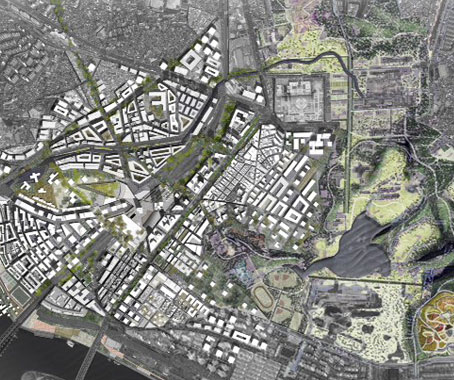
Lifetime City: Laura Dinkla, Katerina Salonikidi, Stamati Maria, Johnny Tascon and Qiu Ye
Team B’s Lifetime City proposal stems from a study of existing urban conditions. “After researching neighbourhoods in different cities around the world and in Yongsan [South Korea] as well, we identified a specific neighbourhood structure and a hierarchy between the streets: the most important part of the neighbourhood is its streets starting from the neighbourhood backbone which contains most of the local functions and which is connected through secondary streets with the primary road of the area. Our most important strategy was to identify the existing neighbourhoods with its street pattern and densify the site by adding neighbourhoods and using the above street structure,” explains team member Katerina Sslonikidi.
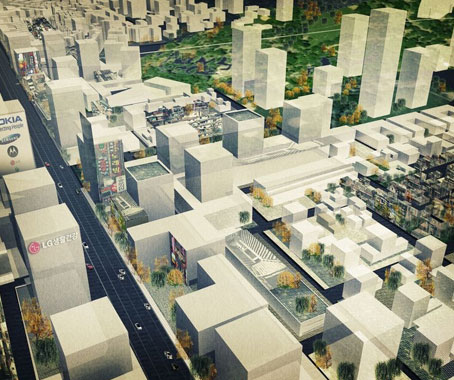
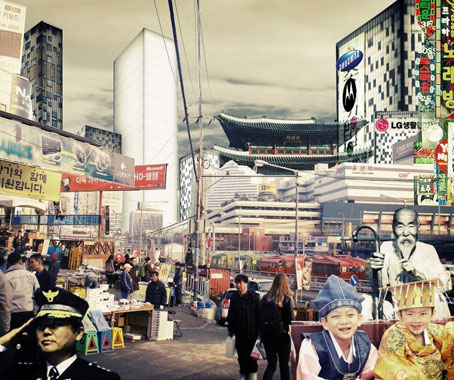
Lifetime City
The design also takes into account the development of the new Yongsan National Park. “With the new Yongsan National Park a large green area will be added to Yongsan. However, the new park is not very accessible for the dwellers around, for instance due to railways. We proposed new green connections from west to east and from the river to the park in order to bring the people closer to green; also, flora and fauna will profit from these connections,” adds Sslonikidi. The team also identified that basic urban services needed to be made accessible to everyone, so walking distances became a tool for locating destinations such as the grocery shop, the hair salon, the community centre, the station, and even a friend’s home.
2nd prize – The University of Tokyo
The second and third prize of the competition were awarded to The University of Tokyo and Tongji University respectively, while four Honourable Mentions were also handed out to teams from ETH Zurich, University of Michigan, National University of Singapore and The University of Tokyo.

3rd prize – Tongji University
Vertical Cities Asia
verticalcitiesasia.com
INDESIGN is on instagram
Follow @indesignlive
A searchable and comprehensive guide for specifying leading products and their suppliers
Keep up to date with the latest and greatest from our industry BFF's!
Australian high-end timber furniture manufacturers, Beclau, have recently been awarded Good Environmental Choice Australia and Forest Stewardship Council Chain of Custody certifications. The company uses production methods that adhere to high environmental standards, as well as using environmentally sensitive packaging, choice of adhesives and finishes. They are also the only Australian furniture manufacturers to import […]
The internet never sleeps! Here's the stuff you might have missed