The home of architecture and design in the Asia-Pacific
Get the latest design news direct to your inbox!

Get the latest design news direct to your inbox!
This year’s award offers a revealing look at how designers are responding to worldwide developments and trends.

October 24th, 2012
A design award that invites proposals of yet-to-be-realised products is generally an excellent opportunity to attain a macro view of current and upcoming trends and issues.
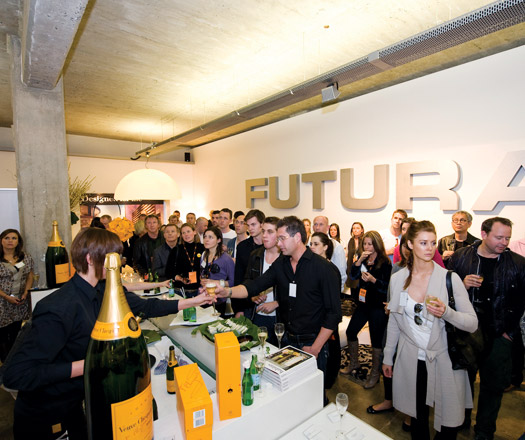
And so at the recently held 2012 red dot award: design concept in Singapore (the only professional level design concept competition opened to both companies and students on an international scale) eyes were keenly set to spot common themes even as the winners paraded down the red aisle.

The red dot: luminary winners taking in the moment

Making one’s way down the red aisle is a performance in itself
There were a total of 3,672 entries from 57 countries this year, of which 217 received the “red dot” and 46 were honoured with the “red dot: best of the best”.
Perhaps as a sign of the times, the top prize of the “red dot: luminary” went to Float Base Station (top image, a rapidly deployable communications system during a disaster) by Huang Hsin Ya and Huang Pin Chen from Taiwan. With its aim to provide a critical lifeline solution of communication during natural disasters “it exemplifies and reflects the ethos of great design”, says juror Takashi Yamada, founder of Yanko Design.

eSetta by Anton Weichselbraun, Austria

Add Up by Deng Pei Chih and Hsieh Tsai Ni, Taiwan
A good variety of such emergency proposals were entered in this year’s awards, no doubt in response to the significant number of natural and human-engineered disasters that have occurred around the world in recent times. Yet other interesting themes were observed.

Flexita Grater by Ely Rozenberg, Italy & Israel
Nils Toft, Managing Director and owner of DESIGNIDEA, noted that many concepts were “ideas that solved small everyday challenges in a smarter and more interesting way”. The Flexita Grater, for example, is a flexible food grater made from harmonic steel that can be efficiently stored flat.

Zipper Lock by Ke Chih-Teng and Shih Chang-Chi, Taiwan
Another strong theme, says Toft, were product concepts for security and personal safety, including the Zipper Lock, an integrated alternative to an otherwise separate padlock, and the similarly named (but controversial) Zipper – a silent flying indoor camera meant for film production as well as security patrols and surveillance.

Zipper by Emami Design, Germany
Proposals for urban congestion, worker health, bicycling, new uses for new technologies, and memorable user experiences also surfaced repeatedly.
Across the board, user convenience, product and operational efficiency, and the integration of two or more functions in a product were common designer considerations.
Jurors also had their thoughts on how designers could step up on their entries next year.
Says Yamada, “The marriage between design and the use of the latest practical technology hasn’t been fully utilised and integrated. For example, voice recognition technology allows us to literally talk to hardware and for it to talk to us.”
Ken Koo, Asia President of the red dot design award adds that he hopes to see more designers apply a deeper consideration and implementation of sustainability, in its many different facets, in next year’s competition.
Top image: Float Base Station by Huang Hsin Ya and Huang Pin Chen, Taiwan
red dot award: design concept
red-dot.org
INDESIGN is on instagram
Follow @indesignlive
A searchable and comprehensive guide for specifying leading products and their suppliers
Keep up to date with the latest and greatest from our industry BFF's!
New lighting artworks from some of Australia’s most innovative artists and designers using new technologies.
Daily until 10pm
The internet never sleeps! Here's the stuff you might have missed