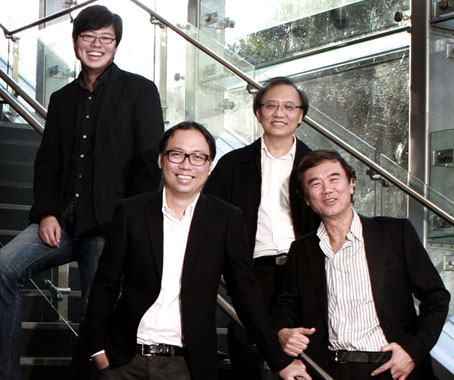
LAUD Architects has designed an unusual number of church buildings – thirteen, with five under construction – but a closer look at their diverse portfolio reveals also condominiums, houses and public buildings.
Set up in 2004, the 38-member office is helmed by its four directors – Joseph Lau Tse Kit, Ho Tzu Yin, Jason Bok and Melvin H J Tan. Regardless of client, project size or type, each project sees involvement from all directors. This, Melvin highlights, enhances learning among the directors and staff.


The division of the Bible Society of Singapore (2010) by a dynamic red wall represents the two parts (old and new testament) of the bible
Such an approach has perhaps led to the practice eschewing a fixed design language. Instead, creative problem solving and clarity of ideas is at the heart of each design. Each project the firm takes on pursues the exploration of “clear parti diagrams.”

Bethel Assembly of God church (2012)
Tzu Yin points out some examples: the datum for Bethel Assembly of God church was the “stairway (to heaven)” and this leitmotif was translated from the exterior right into the interior design; a recent entry for the Singapore Subordinate Courts competition that won the 2nd Prize expounded on ideas of transparency – it featured a central walnut-shaped core suspended within the curtain-walled court tower to represent “the impartiality of our judicial system.”

The Singapore Surbodinate Court competition entry explores high-rise greenery as environmental filters and privacy screens for discussion areas

Oxley Condomium weaves together four strata terrace houses and a five-storey apartment block in the rear
For sure, there is a sense of the contemporary about LAUD Architects’ designs. For example, Oxley Condominium (under construction) embodies a striking futurist aesthetic created by the weaving ribbon that ties the floors of the development together.
In its church buildings, traditional elements like stained glass are absent. Instead, the abstract manipulation of transparency, form and finishes are used to translate biblical metaphors and the churches’ visions. It is as much the firm’s reaction to modern ways people practice the religion – in auditorium-like halls, for instance – as it is the firm endeavouring to find new ways of representation that are relevant to our times.

The Grace Assembly of God II church (2006) extension was one of the firm’s first church projects

The design of Grace Assembly of God I church development (in progress) has a central atrium inspired by the natural terrain of Petra in Jordon
Even when it comes to seemingly mundane typologies like high-rise apartments, the firm finds new issues to explore. One example is the design of Fulcrum Condominium (under construction).
“[The design] started with us questioning the typical stacking of units one above the other. The varying units and double-volume lofts are fully expressed on the façade. Thus the aesthetic relies heavily on [this spatial arrangement], rather than decoration,” Tzu Yin shares of this form-follow-function trajectory.

Fulcrum Condominium (in progress)
Current projects in the pipeline include the ACE Community Club in Woodlands and the Marymount Centre. Both enable the firm to explore new kinds of gathering spaces.
“The ACE Community Centre [takes] a fresh approach to the established typology of communal institutions. To enhance the concept of ‘community’, we explored the idea of widened corridors as a communal ‘living room’ rather than a mere transitional space,” Melvin elaborates.


Design for AEC Community Centre (in progress)
For the Marymount Centre, a social welfare institution that houses a “crisis” shelter, children’s home and kindergarten, the team pushed the idea of maximising the green plot ratio of the site by introducing multiple terraces and green roofs.
“Every project presents new issues, constraints and opportunities,” Melvin affirms. “It is with this excited sense of ‘newness’ that we approach each project.”

Design of the Marymount Centre (in progress)
Top image: From left – Melvin H J Tan, Ho Tzu Yin, Jason Bok, Joseph Lau Tse Kit
LAUD Architects
laudarchitects.com