The home of architecture and design in the Asia-Pacific
Get the latest design news direct to your inbox!

Get the latest design news direct to your inbox!
Landscape architect Ng Sek San takes the unconventional route in his quest to find solutions that are simple, affordable and local.

August 27th, 2012
About eight years ago, landscape architect Ng Sek San became “really uncomfortable about the globalisation of design” and attempted a radical move: he decided that he would only take on commission work in Kuala Lumpur, Malaysia where he’s based.
In his work, Ng seeks to find egalitarian solutions that are simple, affordable and that tread the land as lightly as possible. He also invests his time in his personal (Sekeping) projects with, in his words, “total irrelevance to engineers, clients and local authorities” in a bid to explore alternative earth-friendly solutions on sensitive and challenging terrains as well as ordinary environments. Here he shares with us his thoughts.
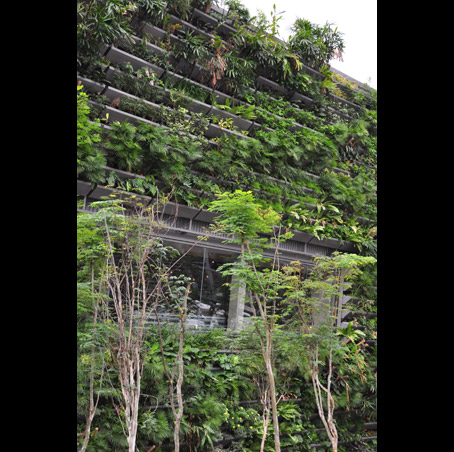
Lot 10 rooftop, Kuala Lumpur
On the term ‘sustainability’.
I’m really now questioning the word sustainability. Because I think the word has been hijacked anyway. I’ve seen high-rise buildings being built in the desert and they call it a sustainable building because it fulfills all the LEEDS requirements. So my preferred route for operation in the third world country is ‘appropriate’. It [should really be about exploring] what is appropriate [for] us and how we can help each other to find a solution that is more local than global.


PJ8, Petaling Jaya, Selangor
On his Sekeping projects.
They are mainly my personal projects. I do them to test ideas… ideas that are difficult to implement on commercial clients’ money.
I think the underlying philosophy is really about the idea of doing things simply and without fuss. It is to imagine new possibilities of building on difficult terrains or sites with long histories or ordinary houses in ordinary neighbourhoods.
It is also about extending the influence of our projects beyond their physical boundaries to contribute to a wider neighbourhood.


Sekeping Serendah – guesthouse in a forest near Kuala Lumpur
On the importance of research and experimentation.
Experimentation is an important aspect of our work, the reason being that our nation has only a very brief history and existence unlike the older cultures of our neighbours like Indonesia, China and Japan.
We are hoping that with such experimentation done by us [as well as] others, some crystallisation of a building design ‘culture’ or ‘tradition’ will begin to evolve in the next 100 years.
We are constantly experimenting with using local materials ‘with a slight design twist’ for construction and constantly looking out for totally non-standard materials for buildings. E.g. leaves, architectural plants, mud, recycled commercial signboards, etc.
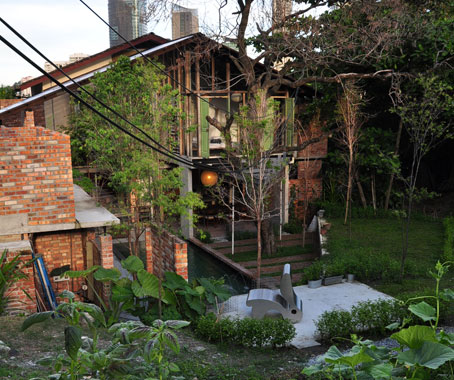

Sekeping Tenggiri – guesthouse in Kuala Lumpur
On his philosophy of not finishing things.
I think this is informed by a larger philosophy of appreciating ‘imperfection’, that only god is perfect but humans like me are born to err.
It is also derived from my years of involvement in the building industry, which is a very ’inhumane’ industry – a very hierarchical top down and ’vain’ business.


Sekeping Kong Heng – conversion of a pre-war building into a guesthouse in Ipoh. Photos by Rupajiwa Studio
The turning point [came when] I observed a fellow interior designer taking a big marker and crossing out all the tiles and Alucobond cladding that he deemed to be ’not perfect’ in front of all the poor workers who had laboured night and day to finish the job and to meet his ’manmade deadline’.

Sekeping Kong Heng
So this recent attempt of mine to ’unfinish’ a job is an attempt to let go, to be less perfect but in return hopefully [to] be more humane in my design, and allow time or god to finish things for me.
Perhaps it is also [recognising] that I’m human and I do not have the solution and answer to everything at that particular point in time. Leaving it unfinished allows me the opportunity to revisit it when I grow wiser with time. It is also less wasteful than forcing a finish and then regretting and renovating later.

Sentul Park, Kuala Lumpur
On developing a ‘third world’ aesthetic.
I have also been trying to see things and define ’beauty’ from our point of view of living in a sea of poverty and deprivation in our region; to provide an alternative to the conventions that we are so used to especially when most of us are trained in western schools and our dominant aesthetic sense are from the developed west.
It is an aesthetic that I’m retraining myself to see in the messiness, dirt and grime, unfinished and raw taken-for-granted everyday life, and to apply that in my design.

Sentul Park, Kuala Lumpur
[An example would be] developing affordable and emergency small scale housing with very simple cladding and skin and using plant material as a second skin that in time will provide more comfort and a cooling effect to the buildings, and a very green environment as compared to the present day dusty and hot shanty towns.

Sentul Park, Kuala Lumpur
On refraining from using matured, transplanted trees in his work.
We are just trying too hard to play god. It means contractors [are digging up] big trees in forest reserves or from villages; it means that the old trees have to be cut and mutilated to a size that can be transported along the highways; it means a high probability that the old tree will not survive the transplanting process.
I much prefer [to use] the same amount of money to buy many more tree saplings and plant them at higher density to achieve the ’green effect’… planting them closer together also creates ’competition’ for light and the tree saplings grow tall much faster as the reach out for the light.
I [should] also mention that in special circumstances like planting on weight sensitive rooftop gardens, I prefer to use creepers [rather] than trees as they require less soil and they achieve the same amount of green density in less time.
Profile image by Soraya Yusof Talismail. Other images courtesy of Seksan Design.
Seksan Design
seksan.com
Ng Sek San is one of the jurors for the President’s Design Award 2012 and was in Singapore earlier this month to share his work at the inaugural President’s Design Award Jurors’ Forum.
INDESIGN is on instagram
Follow @indesignlive
A searchable and comprehensive guide for specifying leading products and their suppliers
Keep up to date with the latest and greatest from our industry BFF's!
The internet never sleeps! Here's the stuff you might have missed