The home of architecture and design in the Asia-Pacific
Get the latest design news direct to your inbox!

Get the latest design news direct to your inbox!
The controversy surrounding the demolition of Sydney’s 25 year old Convention and Exhibition Centres, lingers on
February 5th, 2013
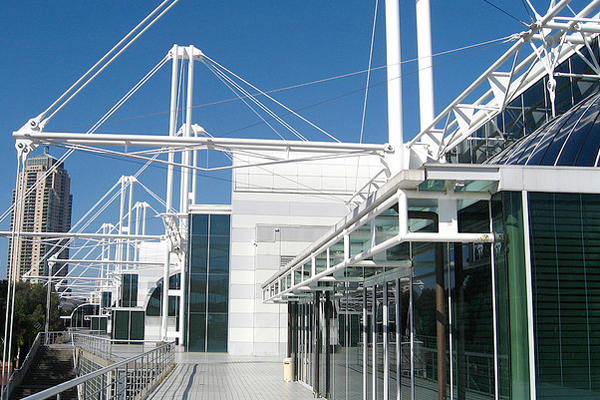
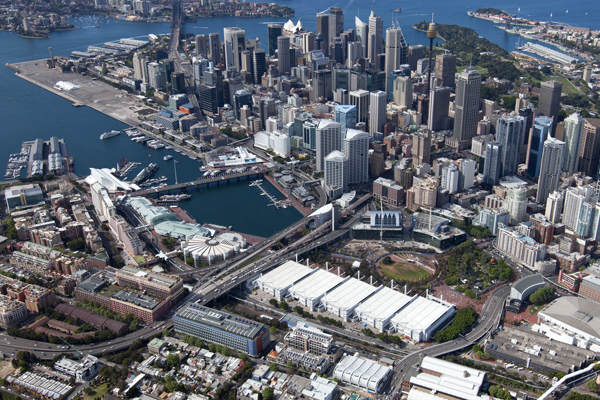
Philip Cox’s 1989 Sir John Sulman Medal winning development in the gentrified Darling Harbour district of inner Sydney was a benchmark development for its time, playing its part in the celebration of a Nation’s coming of age.
Simon Chan, an impassioned architect and Sydney-sider has launched an online petition in the hope of lobbying Barry O’Farrell, Premier of NSW to consider an extension proposal in place of demolishing the site.
“..built as part of the great tradition of exhibition buildings, this internationally acclaimed building was a cornerstone for the redevelopment of Darling Harbour and the Nation’s Bi-Centennial celebrations.”
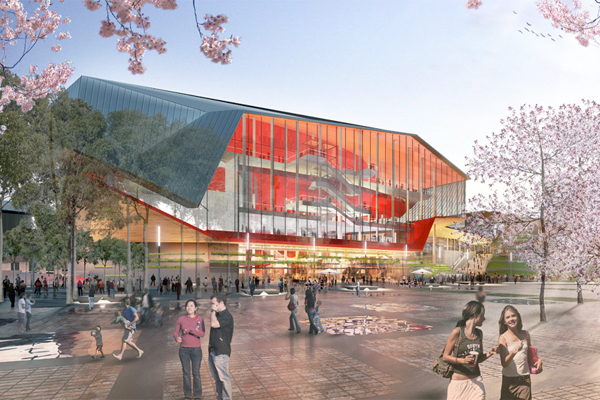
Image © OMA/HASSELL/SICEEP
Chan’s case for renovation and a salvage-first approach to ongoing planning is one broadly shared by stalwarts of 20th Century Australian architecture.
Last week leading architectural commentator Professor Jennifer Taylor threw her support behind the preservation of the site,
“The inner city cultural precinct of Darling Harbour was born of a time for Sydney of economic buoyancy and optimism and the major public buildings of the Exhibition Centre and the Convention Centre are representational of that time and a part of the weave in both the fabric and story of the city. Public buildings speak for the collective, and the loss for the city of the unjustified proposed demolition of two of Sydney’s most significant public buildings of the end of twentieth century, must be realised and such a short-sighted and irresponsible act prevented.”
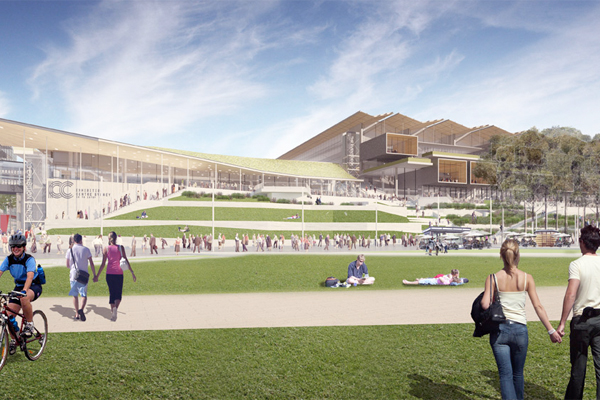
Image © OMA/HASSELL/SICEEP
In April 2012 the NSW State Government made public their masterplan to demolish the contentious 30 year old Sydney Entertainment Centre and as part of a $1.2b renovation plan to incorporate the adjacent Sydney Convention and Exhibition Centre – in doing so, expanding the facilities by two-thirds again.
The winning project team behind the renewal is a consortium of local and international firms.
Australia’s HASSELL, OMA from the Netherlands and Populous have presented a mixed-use development incorporating hospitality, open space and commercial precincts.
The demolition and construction is earmarked to begin in late 2013 through to late 2016.
INDESIGN is on instagram
Follow @indesignlive
A searchable and comprehensive guide for specifying leading products and their suppliers
Keep up to date with the latest and greatest from our industry BFF's!
Check out the highlights from Dance for Life 2012, which saw architecture firms take to the stage in a 1980s dance off!
The internet never sleeps! Here's the stuff you might have missed