The home of architecture and design in the Asia-Pacific
Get the latest design news direct to your inbox!

Get the latest design news direct to your inbox!
The latest project from via. speaks of the natural world and provides a place to work for the World Wildlife Fund in Hong Kong. The design is elegant and fitting for both staff and visitors as the surrounding habitat and the man-made sit comfortable together.


July 18th, 2024
Completed in November 2023 by via., the World Wildlife Fund (WWF) Peter Scott Visitor Centre stands as a testament to appropriate and fine design. The centre is located in San Tin near Yuen Long in Hong Kong and celebrates the work that the World Wildlife Fund contributes to the conservation and sustainability of our environment. This beautiful project situated in one of the world’s most densely populated countries, speaks of the resilience and value of the WWF and its design effortlessly translates the ideas of the natural world and of conserving it.
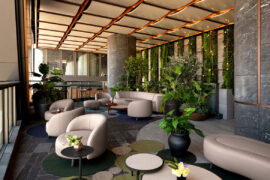
The centre, designed by Frank Leung, founder and principal via. and lead on the project and his team, have created a home for the WWF that is spatially generous, aesthetically pared back and highly functional. The project offers myriad facilities and amenities all cloaked in a minimal material and colour palette of pale timber hues, base grey terrazzo and golden bamboo.
“Our commitment to sustainability guided our material choices. We opted for a pared-down palette, using a special type of terrazzo with embedded wood chips for floors, and bamboo to bring warmth to the spaces. I feel grateful and humbled to have this unique opportunity to create something for the environment, within the nature reserve, for the people of Hong Kong and our next generation.” says Leung.

On the ground floor is a learning centre, Jockey Club Gallery, a gift shop and Kingfisher café. The upper level includes numerous private spaces for researchers and staff, with meeting and training rooms and nine accommodation suites. A pyramidal volume has been inserted into the middle of the floor and all functions on both levels are organised around this atrium. The space is also linked to a skylight that provides ample natural light and also reduces thermal gain.
The atrium form is defined by mass-bamboo slats with three ‘bird hides’ on the upper floor that overlook the activities and visitors below. The east hide is positioned at the top of the staircase landing and also becomes a breakout space for meeting rooms; the south hide forms part of the hallway to the accommodation rooms; and the north hide appears as a wall niche inside the training room.
Leung comments, “We envisioned a visitor experience that mirrored the act of birdwatching, a key activity in the nature reserve. The soaring, pyramidal atrium, with its concealed “bird hides” on the upper level, provides glimpses into the vibrant foyer below, mirroring the careful observation of birdwatchers.”
Related: A new hospitality venue by Frank Leung, in Hong Kong, creates a home away from home

Special features abound such as the pattern on the ground floor that refences the flyway of birds and there are modular bamboo seating sculptures from Bamboo International Group and tea tables from Hong Kong Timberbank that provide places for relaxing. Flappable timber shelving has been included at the gift shop and there are curved bamboo walls in the gallery that bring warmth and texture to the interior. Full height glazed doors ensure air circulation is optimised and there are panoramic views of the surrounding landscape of the Mai Po fishing ponds.
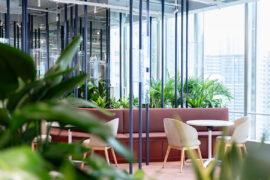
On the upper level the accommodation rooms with en suite bathrooms are positioned across the floor and again, the colour palette is subdued and concise. The rooms boast woven cane cabinets and headboards along with selected furniture made from natural materials that combine to create comfort and a sense of hominess. Along the hallway that connects the rooms there are seating niches and teak timber furniture where guests and staff can meet for more intimate dialogues.
While WWF Peter Scott Visitor Centre is a place for work, research and collaboration, via.’s design is both authentic and sophisticated. There are multiple areas for work, staff and the public and these have been artfully designed and expertly integrated into the spatial plan. Creating the central atrium provides room to move and easy access to the areas utilised by visitors, while on the level above, there are myriad spaces and places for the diverse undertakings of the WWF.

Frank Leung founded via. over 25 years ago and the practice has amassed multiple honours and awards during that time. Leung trained in the US and returned home to establish via. and his projects, that cross the genre of residential, retail and hospitality, are characterised by his innate talent, experience and respect for cultural nuances.
The WWF Peter Scott Visitor Centre is a thoughtful and sensitive design for a particular client and via. has excelled in the resolution of this project. Afterall, what could be more important than addressing the changing environment and the many challenges that this presents in a dedicated home that reflects the natural world.
Via
via-arc.com
Photography
Kris Provoost, Marcus Yau, Frank Leung


Next up: Studio Lotus’ Biju Janata Dal Party HQ connects with the streetscape in India
INDESIGN is on instagram
Follow @indesignlive
A searchable and comprehensive guide for specifying leading products and their suppliers
Keep up to date with the latest and greatest from our industry BFF's!
The internet never sleeps! Here's the stuff you might have missed