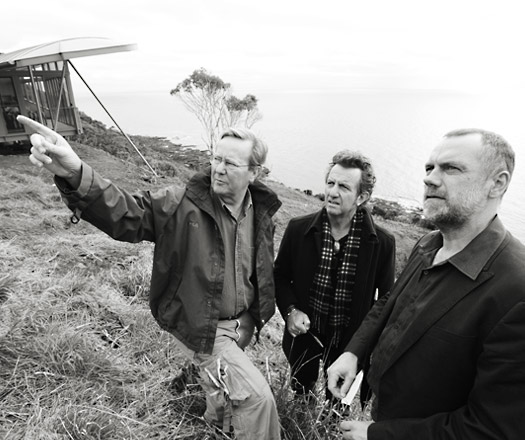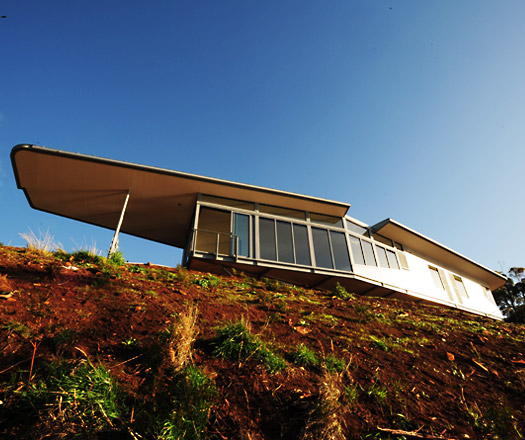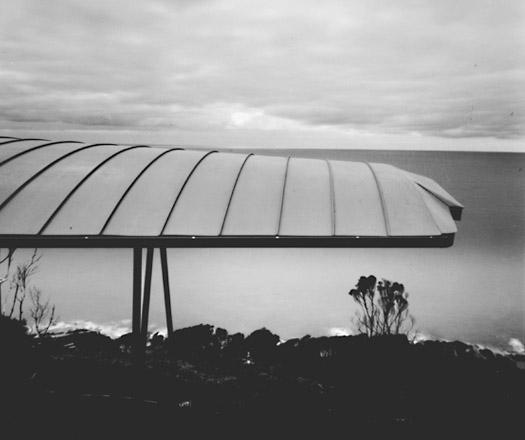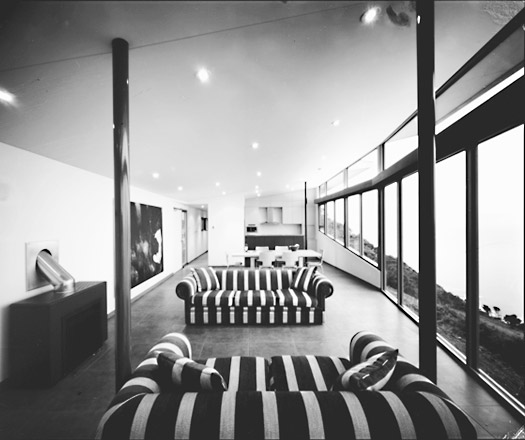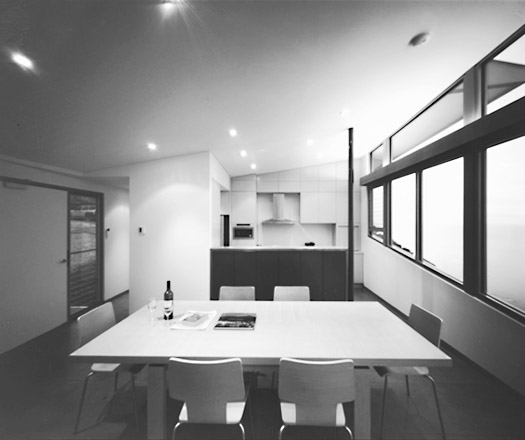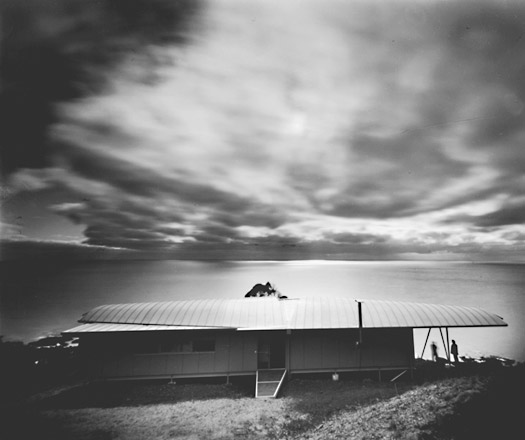
Paul McGillick visited Quentin’s Winged House, designed by Goodwin, perched on the northern cliffs of the Tasmanian coast. In this rugged landscape, the structure sits lightly, almost precariously, like a bird or plane on the brink of flight.
This article appears in Issue 02 of Habitus, on sale now. Photography by Anthony Browell.
First, some facts about the two main players. Richard Goodwin is an architect and an artist whose major preoccupation is bringing architecture and art together in a seamless union, working on freeway walls, bridges and extensions.
His ‘gallery’ art typically involves the re-assembly and documentation of industrially constructed vehicles such as bicycles, cars, motor cycles and helicopter models, although examples of his paintings are to be seen on the walls at the Winged House.
But central to his practice is the fusion of art and architecture, which apart from calling into question traditional public art, explores urban political issues such as the progressive alienation of public space for private purposes.
Quentin Dempster is a television journalist who made his name as an investigative reporter exposing corruption in Queensland. He now lives in Sydney where he hosts a straight-shooting weekly exposure of state politics on ABC TV.
You see, there is something in common: they are both political pot-stirrers. But it was art that brought them together. “We had bought Queensland art,” says Quentin, “but when we moved to Sydney in the early 1990s, it was Richard’s art which was captivating.”
Quentin and his wife, Beth (a psychiatrist) had first taken an interest in Richard’s freeway walls in Sydney. “Then,” says Quentin, “we got in touch with his other stuff – ‘Möbius Sea’ and the Parramatta Square fountain. We did a story on the design competition for what is now the Anzac Bridge and I was interested in Richard’s proposal, seeing what he was doing with art and architecture.”
The families became friends and the Dempsters began to collect Richard’s work.
In the effluxion of time, Quentin and Beth began looking for a place to get away from it all, which could also double as a holiday house to rent out and pay for itself. After toying with New Zealand and checking out the south of NSW, they began to focus on Tasmania…
To read this and other great articles get your hands on a copy of Habitus issue 02 from your nearest stockist, or subscribe to future issues here.