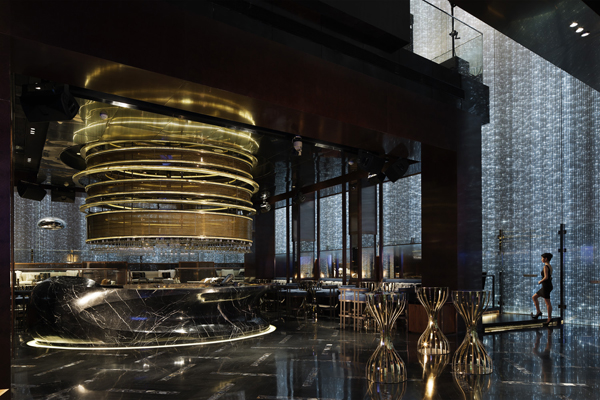
A spectacle of light and levels, this new bar at China’s W Guangzhou is designed by Japan’s Aoyama Nomura Design. No need to adjust your screen’s settings, all images are photographed – no renderings!
August 6th, 2013
As with all W hotels and residences, the newly opened W Guangzhou in China seduces the senses with playful, dynamic interiors and an inventive play of light.

That same spirit translates readily into the design of Fei Ultralounge, conceived by Aoyama Nomura Design (A.N.D.) – a Japanese firm that has worked on many well-known restaurants and hospitality projects in Japan and, increasingly, around the world.

According to the team at A.N.D., the original space was a large cubic area spanning 938 square metres, with 18m glass walls rising on three sides. A voluminous starting point.

While W Hotel’s core clientele are “the young”, A.N.D. share that the client’s brief was broaden the appeal of the venue, creating a “sophisticated space where mature adults in their 30’s, 40’s and over could also enjoy”.

The enormous, cold glass curtain wall has been treated with a film of light bringing warmth to the space, binding the various levels into the same venue. The colour and flicker rate of the vast film, made up of countless glass fibres, can be sensitively manipulated to envelop guests in changing light. The film also creates a facade that sparkles and beckons to passers-by on the street, a rainbow waterfall.

Employing a “carefully devised technique” the design team have managed to reflect and amplify the light with less light emitting products. During the day, the same film becomes a translucent screen that serves to soften the sunlight pouring into the space.

Spatially, the insertion of multiple levels and sporadically placed vertical walls creates segmented, individual rooms of differing density and taste such as a VIP area and several private rooms, allowing guests to pick and choose a space that best suits them.

The diversity in materials range from custom stone work to intricate metal latticing and solid timbers. The result, paired with the evolving light play throughout a visit, is immersive and entirely decadent, meeting W Guangzhou’s brief, perfectly.


Aoyama Nomura Design
and-design.jp
Images © Nacasa & Partners Inc.
INDESIGN is on instagram
Follow @indesignlive
A searchable and comprehensive guide for specifying leading products and their suppliers
Keep up to date with the latest and greatest from our industry BFF's!
In a tightly held heritage pocket of Woollahra, a reworked Neo-Georgian house reveals the power of restraint. Designed by Tobias Partners, this compact home demonstrates how a reduced material palette, thoughtful appliance selection and enduring craftsmanship can create a space designed for generations to come.
Herman Miller’s reintroduction of the Eames Moulded Plastic Dining Chair balances environmental responsibility with an enduring commitment to continuous material innovation.
At the Munarra Centre for Regional Excellence on Yorta Yorta Country in Victoria, ARM Architecture and Milliken use PrintWorks™ technology to translate First Nations narratives into a layered, community-led floorscape.
Design student, Anthony Manuatu, has won the Art on the Floor competition – a collaborative design competition and exhibition of contemporary rugs exclusively designed for Designer Rugs.
Eastern Commercial Furniture recognise the influence a particular space has on our understanding of a product. In their recent installation at Melbourne Indesign, for The Project, they explore this idea through projection, challenging our often ‘fixed’ perspectives.
SpeakersPAULMCGILLICK MC – Editor InDesign magazineMICK PEARCE – ArchitectSHERIDAN KENNEDY – Contemporary JewellerMARTY ROSS – MathematicianCHRISTOPHER BOUTSINIS – DesignerJON COE – Zoological Park DesignerSTEPHEN PERRY – Landscape ArchitectPROFESSOR MV SRINIVASAN – Researcher & ScientistDR LARRY JORDAN – ScientistLAWRENCE ENGLISH – Sound Artist
The internet never sleeps! Here's the stuff you might have missed
In cafés, bars and restaurants, stools do more than fill gaps at counters and bars. They support density, encourage movement across scales – making them a strategically important seating typology to get right in hospitality design.
Following his appointment as Principal at Plus Studio’s Sydney office, architect John Walsh speaks with us about design culture, integrated typologies and why stretching the brief is often where the most meaningful outcomes emerge.