Eagle House in Melbourne’s CBD is a testament to the potential of refurbishment and renovation. The heritage-listed office block has undergone a full revitalisation, with a new floor plan and new internal areas helping breathe new life into the existing space. Leading Australian interior design and architectural consultancy IA Design were the masterminds behind the project and worked with the client to achieve a functional and beautiful space that had intention and thought behind every design decision.
A sustainable project by its very nature, Eagle House also demonstrates the broader impact of design, with specification choices, including the Milliken Free Flow collection, also working to drive social change.
A spatial redesign
The biggest transformation for the Eagle House was in the building’s top level, where IA Design converted two unused spaces into communal shared zones. The zones, aptly named ‘The Nest’ and ‘The Perch’, act as bookable event, meeting, and boardroom spaces, demonstrating how considered refurbishments can also extend a building’s usage and market viability.


In creating these new spaces, the design team had to contend with access issues, with the top level previously only being accessible through fire stairs. Uneven flooring, acoustic concerns and a complete absence of natural light were also challenges that required addressing, with IA Design having to do so without affecting the fabric of the heritage listed building.
Now, as guests make their way up the extended lift shaft, they’ll be greeted by a dark panelled corridor with directional signage to both The Nest and The Perch. As they move into the north or south wings, the snug hallway space opens to expansive rooms flooded with natural light, with sheer curtains and open facilities only adding to the level’s generous proportions.
The Nest (north suite) features a multi-use space that can be configured to facilitate a 20-person boardroom, training facility, or lecture space. State-of-the-art AV equipment and concealed storage helps the space through its multiple usages, while a kitchen allows for visitors to be hosted in the shared zone without the need to occupy one of the private tenancies below.


To the south, The Perch is a relaxed zone with all spaces free for touchdown use. Taking advantage of the uninterrupted city views, meeting and collaborative spaces track around the wing’s perimeter, while an AV zone in the centre of the room acts as a visual and technical centrepiece in the open-plan footprint. A stocked kitchenette provides tenants with access to water and coffee making facilities, while the bathrooms tucked behind The Perch also ensure all services are centralised and accessible.


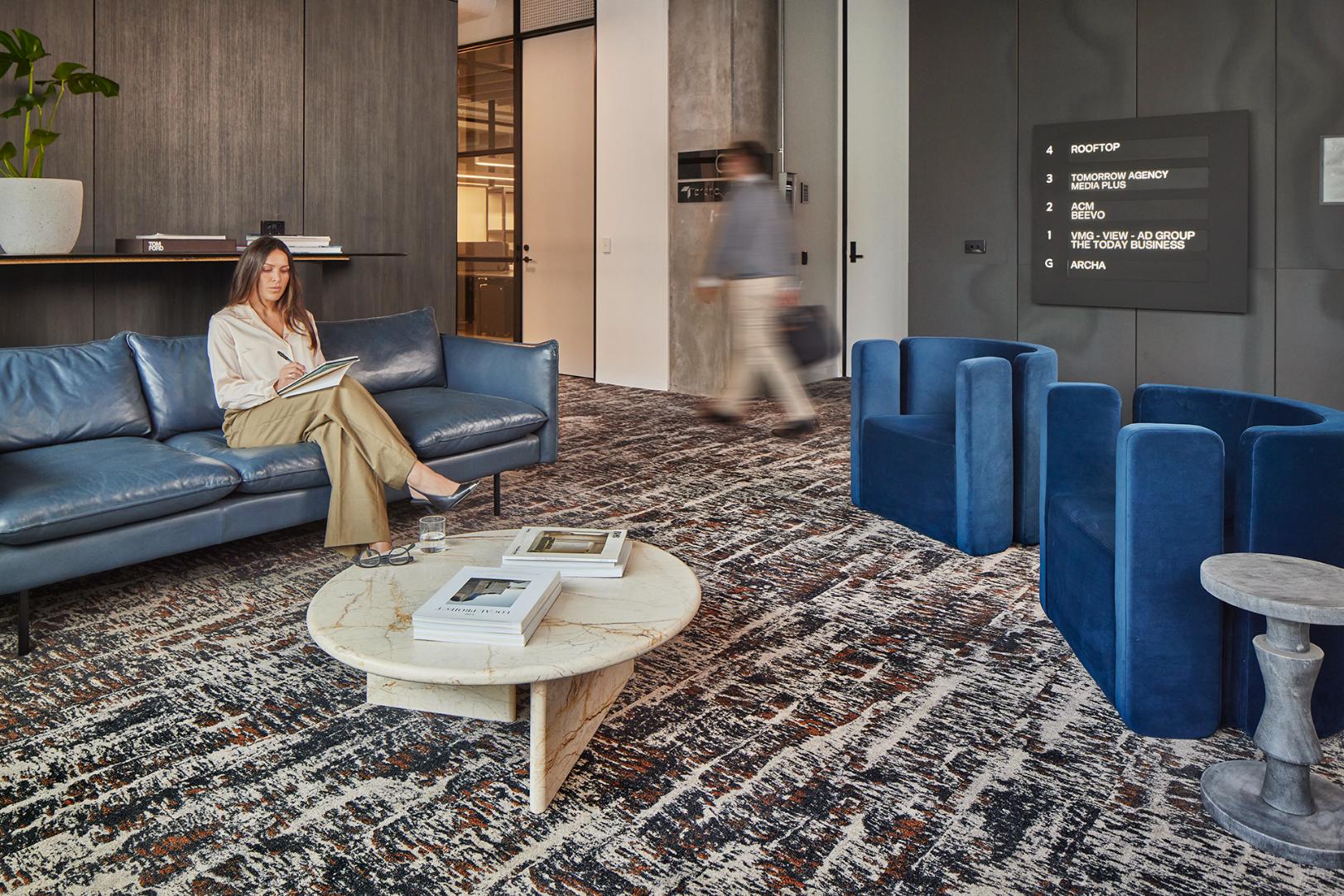
Milliken’s Free Flow carpet tiles create continuity between The Nest and The Perch, where the versatility of the product made it the perfect specification choice to cover highly trafficked, multi-use spaces that span across an expansive and reconfigurable space. From a design perspective, the delicate etchings in the tiles’ design provides visual interest and tactility, grounding the entire top floor in a warm material anchor.
Design with a conscience
The redesign of Eagle House’s top level also gave IA Design the opportunity to create spaces that have an impact on the wider community. Just as refurbishing helps to prolong a building’s life cycle, product specification also has impacts on sustainability, supply chain and people, and IA Design’s approach was to approach the task with ethics and responsibility.
Milliken’s Free Flow collection is part of their “purpose-orientated” product pathway initiative, which sees revenue from every specification channelled towards youth homelessness. This initiative is part of a collaboration with the Property Industry Foundation, who build Haven homes for its charity partners which provide frontline services for homeless youth.
Imogen Birch, Senior Interior Designer at IA Design and project lead for Eagle House, emphasises the importance of Milliken’s wider social engagement when specifying products. “It’s very important,” she says. “As designers, we have a responsibility to be selecting socially and environmentally conscious products. Meaningful product selection not only benefits our clients directly but society as a whole through our supplier’s programs and partnerships.”


In specifying the Free Flow collection, Milliken and IA Design have ensured the Eagle House’s sustainability footprint extends beyond the environmental, with social sustainability also covered thanks to the revenue stream with the Foundation.
Sustainability on show
Eagle House is a shining example of the potential inherent in our existing buildings, where a considered design approach can breathe new life into older structures without the need to tear down and start again. Working within the confines of a heritage-listed building, IA Design has shown how contemporary needs such as hybrid and co-working spaces, can work within an existing envelope. By reworking a site’s footprint and making considered fitout choices – like the Milliken Free Flow collection – the design team have created a beautiful and functional space which is not merely a practical commercial building, but an environmentally and socially sound one too.
Milliken
millikenfloors.com.au