Anthony Caggiano checks out “egalitarian commercial design” at an Adelaide car dealership.
October 7th, 2010
Many a prestigious car brand has a sales and service supercentre, but in Adelaide’s CBD, a Toyota dealer has built its own “haus of car”.
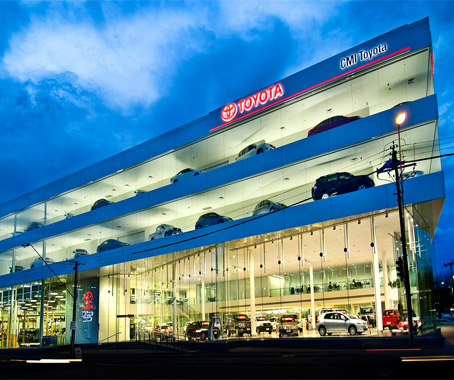
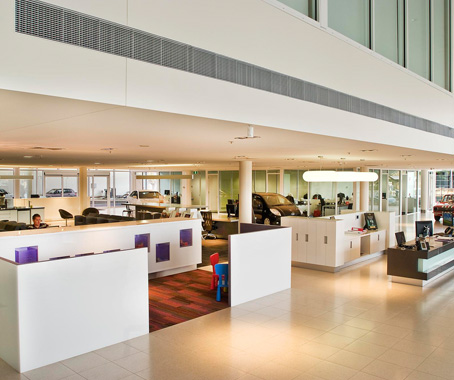
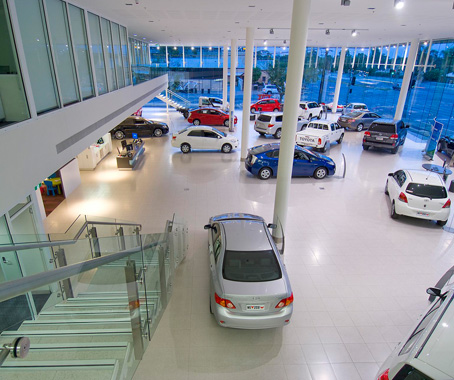
Designed by Matthews Architects, the $24 million, four-storey CMI Toyota on West Terrace includes a new car showroom, two galleries, two car washers, service centre and sales and fleet departments.

The facade features 25-millimetre thick, seven-metre high glass panels, supported by billets suspended from the second floor. Complimented with aluminium composite panelling, they maximise visibility through the building from the road.

In keeping with the concept of “egalitarian commercial design,” director Gerald Matthews said all parts of the business are seen as equal.
Glass panels to define the departments within the building bring a new layer of transparency and break the traditional visual notions of hierarchy.
“No matter who the customer is, they walk through the same door,” Mr Matthews said.
This is arguably best expressed with the service centre. Visible from the main road and new car the sales area, Mr Matthews said this “celebrates its technical modernity”.

Inside the showroom, perforated plaster board panels in the ceiling draw the attention on the cars.
Galleries on the second and third floor show off the vehicles, which have often featured classic Toyotas, such as a fully-refurbished Land Cruiser.

3 80,000 litre underground water tanks collect rainwater and help supply water to the car washers on the second floor.
Being a west-facing building, thermal properties were carefully calculated with the thickness of the front glass surfaces.
Although its contents may be modest, the building sets a benchmark in visual excitement and class to automotive retail in Adelaide.
Matthews Architects

INDESIGN is on instagram
Follow @indesignlive
A searchable and comprehensive guide for specifying leading products and their suppliers
Keep up to date with the latest and greatest from our industry BFF's!
At the Munarra Centre for Regional Excellence on Yorta Yorta Country in Victoria, ARM Architecture and Milliken use PrintWorks™ technology to translate First Nations narratives into a layered, community-led floorscape.
In an industry where design intent is often diluted by value management and procurement pressures, Klaro Industrial Design positions manufacturing as a creative ally – allowing commercial interior designers to deliver unique pieces aligned to the project’s original vision.
Now cooking and entertaining from his minimalist home kitchen designed around Gaggenau’s refined performance, Chef Wu brings professional craft into a calm and well-composed setting.
Natural stone shapes the interiors of Billyard Avenue, a luxury apartment development in Sydney’s Elizabeth Bay designed by architecture and design practice SJB. Here, a curated selection of stone from Anterior XL sets the backdrop for the project’s material language.
This home in Melbourne makes quite the statement. Yet like the Vivid Slimline range from Phoenix Tapware less is more and a few iconic elements of design is enough to make a lasting impression.
‘Breathing Helps’ is a major solo exhibition bringing together Nolan’s large-scale works with new commissions and performances.
The internet never sleeps! Here's the stuff you might have missed
From robotics and Blak design to food, furniture and climate-responsive sportswear, Australia’s largest design event will return in May with more than 400 events across Melbourne.
Cottee Parker Architects has launched ‘Elevate,’ an eight-month program designed to rethink how emerging leaders are mentored, recognised and prepared for the realities of contemporary practice.
Meet the 2026 INDE.Award jury for our 10th anniversary year – an amazing group of the best practitioners from across our region and indeed the world.
In this SpeakingOut! Interview, Peter Titmuss from BVN explores the complexities of adaptive reuse through the transformation of Sirius, unpacking how legacy, sustainability and contemporary living can coexist within one of Sydney’s most debated residential buildings.