The home of architecture and design in the Asia-Pacific
Get the latest design news direct to your inbox!

Get the latest design news direct to your inbox!
Desks that are height adjustable did not always exist. So where did they come from? Why are they so important? And where are we now in terms of development?
April 1st, 2015
If you weren’t already aware, it was ThinkingWorks that first manufactured height adjustable desks in Australia. In 1984 John Grout designed the first H/A desk to satisfy a Federal Government contract. It was then that John started the business Ergonomix Equipment, which then became Thinking Ergonomix and now trades as ThinkingWorks.
Back then, in 1984, the Sit Stand desk had a height range of 600mm to 900mm and was manually adjusted via a crank handle. The height range wasn’t what we would consider a true sit stand desk, but it did offer a broader range than the Australian Standards which required 580mm to 730mm of adjustment. Any more adjustment was not practical with crank handle adjustment, so an electrically operated desk was the obvious option.
Just before the year 2000 the electric Sit Stand desk with a height range from around 600mm to 1200mm started to become more common. Users were finding the option to work sitting or standing meant they could be in the correct ergonomic position for the job – the 600mm adjustable height range working for the whole population and the electric operation allowing users to quickly change the height of their work surface to suit their preferred option of sitting or standing.
The benefits of changing your working position from sitting to standing has been well documented over the years, and include changing your posture so muscles are not “holding” the same position for long periods. By constantly changing your working position you minimise the likelihood of aches and pains typically in the back and neck area. Research has also found by working in the standing position the user will increase fitness and the body would typically burn 30% more calories than sitting down at work over the course of a day.
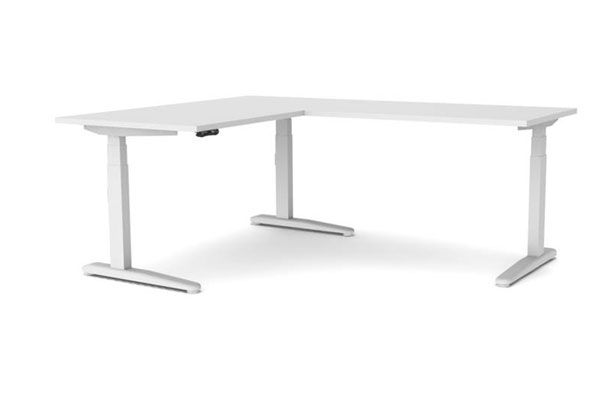
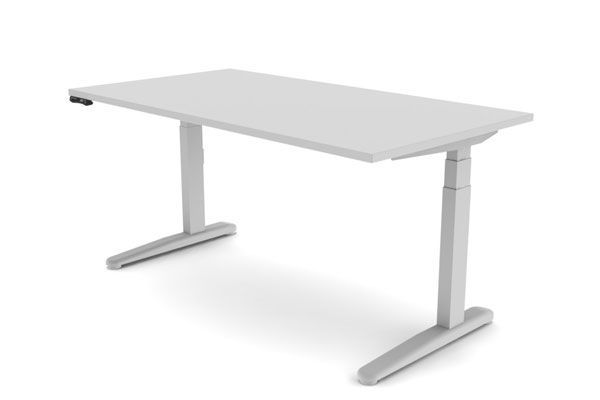
These are all the findings ThinkingWorks have used in their product development. Continuously researching, the latest to the market is their Sit ‘n’ Stand 2. The totally flexible height adjustable desk frame developed by ThinkingWorks has a new height Range of 575mm to 1230mm. Configurations are rectangle and right angle, adjustment is electric and has 4 programmable height settings with electronic display. Yes, Sit ‘n’ Stand 2 is leading the way, when it comes to height adjustable desks.
Namely, the improvements are a right-angle table design, as well as creating a range of suitable accessories including a cable basket and privacy screens for workstation fit outs. Of course, they don’t stop there. The newest accessory will be the addition of an acoustical screen system which aesthetically and functionally suits the varying heights, the users will adjust their desks to. ThinkingWorks are currently developing a H-Frame version of the product.
More info:
Travel Speed: 30mm per second
Weight capacity: 80.0kg evenly distributed load (including worktop)
Suits worktop lengths: 1200mm to 2000mm
Suits worktop depths: 700mm to 900mm
Finishes:
Standard colours: Leg: White or silver steel
Feet: White or silver steel
Rail: White or silver steel
ThinkingWorks
thinking.info
sales@thinking.info
INDESIGN is on instagram
Follow @indesignlive
A searchable and comprehensive guide for specifying leading products and their suppliers
Keep up to date with the latest and greatest from our industry BFF's!
The internet never sleeps! Here's the stuff you might have missed