The home of architecture and design in the Asia-Pacific
Get the latest design news direct to your inbox!

Get the latest design news direct to your inbox!
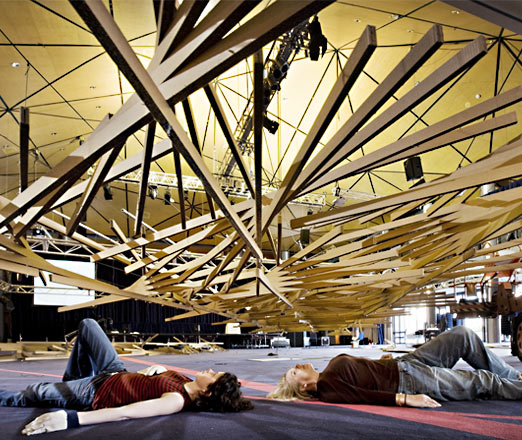
Christina Waterson’s sculptural cardboard installation was an instant hit at 2007’s RAIA dinner. Read the extract article by Stephen Crafti for Indesign Magazine #32 here.
February 19th, 2008
Christina Waterson wears several hats: an architecture graduate, a designer and an artist.
“I’ve always thought of myself as an artist first,” says Waterson, who has been making things for as long as she can remember.
“I feel most content when I’m working with my hands.”
Waterson has been oscillating between art and architecture since graduating in architecture from the University of Queensland in 2005, where she received the top graduate award in Architecture, a prize that included placement with Cox Rayner Architects.
Her decision to focus on her art practice was initiated by a design conference, held at the Bay of Fires in Tasmania (May 2007).
“That week away gave me a chance to reflect on where I was headed. I’ve always had an art practice, but now the focus has changed,” says Waterson
However, even before graduating in architecture, Waterson worked in public art management, securing a position with the Queensland Art Gallery.
Working as an exhibition designer with the gallery for four years gave Waterson the opportunity to look at design in a broader context.
“My work has always been materials based. I’ve always seen architecture as a form of art,” she says.
Waterson’s designs involve complex structural weaving in a variety of scales. Recycled materials, cardboard, stainless steel, plywood and polypropylene are all fashioned into sculptural forms.
Some of these forms end up as lighting, both floor and ceiling, while others may appear as a brooch. And often, the one design can be both.
For last year’s Royal Australian Institute of Architects (Queensland Chapter) dinner, Waterson worked with Cox Rayner Architects in creating a large installation that would provide an architectural canopy over guests.
Measuring 20x30m Waterson’s sculptural forms covered the dining area in the grand ballroom at the Brisbane Convention and Exhibition Centre.
Made of cardboard, each form took the shape of a Komodo dragon….
Read the whole article in Indesign Magazine #33, in newsagents 28th February.
INDESIGN is on instagram
Follow @indesignlive
A searchable and comprehensive guide for specifying leading products and their suppliers
Keep up to date with the latest and greatest from our industry BFF's!
The internet never sleeps! Here's the stuff you might have missed