The home of architecture and design in the Asia-Pacific
Get the latest design news direct to your inbox!

Get the latest design news direct to your inbox!
Fall into conversation with Ed Linacre, industrial designer and winner of the global James Dyson Award, and you’ll find yourself discussing a whole range of stimulating topics. Alice Blackwood reports.

February 20th, 2012
Melbourne based designer Ed Linacre is riding a pretty serious wave of international acclaim right now, having just last November received the international James Dyson Award (JDA) for his ’Airdrop’ Irrigation system.
Ed’s design was the only Australian project selected from the finalists at last year’s Australian International Design Awards, and from there it progressed to the top 15, top 5, and finally the top.
“It was an enormous privilege to even get through to the top 15 for the award… but to win such a major award outright is almost indescribable,” says Ed.
The ’Airdrop’ system was conceived during Ed’s honours degree at Swinburne University, where the project briefs “required us to investigate social and environmental issues affecting Australia.”

Airdrop
For the environmental brief, Ed looked at the 100-year drought that was at that time gripping Australia – “and the outcome was the ’Airdrop Irrigation.”
Capturing moisture from the air and condensing it into water which is delivered directly to the roots of the plants it services, the irrigation system is biomimicrous in style, emulating the survival techniques of the Namib beetle which “consumes the dew it collects on the hydrophilic skin of its back.”
For the socially orientated brief, which was sponsored by Kids Under Cover, “we dove into the principles of human-centred and inclusive design, which gave me the opportunity to explore emotional reactions to the environments that surround us and the objects within them,” Ed says – “something I’m now very passionate about as a designer.”
Having recently spent 17 months in Germany studying at HAWK Hildesheim and interning with german design consultancy, wiege, he has really honed his design development processes – informed by fundamental German design principles.
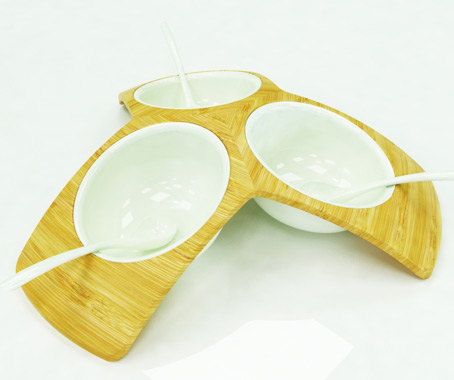
Bolo serving bowls
“In the German industry there was a strong focus on the incorporation of environmental considerations at every stage of development,” says Ed.
“I became aware of the value and environmental benefit of a closed loop system of production, where every part – if not designed for deconstruction and not used again in the next model – [is] recycled and fed back into the system, drastically reducing raw material usage.”
“I also found a love for the tangible qualities of natural materials and how they complement each other.”
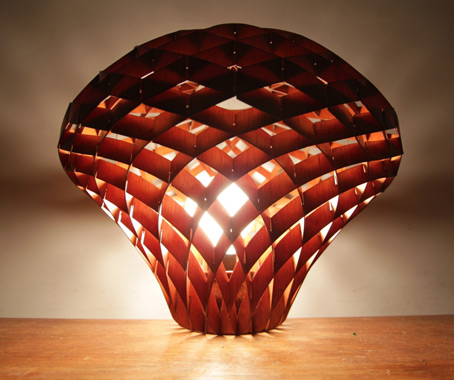
Mushroom weave
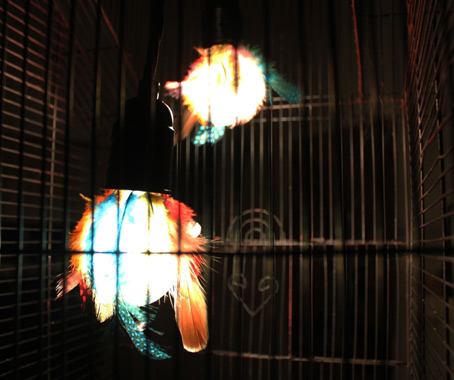
Birds Caged – private lighting commission
Today, Ed is based back in Melbourne, working with CP DESIGN developing medical products, and consulting on-site with a vehicle disability access company.
He also produces his own range of lighting, furniture and jewellery – work which he says is inspired by “nature’s geometry”.
His ’Weave’ lamps, which are inspired by a “sacred geometrical structure”, are already making their way into commercial fit-outs, recently commissioned by JDA Architects for a lobby in the St Vincent’s Hospital.
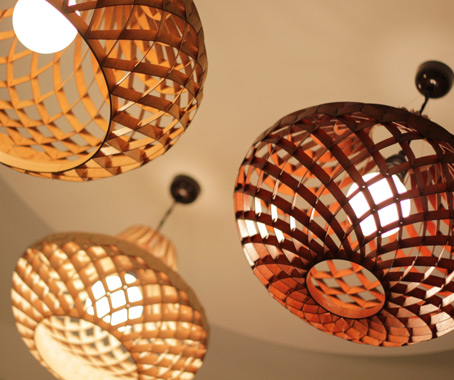
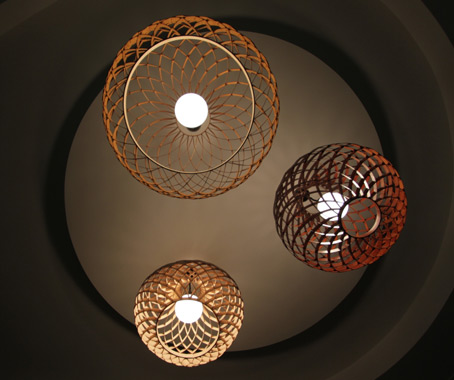
Weave lamps, St Vincents Hospital lobby
And you’ll be pleased to hear, the JDA win is just the beginning for the ’Airdrop’, with the JDA £10,000 prize assisting in developing and testing the system further.
“There has been a lot of interest in the project since I won the award, from Aboriginal communities in Australia to eco-tech companies in China,” says Ed.
“I’d like to keep it in Australia if I can, to support Australian innovation and manufacture.”
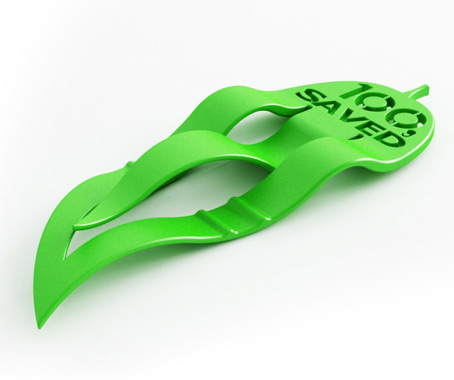
Environmental Awareness peg
Ed Linacre’s Weave lamp is now available in Australia from Workshopped
Ed Linacre
edwardlinacre.com
INDESIGN is on instagram
Follow @indesignlive
A searchable and comprehensive guide for specifying leading products and their suppliers
Keep up to date with the latest and greatest from our industry BFF's!
The internet never sleeps! Here's the stuff you might have missed