The home of architecture and design in the Asia-Pacific
Get the latest design news direct to your inbox!

Get the latest design news direct to your inbox!
Since founding in 1968, Dauphin has stood at the forefront of ergonomics, design, and aesthetics. Founder Friedrich-Wilhelm Dauphin has driven this story and now he looks back on a legacy certified in design gold, but one still growing.

From humble beginnings in Offenhausen, Germany, Dauphin has grown into a multinational group with some 740 employees around the world. The company’s market-defining ergonomic office chairs are well known, yet the company also offers cutting-edge room-in-room-solutions, tubular steel furniture and office desks under its Bosse brand, along with Züco’s luxury seating and lounge collections, and its co-working and young business specialist brand Trendoffice. Dauphin is more than meets the eye, and so is its founder Friedrich-Wilhelm Dauphin.
Now 81 years old and still active within the company, Dauphin’s interest in design did not initially stem from furniture; it came from cars.
“I restored my first car when I was 18. My father helped me get the old model, which was the only one I could afford, into working order. Since then, I like working with the mechanics and I am a fan of their beautiful designs,” says Dauphin

A selection of the classic car collection of Friedrich-Wilhelm Dauphin
“When we started the collection, my wife Elke and I had the vision of creating an exhibition that shows the evolution of some famous designs and brands, and I am proud to say that we managed to do that. I think the connection to our products is exactly that: the combination of technology and design is essential when you want to create a great chair. Just look at our X-code range: It does not only look great, it is also highly ergonomic and can be adapted to its user’s individual needs.”
A pioneer in the world of ergonomic seating from day one, the Dauphin brand has helped change and shape the way we see ergonomics in the workplace. Today, no office chair is designed without ergonomic benefits in mind, yet this was not the case 50 years ago.
“When my wife and I first started our business, ergonomics was not even thought of. We were quite the trailblazers in the development of chairs that help maintain the health of users. By now, this idea is firmly established in any business and even at home. But evolution never stops and by now we have acquired a more holistic idea of ergonomics. We know that people who feel at home in their office are happier, healthier, more loyal to their employer, and perform better. Businesses are keen to provide such an environment in order to improve their overall performance,” Friedrich-Wilhelm Dauphin remarks.
“Plus, digitalisation and globalisation change the way we work in a quite dramatic manner. Teamwork, creativity, flexibility, agility – offices have to enable all the new ways of working, which is why we combine the solutions of our individual brands to form “officescapes” that are tailored to the individual need of the business.”

Dauphin has been an advocate for the importance of ergonomics for human and office health since founding the company, and this philosophy of a healthy workplace separates his namesake brand from the pack.
“I believe that the strong focus on ergonomics, which we set early on, is still at the core of our business. It means that we always put the user of our solutions front and centre. This is of course key to the excellent mechanics we use but also influences our designs and product development. For us, it is about the continuous improvement of work environments and we believe that we can help businesses perform better through this.”

With ergonomics though there is no ‘one size fits all’ approach for design. Every human body is different, and proper design needs to reflect this. The Dauphin philosophy reflects this, and their interdisciplinary research and development teams draw inspiration wide and far to create highly individually tailored solutions for the modern office.
“There are of course the industry norms and standards of several countries that cover a broad spectrum of body types,” says Friedrich-Wilhelm “The Netherlands, for example, developed a set of guidelines that accommodate very tall as well as quite petite people, as their population is extremely diverse. We use these guidelines for nearly all our development projects to ensure that as many people as possible can use our standard sizes. In addition to that, we test every new development with real people, to make sure that they work in real life. In over five decades of experience, we have built quite an impressive collection of patterns in our upholstery workshops that we use for special cases.”
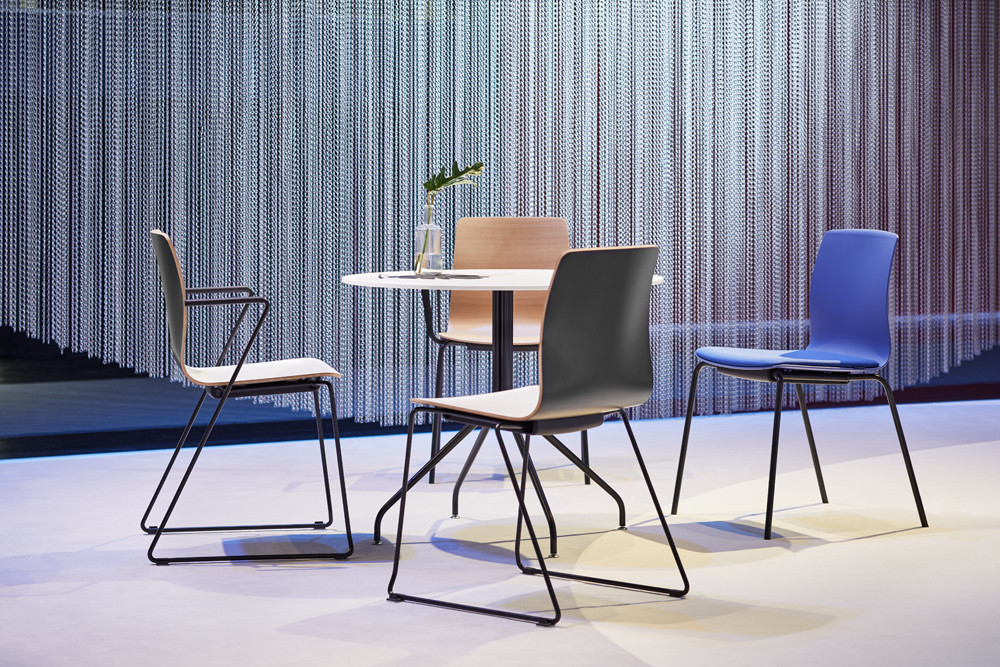
Dauphin developed the first synchronised mechanism for office chairs, an innovation that changed chair design and the workplace forever. Innovation has always been a central tenant of the brand, and this is driven by a keen consideration for what people actually need in the office, as Friedrich-Wilhelm Dauphin himself says,
“The basis of innovation is always to listen to our customers. We aim to understand their particular needs and how the changing work culture impacts their work environments. Then we develop solutions that either solve a certain issue, like the synchronised mechanism did, or we support customers in getting creative themselves. Take our new “Bosse Human Space Cube” range. They are extremely flexible: Customers use them as meeting rooms, creative rooms, for breaks, as a quiet office, a telephone booth, or all of those. We developed the technology and design options that support all those uses – and many more.”

Bosse Human Space Cube
The design process for the Dauphin team also begins with looking to what customers actually need from their ergonomic furniture – how it will be used, what kind of office it could be used in, and who will be using it.
“We always look at what our customers require,” says Friedrich-Wilhelm Dauphin “For the new Dauphin Reefs, Designer Jessica Engelhardt’s goal was to make workers comfortable in open spaces. That is how she got the idea of creating islands of cosiness. From there, it was not a huge leap to imagining islands with different functions. The final lounge range is modular, has power connections, and acoustic walls that also help create visual protection.


Dauphin’s range of ergonomic office products is available Australia-wide thanks to Business Interiors, and Friedrich-Wilhelm Dauphin is well aware of the need for such products in the Australian officescape.
“The Australian market has a strong focus on design and innovation and its work culture is driven by collaborative approaches. There is a very progressive attitude and businesses want to try new things. Most offices in Australia are open-plan and support this communicative, collaborative culture. Flat hierarchies, mobile work, and the importance of creativity are also reasons for an increased interest in products with a softer, more residential flair that encourages exchange.”
For the full range of Dauphin office products and solutions available in Australia visit Business Interiors.
INDESIGN is on instagram
Follow @indesignlive
A searchable and comprehensive guide for specifying leading products and their suppliers
Keep up to date with the latest and greatest from our industry BFF's!
The internet never sleeps! Here's the stuff you might have missed