The home of architecture and design in the Asia-Pacific
Get the latest design news direct to your inbox!

Get the latest design news direct to your inbox!
INDE.Awards 2019 Jury member Chui Lai Judy Cheung, co-founder of Cheungvogl (with Christoph Hoelscher Vogl), tells us about poetic pragmatism, progressive clients and what she’ll be looking for in this year’s entries.

Christoph Hoelsche Vogl (left) and Chui Lai Judy Cheung (right), co-founders of Cheungvogl.

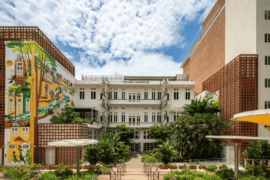
Au Pont Rouge, Saint Petersburg

Au Pont Rouge, Saint Petersburg

Au Pont Rouge, Saint Petersburg

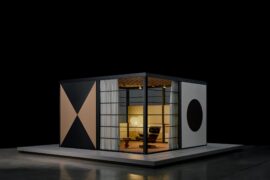
Shinseoul (“New Seoul”)

Shinseoul (“New Seoul”), pavilion entrance

Shinseoul (“New Seoul”), pavilion interior


Yeoui-Naru Ferry Terminal, Yeoui-Naru, Seoul
Cheungvogl is an architecture practice based in Hong Kong with site offices in China and Germany. In our work, we aim to create architecture, which on the one hand is extremely rational and pragmatic and at the same time sensitive and poetic – aspects that are seemingly antithetic to each other. To achieve this, we explore connections between architecture, art, science and philosophies, freeing architectural thinking from pre-definitions and discovering new potentials within our own thinking and the architectural design process. We like to describe our way of working and our architecture as ‘Poetic Pragmatism’.

Yeoui-Naru Ferry Terminal, Yeoui-Naru, Seoul. The slender terminal building follows the river’s flow and is sheltered by a continuous undulating roof.
We are currently realising the Yeoui-Naru Ferry Terminal on the Han River in Seoul after winning the largest completion in South Korea held to date, with Ryue Nishizawa and Alejandro Zaera-Polo on the jury. Alongside other projects in South Korea, we are currently also working in China, Hong Kong, Japan and Germany.
Cheungvogl has always worked internationally, also because of our personal and professional backgrounds. Our international experiences and exposure enable us to enrich the view on local projects with a much wider perspective. To really understand and love a place, you have to see it from a distance and in comparison with alternative ways of thinking, doing and making in other places.
We see the potentials of new construction technologies and materials in combination with new infrastructure and mobility concepts as a promising way forward to develop the ongoing worldwide urbanisation in a more sustainable and holistically responsible direction. Architecture and urban planning, as well as the construction industry, will be key sectors to achieve energy and emission reduction in accordance with climate goals.
Intellectually, we are mostly driven by questions deriving from the philosophical and artistic realms, from the definition of ‘being’ and the meaning of ‘time’ to the definition of ‘human’ and ‘life’. These questions stand before any aesthetical thinking.
In this sense, the Teshima Art Museum by Ryue Nishizawa in collaboration with the artist Rei Naito is certainly the most remarkable space as it conjures up such intellectual complexity in its reduced simplicity on an emotional level.

Shinseoul (“New Seoul”), a concept for the reactivation and expansion of Hoehyeon underground system adjacent to Shinsegae Department Store
The main factor in a successful project is progressive and forward-thinking clients. All other parameters, like location, typology, brief and budget are surely important but secondary to having successful like-minded collaboration in the client-architect team.
We challenge ourselves to overcome our own pre-conceptions in the process of our work to inform the design by rational, abstract and philosophical thinking. We are free in our thinking, freeing our minds and the resulting architecture from pre-definitions.
Besides the general tools and devices involved in the process of architecture, it would be ‘curiosity’, rather than a physical item.

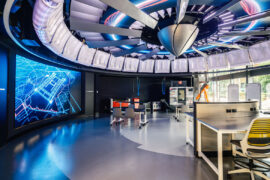
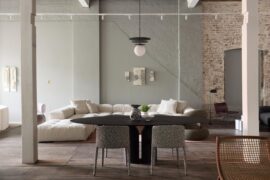
Au Pont Rouge, Saint Petersburg – an open exhibition retail space and a robotic system within a 110-year-old iconic department store.
We hope not to look towards the horizon too much, but to focus on every step on our creative process as a journey. We do see architecture as an intellectual process, with singular projects and events being part of ongoing development and discourse.
In recent years, Asian architecture and design, especially from Japan and China, has gained global significance and we do hope to see projects reflecting the continuation of this creative process.
INDESIGN is on instagram
Follow @indesignlive
A searchable and comprehensive guide for specifying leading products and their suppliers
Keep up to date with the latest and greatest from our industry BFF's!
The internet never sleeps! Here's the stuff you might have missed