The home of architecture and design in the Asia-Pacific
Get the latest design news direct to your inbox!

Get the latest design news direct to your inbox!
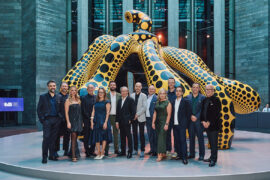
A new analytics lab led by UNSW researchers will draw on generative AI in an attempt to tackle Australia’s housing crisis, and has opened with an event attended by the NSW Premier in Eveleigh.

Prof. Chris Pettit speaks at the launch, photography by UNSW Media.

May 19th, 2025
Launched today at Sydney’s Tech Central in Eveleigh, the new Housing Analytics Lab is based within Commonwealth Bank and boasts a wide range of collaborating partners across various sectors. The initiative is led by UNSW Sydney researchers and brings together academics, industry, government and not-for-profit organisations such as the NSW Tenants’ Union to focus specifically on Australia’s critical housing affordability and supply crisis.
“At the moment, the partnership spans 15 organisations, including financial organisations like Commonwealth Bank, housing developers like Mirvac, the community housing industry sector, research organisations… it’s a multidisciplinary approach,” says Professor Chris Pettit, project lead and director of the City Futures Research Centre.
“If we look at the challenges of housing, we need a cross-disciplinary approach, bringing in architects, designers, planners, data scientists, economists and so on. With the physical space that we have in the Lab, we hope we’ll be activating that with co-design workshops – we hope to bring these different skill sets together to really look at holistic solutions to housing problems.”

The Lab is analytically focused, using cutting-edge technology – including live dashboards of real-time planning approval data and a generative AI Assistant – in an attempt to create reliable data. Rather than any kind of silver bullet, it’s a wide-ranging project that aims, in part, to provide appropriate and accurate data and information for others to make decisions in relation to housing. Relevant parties here are likely to include policy-makers in government as well as architects, planners and developers.
“The Housing Analytics Lab involves UNSW researchers from within the City Futures Research Centre, so work closely with built environment professionals within the school, which includes our colleagues in architecture and design. I guess it’s that interface between that granularity of planning and getting to the building level. We’re looking at running AI to get new insights and learnings, [such as] economic feasibility, and providing that to designers and architects when they’re looking at what sort of buildings might be feasible,” says Pettit.
Related: Eight thought-provoking stories on housing

Some of the kinds of insights which the Lab will aim to provide include housing capacity around train stations, local government social housing requirements, distribution and turnover of short- and long-term rentals, and data on housing and apartment development.
“We can use real-time housing datasets and the power of machine learning to explore multiple planning scenarios with live feedback,” adds Pettit. “This will help provide decision-makers with the ability to assess the impacts of different policy options before implementation.”
Alongside the technology, the project is defined by its wide scope of collaboration. Pettit says that “there’s a myriad of challenges around housing, and one of the foremost is around the housing development pipeline – from development application through to occupancy. One of the challenges that we’re looking at is understanding where we can sensibly use data – ethical, trustworthy AI – to help deal with some of those bottlenecks so we can try to help the Federal Government with the Prime Minister’s target of 1.2 million houses by 2029. But also making sure it’s not just about efficiency; it’s about good quality planning and design, so when we activate those developments, they’re precincts that people will want to live in, that we’re making sure community fabric is maintained and enhanced.”
UNSW City Futures Research Lab
cityfutures.unsw
Photography
UNSW Media

This podcast episode features a former MP and Housing spokesperson
INDESIGN is on instagram
Follow @indesignlive
A searchable and comprehensive guide for specifying leading products and their suppliers
Keep up to date with the latest and greatest from our industry BFF's!
The internet never sleeps! Here's the stuff you might have missed