The home of architecture and design in the Asia-Pacific
Get the latest design news direct to your inbox!

Get the latest design news direct to your inbox!
Haworth’s Shanghai showroom and office has become the first commercial project in Asia to achieve WELL certification through the WELL Building Standard.


December 19th, 2016
While green building standards have successfully increased the awareness and adoption of sustainable building practices over recent decades, measuring the health and wellbeing of building occupants has been paid less attention – even though some strong links can be drawn between the two fields. That is changing, thanks to the recent introduction of the WELL Building Standard (WELL) by American ‘wellness real estate’ and technology company Delos Living.
The standard is the first of its kind to focus on the people within the building by measuring, certifying and monitoring a built environment in terms of how successfully it promotes health and wellness. It identifies 100 performance metrics, design strategies and policies that can be implemented by a building’s owners, designers, engineers, contractors, users and operators.
Via on-site assessment and performance testing, WELL reviews air, water, nourishment, light, fitness, comfort and ‘mind’ (or mental health). Interestingly, some features encourage behavioural change and personal empowerment – by providing information and support for making positive lifestyle choices, for example.
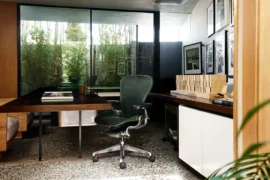
Haworth’s Shanghai showroom and office served as a pilot project for WELL. The space is one of just nine WELL-certified projects in the world to date. Aside from enjoying the honour of being the first commercial project in Asia to be WELL certified, it has also achieved LEED v4 Gold certification from the United States Green Building Council (USGBC).
Says Frank Rexach, Vice President and General Manager for Haworth Asia Pacific, the Middle East and Africa, “While LEED v4 raises the bar on green building leadership and requires a new level of commitment to building sustainability, it was important for us to go beyond [that].” The space incorporates increased levels of fresh-air exchange, non-toxic and non-off-gassing materials, air and water quality filtering and testing, as well as ergonomic furniture and sit-stand desk options.
He explains, “We embedded elements covering everything from securing a high quality of air and water, to providing ideal environmental comfort, places to rest and recover, places to collaborate and be energised, policies for healthy nutrition, settings to stimulate movement around the office, and work settings promoting a variety of work postures – from sitting to standing, lounging, leaning, stretching and resting.”
Haworth’s Wellness and Sustainability Manager Faye Hugo adds, “For us it was also important to bring biophilia elements into the entire environment. We have used indoor plants as aesthetic and psychological enhancers. Our work environment is a major influencer of human behaviour. So when we design Haworth offices, we consider designing for wellness in a holistic way.” The space exceeds the required ‘Indoor Environment Quality’ by 30 per cent.
To complete the project, Haworth partnered with BEE Inc. – a specialist in China for the trading of green materials as well as LEED consulting. “Throughout the construction process, we reused 40 per cent of non-structural interior elements and achieved 60 per cent lighting-power reduction. The percentage of regularly occupied work area with access to views is 85 per cent of the whole floor plate,” says Rexach.
“We wanted to engage with business leaders and the community to let them experience, first hand, what was possible in wellness design,” he further explains.
Haworth has extended an open invitation for its customers and partners to visit the showroom, explore the various areas, find out more about the WELL journey and exchange ideas on improving the wellness attributes even further.
INDESIGN is on instagram
Follow @indesignlive
A searchable and comprehensive guide for specifying leading products and their suppliers
Keep up to date with the latest and greatest from our industry BFF's!
The internet never sleeps! Here's the stuff you might have missed