The home of architecture and design in the Asia-Pacific
Get the latest design news direct to your inbox!

Get the latest design news direct to your inbox!
Stephen Crafti reports on a special fashion exhibition at the National Gallery Victoria, exploring the colour black in fashion – a perennial favourite. Showing until August.
June 27th, 2008
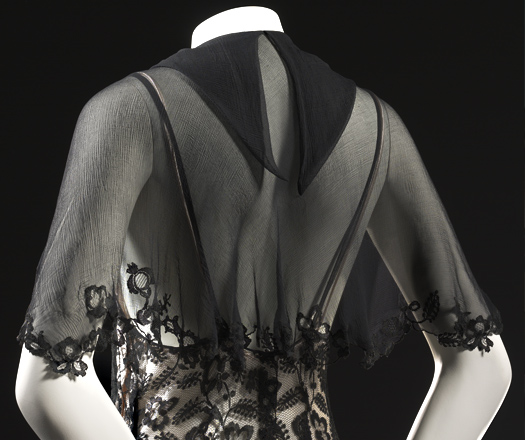
Black is one of the most popular non-colours in fashion. Once signaling a time of mourning, black has also been used to excite teenagers, from punks to goths to rockers. The exhibition at the National Gallery of Victoria ‘Black in Fashion’, shows why black is still a perennial favourite. Stephen Crafti went Black in Fashion, not that he ever steers too far from it.
One of Christian Dior’s boasts was that he could write an entire book on fashion dedicated to black clothing. But Dior wouldn’t be the only designer who could fill a book on the subject. The exhibition ‘Black in Fashion’ at the National Gallery of Victoria (NGV), could easily fill several volumes. “Black is really never out of mainstream fashion. It always hits a nerve,” says Roger Leong, Curator of International Fashion and Textiles at the NGV.
Leong collaborated with Danielle Whitfield as well as Paola Di Trocchio and Laura Jocic for Black in Fashion. Displayed at the Ian Potter Centre, Federation Square, as well as the National Gallery in St.Kilda Road, Black in Fashion is overseen by a large portrait of Queen Victoria (Hubert von Herkorner painted in 1891). To add to the richness of the exhibition, there are also elaborate mourning cards.
“The 19th Century was a significant moment in black fashion. And it continued through to Chanel,” says Whitfield, who was keen to reflect on the social norms of each period. “The black dress came to express modernity. A woman could wear the one simple black dress from morning to night,” she adds.
While the exhibitions display a ‘whose who’ of fashion’s elite: Yves Saint Laurent, Christian Dior, Balenciaga, Yamamoto, Rei Kawakubo for Comme des Garcons and Jean Paul Gaultier, they also showcase the work of Australian designers: Linda Jackson, Jenny Bannister, Mad Cortes and Stephen Bruton.
Pat Rogers, who designed for La Petite Melbourne, used black as a backdrop for her highly decorated cocktail dress (1958). Jenny Bannister showed a riskier side to black, with her ‘Window Dress’, featuring clear plastic panels both back and front. Bannister’s leather dress, made of uncut pelts and fixed with studs, also captures the music scene of the early 80s.
Nick Cave, along with other musicians who recorded songs dedicated to black can be heard in a soundtrack that reverberates through the exhibition. “Black has so many different interpretations. It’s strongly urbane. It’s also glamour or ‘black magic’,” says Paola Di Trocchio, pointing out Versace’s ‘Exit Dress’, designed in 1990. Appearing relatively modest from the front, the Versace gown is stripped away at the back, with a plunging back and revealing almost one entire leg. “It has that va va voom factor. But it also shows how black frames the body and exaggerates the exotic zones,” adds Di Trocchio.
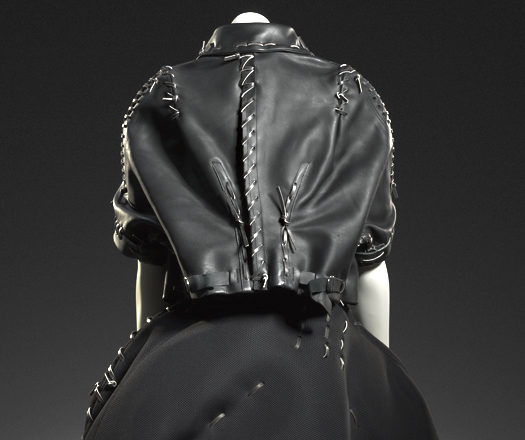
One of fashion’s leaders in black, Rei Kawakubo, is well represented in the exhibition. “In the early 80s, Rei stated that she worked with three shades of black. Her designs have always been highly textured,” says Leong pointing out the designer’s ripped and distressed black fabrics. Kawakubo’s use of stiff black cowhide and upholstering fabric is also on display, with a jacket and skirt designed in 2005. “Australian designers aren’t always able to access these types of fabrics. Their strength often comes from their silhouettes and cut,” he adds.
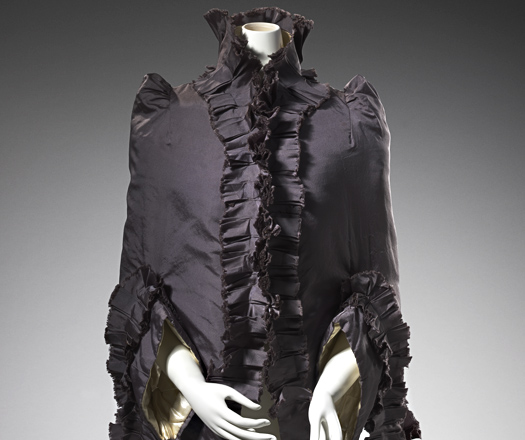
The work of Architect Roy Grounds’ (designer of the NGV) wife, Betty Grounds is also included in the exhibition. Working with Zara Holt for Magg, Melbourne, Betty’s silk taffeta ruffled dress, designed in 1967, is refined and elegant. “There’s a sexual quality to wearing black. But the garment doesn’t have to be revealing,” says Leong, referring to Audrey Hepburn’s famous black dress, worn in the 1961 film Breakfast at Tiffany’s and sold at auction for over one million dollars. While Hepburn’s dress isn’t part of the exhibition, it does illustrate the importance of the Little Black Dress.
While there is a sea of black in both NGV exhibitions, there is one mauve garment. Designed by an unknown English dressmaker in 1878, the mauve dress represents the latter period of mourning. Black, often made of crepe, was worn by Victorian women in the first year of mourning. A white lace collar and cuffs were added a year later.
And by the third year, creams whites, greys and mauves appeared. “They’re were a number of books on etiquette, on how black should be worn. The crepe was usually burnt at the end of mourning, almost as a sign of release,” says Leong, who was fortunate to acquire a black crepe hat, made in 1889.
Black in Fashion doesn’t just showcase black fashion through the ages, it captures the culture and social milieu from 1862 to the present. A painting of ‘Philip the Good’, the 3rd Duke of Burgundy by Thomas de Keyser in 1636, shows the early import of black. Surrounded by lords and ladies of the court, the Duke stands out for his black attire.
“Black isn’t just a post-punk phenomena. It can be seen as rebellious, but it comes with so many different connotations, enough to fill many books,” says Leong.
Black in Fashion at the National Gallery of Victoria
Ian Potter Centre – Australian designers – 8th February – 24th August
National Gallery of Victoria –St.Kilda Road – 29th February – 31st August


INDESIGN is on instagram
Follow @indesignlive
A searchable and comprehensive guide for specifying leading products and their suppliers
Keep up to date with the latest and greatest from our industry BFF's!
The internet never sleeps! Here's the stuff you might have missed